Catch Per Unit Effort Calculator
Convert trip logs, creel notes, and survey hauls into comparable CPUE, biomass CPUE, effective effort, and confidence bands.
📌Scenario presets
⚙Effort settings
CPUE results
Full breakdown
📋Gear efficiency reference
Single Rod
Bank Rods
Trolling
Fly Reach
Trap Net
Fyke Net
Longline
Electrofish
📊CPUE interpretation tables
| CPUE band | Rod-hour meaning | Net-night meaning | Index note |
|---|---|---|---|
| Under 0.5 | Very slow trip rate | Low encounter count | Check method consistency |
| 0.5 to 2.0 | Low to moderate action | Light catch density | Use longer sampling windows |
| 2.0 to 6.0 | Solid recreational rate | Moderate survey return | Good for trend tracking |
| 6.0 to 12.0 | High catch frequency | Strong local abundance | Compare with size data |
| Over 12.0 | Exceptional action | Dense catch point | Watch for hotspot bias |
| Species group | Useful effort unit | Weight signal | Comparison caution |
|---|---|---|---|
| Bass | fish per rod-hour | lb per rod-hour | Separate casting and trolling |
| Trout | fish per angler-hour | kg per reach-hour | Pool counts can inflate rates |
| Walleye | fish per rod-hour | lb per trolling hour | Night bite can shift catchability |
| Panfish | fish per angler-hour | lb per angler-hour | Schooling creates high variance |
| Catfish | fish per rod-hour | lb per rod-hour | Soak time matters more than casts |
| Pike | fish per net-night | kg per net-night | Temperature changes activity |
| Inshore | fish per drift-hour | kg per drift-hour | Tide stage changes availability |
| Offshore | fish per spread-hour | kg per spread-hour | Transect distance should match |
| Effort adjustment | When to use | Typical range | Calculator field |
|---|---|---|---|
| Active share | Idle time was logged | 60 to 100% | Active effort share |
| Gear factor | Methods are compared | 0.06 to 2.10 | Gear or method |
| Condition factor | Bite windows differ | 0.72 to 1.25 | Catchability condition |
| Distance density | Trolling or shoreline pass | fish per mi/km | Distance covered |
| Area density | Lake or bay sample | fish per acre/ha | Sampled water area |
💡Calculation checks
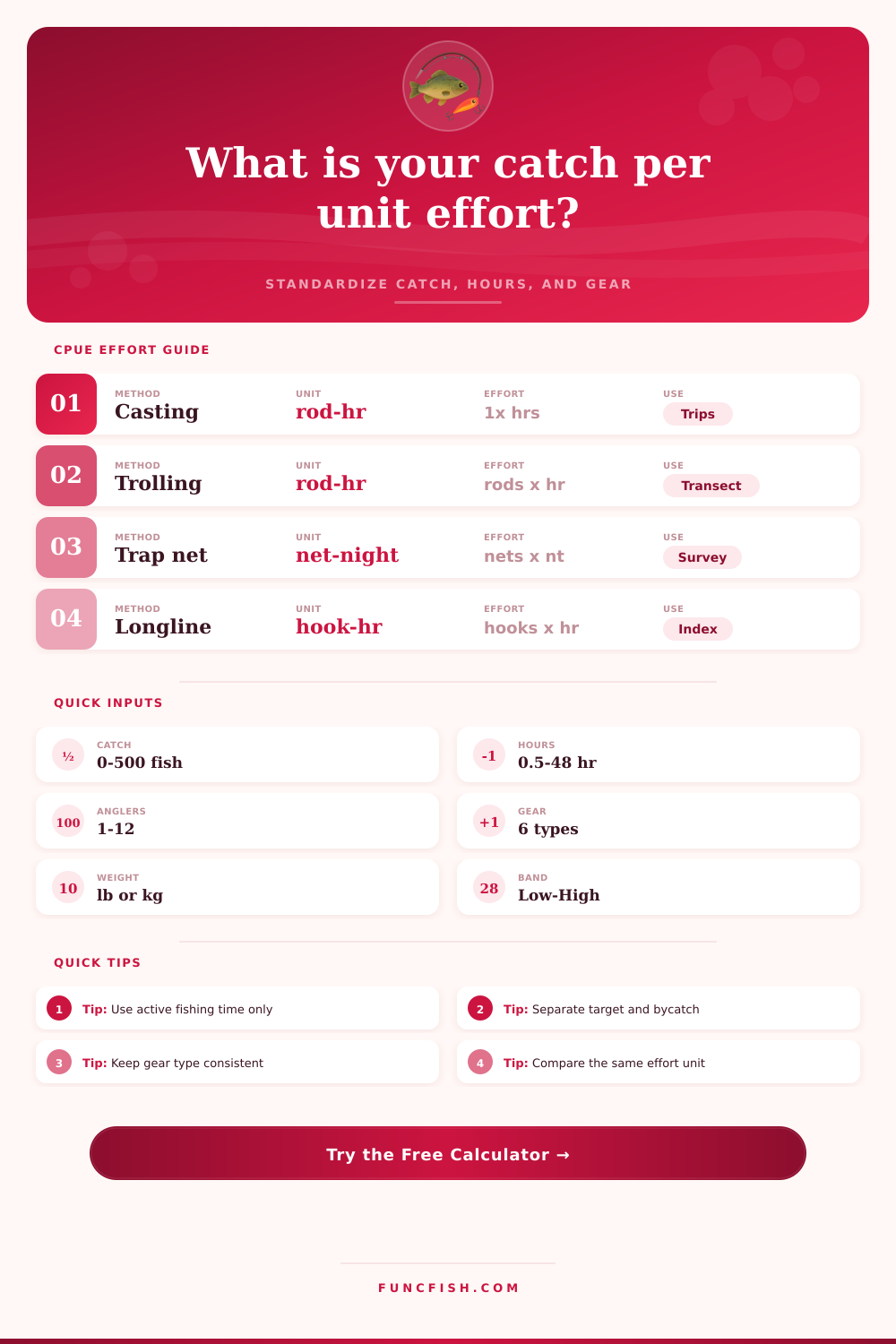
Effort rule: CPUE is only comparable when effort units match. Keep rod-hours separate from net-nights, hook-hours, and boat-hours.
Catch rule: Use target catch for the index and total catch for bycatch share. Mixing both can hide changes in fish availability.
Survey rule: Low catches have wide confidence bands. Treat a one-fish change as noise when effort is short.
Trip rule: Standardized CPUE is a trend tool, not a population estimate. Compare the same place, season, and gear when possible.
Catch per unit effort is a method of measurement that allows a person to compare the success of fishing across a variety of circumstance. The measure is calculated by dividing the number of fish that were caught during a certain period of time by the amount of effort that was expended to catch those fish. Effort can be measured in a variety of different ways, such as in relation to the amount of time spent fishing, or in relation to the amount of gear that was utilize during fishing.
Without a means of measuring fishing effort, it isnt possible to accurately compare the number of fish that is caught in different circumstances. In order to utilize the calculator, a person must decide for themself what type of “effort” is to be utilized in the calculation. For instance, a person who include in the calculation the time that they spent traveling to and from the fishing spot, or the time that they spent rigging their fishing gear, will find that their catch per unit effort calculation is lower then it should of be.
How to Measure Catch Per Unit Effort
Many individual make this mistake in calculating their catch per unit effort. Instead, only the amount of time spent fishing should be included in the calculation. Additionally, if the individual used more than one piece of fishing gear, that effort must also be accounted for in the calculation of the catch per unit effort.
The calculator will only utilize the figure that you provide for each of these variables. The type of gear that is use in fishing can impact the calculation of the catch per unit effort. For instance, if the calculation is based off the use of one casting rod versus a spread of trolling fishing rods, the number of fish that are caught will not necessarily be comparable.
This is due to the fact that each type of fishing gear will cover a different amount of water. Thus, the scientist must make adjustments according to the type of gear that is used, since some fishing gear may be more efficient at catching fish than other fishing gear. Reference table can help the fisheries scientist to make these adjustments.
Many types of fish will change their location within the water based upon the time of day. Thus, the catch per unit effort at different times of the day may not be comparable, even if the number of fish in the water is the same. For instance, fish may move from shallow water to deep waters during the time after the sun sets each day.
Therefore, comparing the catch per unit effort during daylight hour with nighttime hours without making adjustments for the movement of the fish will result in inaccurate data. Because the calculator does not account for the behavior of the fish, it is up to the individual to ensure that the time and location where the fish are caught is note. Instead of measuring the number of fish that are caught, biomass per unit effort can also be calculated.
The biomass per unit effort is a calculation of the weight of the fish that are caught during a certain amount of effort. A person may, for instance, catch ten small fish during a certain amount of effort, or they may catch ten large fish during that same amount of effort. In each case, the catch per unit effort will be the same, but the biomass per unit effort will differ.
Therefore, measuring the weight that is obtained will help to reveal difference in the size of the fish that are caught. The calculation of the change in the index can help to compare the current catch per unit effort with a previous calculation of the catch per unit effort. A person will need to enter the previous catch per unit effort of the same type of water and season into the calculator.
If the current catch per unit effort is similar to the previous calculation, then there has been no significant change in the catch per unit effort. However, if the catch per unit effort is significantly different from the previous entry for that season, it may indicate a change in the fish population, or a change in the method in which the fish are being fished. Finally, it is important to remember that the catch per unit effort is simply a rate.
Thus, catch per unit effort will only be meaningful if the effort is measured in a consistent way, and if any condition of the fishing trip are noted. While the calculator can help to mathematically determine the catch per unit effort for a group of fish, it does not replace the necessity for such measurement. Thus, the individual should focus upon their location fishing, the time at which they fished, and the method by which they measured their effort, all of which will enable them to compare each fishing trip to each other fishing trip.