Fishing Rod Sections Fold Length Calculator
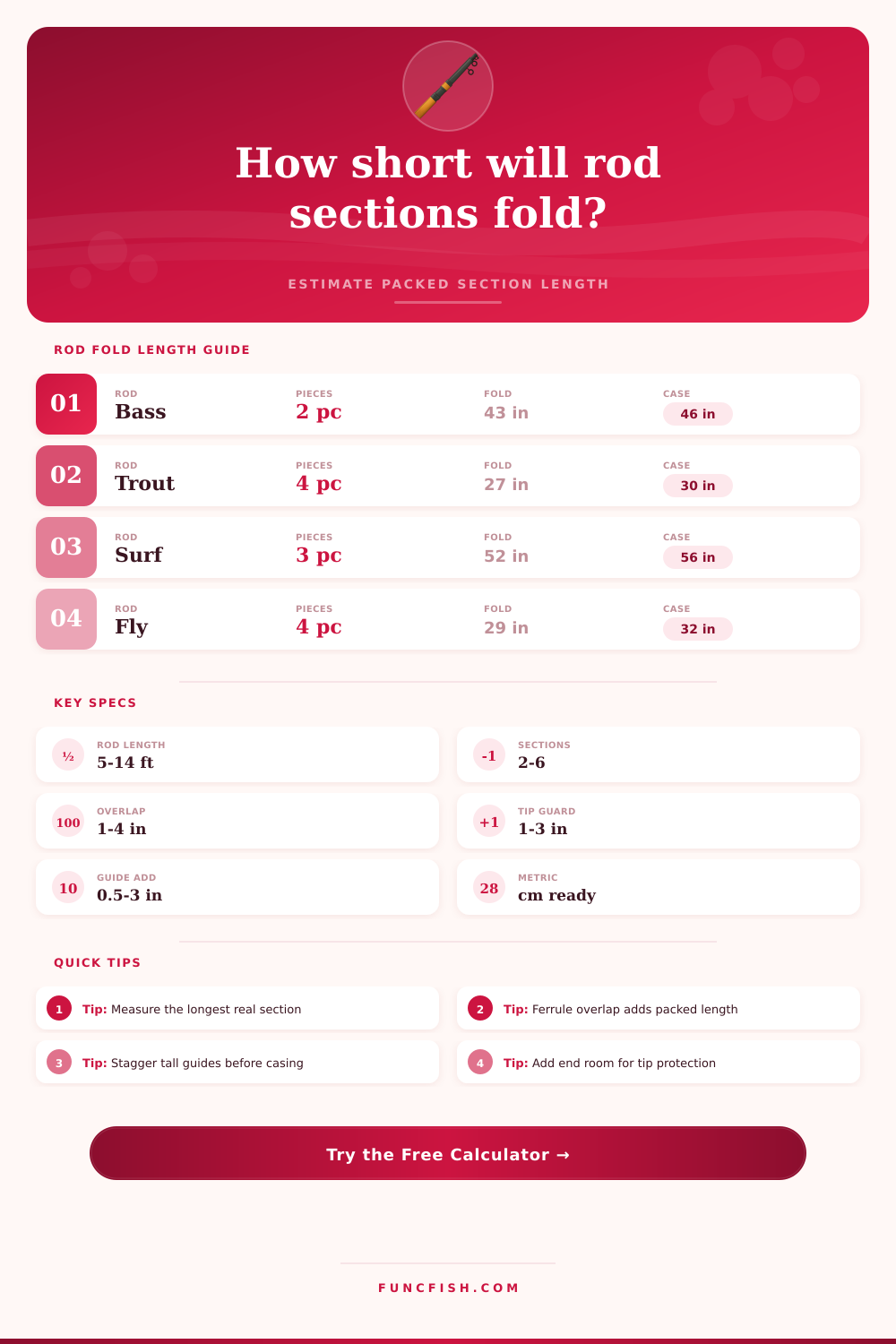
Estimate the folded bundle length of a multi-section fishing rod from assembled length, section count, ferrule overlap, guide stagger, tip protection, and storage clearance.
📌Scenario presets
⚙Rod section inputs
Rod section fold forecast
Calculation breakdown
📊Rod section reference
Two-Piece Bass
Four-Piece Fly
Three-Piece Surf
Telescopic
📐Fold length tables
| Rod setup | Usual sections | Fold length rule | Extra allowance |
|---|---|---|---|
| Bass casting or spinning | 2 | About half length plus ferrule | Tip guard and sleeve end room |
| Trout pack spinning | 4 | One quarter length plus joints | Small guide stagger |
| Surf casting | 3 | One third length plus tall guides | Large ring spacing |
| Fly travel rod | 4 | Nearly equal sections | Tube cap clearance |
| Boat trolling rod | 1-2 | Handle section often longest | Roller or ring height |
| Ferrule style | Overlap range | Packed effect | Fold note |
|---|---|---|---|
| Tip-over-butt | 1.5-3.0 in | Adds hidden physical length | Shoulders can protrude |
| Spigot | 1.2-2.5 in | Balanced section growth | Leave gap visible |
| External sleeve | 2.0-4.0 in | Longest joint allowance | Best with rigid case |
| Metal butt ferrule | 2.5-4.5 in | Butt section dominates | Check cap protrusion |
| Telescopic collar | Nested | Collapsed ratio controls | Guide covers add length |
| Species use | Common rod | Typical fold target | Storage check |
|---|---|---|---|
| Bass | 6.5-7.5 ft, 2 pc | 40-47 in | Car trunk or locker |
| Trout | 5.5-8.5 ft, 3-4 pc | 20-32 in | Pack side pocket |
| Surf | 10-13 ft, 3 pc | 42-58 in | Long hard tube |
| Walleye | 6-7 ft, 2 pc | 36-43 in | Boat locker |
| Fly trout | 8-9.5 ft, 4 pc | 26-31 in | Tube and sock |
💡Practical fold checks
Tip: Fold length is controlled by the longest physical section, not only by assembled rod length divided by section count. Ferrule insertion, handle offset, and tip guards can all add real length.
Tip: If guides stack directly on top of one another, add stagger before choosing a sleeve or tube. Tall surf and spinning guides often need more length and diameter clearance.
Planning a fishing rod travel setup require you to understand how the length of a fishing rod change when the fishing rod is disassembled. The length of each individual piece of the fishing rod dont necessarily have equal lengths. There is several factors that contribute to the total length of each of the disassembled fishing rod pieces, including the length of the ferrules and the size of the guides that is arranged along the fishing rod pieces.
The length of the longest piece of a fishing rod is the most important measurement to make when planning to travel with the fishing rod in disassembled form. The longest piece of the fishing rod will determine the minimum length of the storage container in which the fishing rod pieces will be stored. For example, most two piece bass rods has the handle and other features for gripping the rod (known as the butt section) included in the longest piece of the fishing rod.
Measure Your Fishing Rod Pieces for Travel
The butt section is longer than the tip section of the fishing rod. Additionally, each of the pieces of the fishing rod have ferrules that is added to the length of each individual piece. The spigot ferrule (used on most fishing rods) adds a small amount of length to each piece of the fishing rod when the rod is disassembled.
However, an external sleeve ferrule (often used on rods used for fishing in more challenging environments) add more length to the individual pieces of the fishing rod when the rod is disassembled. If you do not account for the length of the ferrules on each individual piece of the fishing rod in the planning of the storage container for the fishing rod, the length of the longest piece of the fishing rod may be underestimated. As a result, the fishing rod may not be able to fit into the storage container.
Beyond the length of the individual pieces of the fishing rod, another important measurement to make is the width of each individual piece. The width of each piece will determine if the pieces will be able to fit through the opening in which they are to be stored. The guides of the fishing rod add to the width of the fishing rod; the guides is arranged on the sides of the fishing rod pieces.
The taller the guides are, such as those on surf fishing rods, the more greater the width of the fishing rod pieces. If the guides of the fishing rod are stacked upon one another, the diameter of the group of fishing rod pieces will be wider. Thus, the width of the fishing rod pieces will be created by the guides will need to be less than the width of the opening in which the fishing rod pieces are to be stored.
For instance, if the fishing rod is to be stored in a hatch on a kayak, the width of the bundle of fishing rod pieces will need to be less than the opening width of the hatch on the kayak; otherwise, the pieces will not fit into the hatch. Additionally to the length and width of the fishing rod pieces, the thickness of any padding that may surround the fishing rod pieces will need to be accounted for in the calculation of the size of the storage container for the fishing rod. Additionally, the size of the tip protection for the fishing rod will also add to the length of the individual fishing rod pieces.
Each of these small additions to the length and width of the fishing rod pieces may seem small; however, the sum of those small additions will contribute to the total length of the fishing rod. These small additions are significant due to the way in which they compound when the fishing rod is broken into its individual pieces. The calculator provides you with the dimensions of your disassembled fishing rod by entering the length of the fishing rod, the number of pieces into which the fishing rod will be broken, the type of ferrule that will join each individual piece of the fishing rod, and the style of the guides that will surround each piece of the fishing rod.
Based on these entries, the calculator will determine the length of the longest piece of the fishing rod and the width of the guide bundle required to contain the fishing rod pieces. Additionally, the calculator will compare those dimensions to the dimensions of the storage container for the fishing rod and tell the fisher whether or not the fishing rod will fit into the container. If the calculator determines the fishing rod does not fit into the container, the fisher may have to purchase a different container for the fishing rod or he or she may have to break the fishing rod into more pieces.
Breaking the fishing rod into more pieces will allow for each individual piece to be shorter; however, increasing the number of pieces will also increase the number of ferrules and guides for the fishing rod.