Casting Reel Spool Tension Calculator
Estimate a baitcaster spool tension starting point from lure weight, line diameter, filled spool size, brake setting, rod power, wind, and casting skill.
📌Scenario presets
⚙Reel, line, and cast inputs
Spool tension analysis
Calculation breakdown
🎣Spool and line data
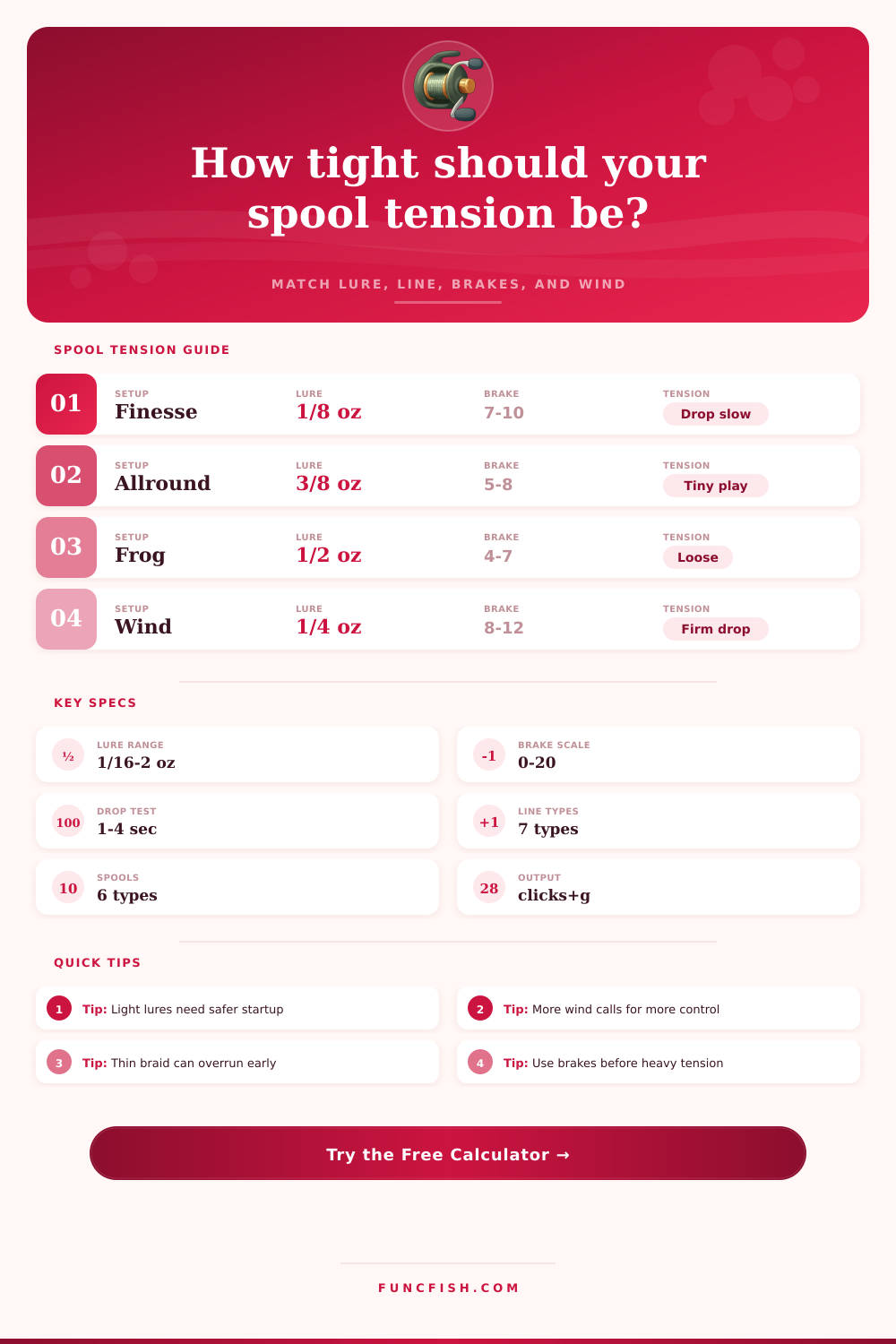
Small lures need low startup inertia, moderate brakes, and a controlled drop instead of a tight cap.
A clean baitcaster often starts near a slow lure drop with only faint side play at the spool.
Very thin braid stores less surface drag, so early cast acceleration can need extra brake help.
The model treats brake setting as mid-cast control and spool tension as startup friction.
📊Reference tables
| Lure and cast | Typical weight | Brake starting range | Spool tension cue |
|---|---|---|---|
| BFS trout plug | 1/16-1/8 oz / 2-4 g | 9-14 on a 0-20 dial | Slow drop, no side knock |
| Finesse jig or Ned rig | 1/8-3/16 oz / 4-5 g | 8-12 on a 0-20 dial | Controlled drop, small margin |
| General bass lure | 1/4-1/2 oz / 7-14 g | 5-9 on a 0-20 dial | Tiny side play, free fall controlled by thumb |
| Frog or pitching jig | 1/2-3/4 oz / 14-21 g | 4-8 on a 0-20 dial | Loose spool, brake and thumb take over |
| Swimbait or surf plug | 1-2 oz / 28-57 g | 3-7 on a 0-20 dial | Side play removed, avoid heavy cap pressure |
| Line type | Startup behavior | Best tension style | Watch point |
|---|---|---|---|
| Monofilament | Forgiving stretch and surface drag | Moderate drop with stable spool | Memory coils can flare on loose reels |
| Fluorocarbon | Dense line with more memory | Slightly firmer startup for light lures | Overfilled spools cast unevenly |
| 4-strand braid | High grip and low stretch | Brake-led control with light tension | Dig-in after hard hooksets |
| 8-strand braid | Slick and fast off the spool | Extra early brake or thumb margin | Can overrun at launch |
| Coated braid | Smoother than rough braid | Balanced brake and low cap pressure | Coating wear changes feel |
| Condition | Adjustment | Reason | Result cue |
|---|---|---|---|
| Headwind | Add brake before cap pressure | Lure slows faster than spool | Cleaner middle of cast |
| Skipping | Add tension and brake | Impact interrupts lure speed | Fewer instant loops |
| Pitching | Lower brakes, light cap | Short cast needs fast pickup | Quiet spool with thumb finish |
| Heavy lure | Do not clamp hard | Cap pressure heats bearings and costs distance | Remove side play only |
| Learning | Use a slower drop | More time to control startup and splashdown | Stable cast first, distance later |
💡Calculation notes
Spool tension controls startup friction. Use it to remove side play and tame the first burst, then lean on brakes and thumb control for the middle and end of the cast.
Heavier is not always safer. Excess cap pressure can shorten casts, mask brake tuning, and load bearings; a smooth lure drop with the right brake setting is usually more repeatable.
Casting a baitcasting reel requires adjustments to the spool tension knob and the brake settings prior to beginning to cast. The spool tension knob provide the initial amount of friction for the spool, as well as prevents the spool from spinning to freely with the falling lure. If the spool tension knob is set too loosely, the spool will spin too fast for the lure, leading to a backlash.
If, however, the spool tension knob is set too tightly, the spool will not spin enough to allow for good casting distances. Therefore, the angler must find a balance with the spool tension knob such that there is enough friction for the spool to prevent a backlash but which does not become so much friction as to prevent long casts with the lure. Spool tension and the brake settings are two separate adjustments for the baitcasting reel that work together to provide control over the spool.
How to Set Your Baitcasting Reel
Spool tension settings add friction to the spool, as well as removes any side play from the spool. The brakes, however, take over for controlling the spool after the spool has started to rotate. An angler may find that they need to use a heavy brake setting to compensate for an incorrect setting of the spool tension knob.
However, this isnt a permanent fix for those adjustment issues, since the brake adjustment does not have control of the spool during the first 0.1 seconds of the cast. Thus, the angler should adjust the spool tension knob for the initial movement of the spool, while the brake settings are adjusted for the movement of the spool after it has begun to rotate. The weight of the lure affects the force that is applied to the spool, as well as the weight that determines the resistance that is placed upon the spool.
More specifically, because heavier lures will place more force upon the spool than lighter lures, it is possible that heavier lures will require more spool tension to overcome the increased force. Additional factors include the diameter of the fishing line, as thinner lines will have less drag upon the spool than lines of varying diameters. Additionally, the amount of line that is placed upon the spool, referred to as the fill of the spool, will also impact the performance of the fishing reel.
More specifically, if the line fill is overfilled upon the spool, it will require more force to spin the spool at the same rate as a spool with less line upon it. Thus, all of these variables will impact the adjustment requirements for one lure as compared to another. Finally, the variable of the wind will impact the interaction between the spool and the lure during the fishing cast.
A headwind will tend to slow the lure down while the spool continues to spin at a high speed; thus, a headwind will create a gap between the speed of the lure and the speed of the spool. Gusty winds will make this even more of a problem since the wind will alter the speed of the lure while it is in the air. In these conditions, you will need to increase the strength of the brake, but you should also make sure that the tension knob on the spool is adjusted to remove any side play from the spool.
The skill of the person who is casting the reel will also alter the way in which the spool should be tuned. For example, a person who has a skilled thumb will be able to better control the spool so that the lure does not slow down too much during the cast; thus, the spool tension knob can be set to a looser setting for these individuals. An individual who is still learning how to use their thumb will likely need the spool tension knob to be set to a tighter setting to avoid any backlash.
Thus, each person can have their spool tuned differently based off their skill level with the casting action. In order to assist with finding the correct setting for your spool, you can use a calculator that takes into account the weight of the lure that you are using, the diameter of the fishing line, the dimensions of the spool, and the conditions of the wind on the day of fishing. The calculator will provide you with a starting point in both clicks and grams for your line tension knob, as well as provide a drop-test window for you to test your settings.
Use this drop test to ensure that your tension knob is correctly set. If the spool immediately begins to stop and the lure does not move much, then the tension knob is too tight. If the line creates loops with the lure before the lure moves a full length of the rod, then the tension knob is too loose.
Small adjustments can be made to the tension knob, but using a drop test will allow you to properly set your tension knob without having to rely upon your memory of where it should be set. Many anglers will continue to tighten the tension knob on the spool to avoid any backlash, but over-tightening of the tension knob will reduce the distance that the lure will travel, and the bearings on the reel will become hot. Instead, ensuring that the lure can carry the cast and that the brakes and the angler’s thumb are able to manage the middle and end of the cast will result in more successful casts.
Thus, while the calculator will provide you with a good starting point for your settings, the conditions on the water will determine whether or not your settings are the correct settings for those waters.