Streamer Sink Depth Calculator
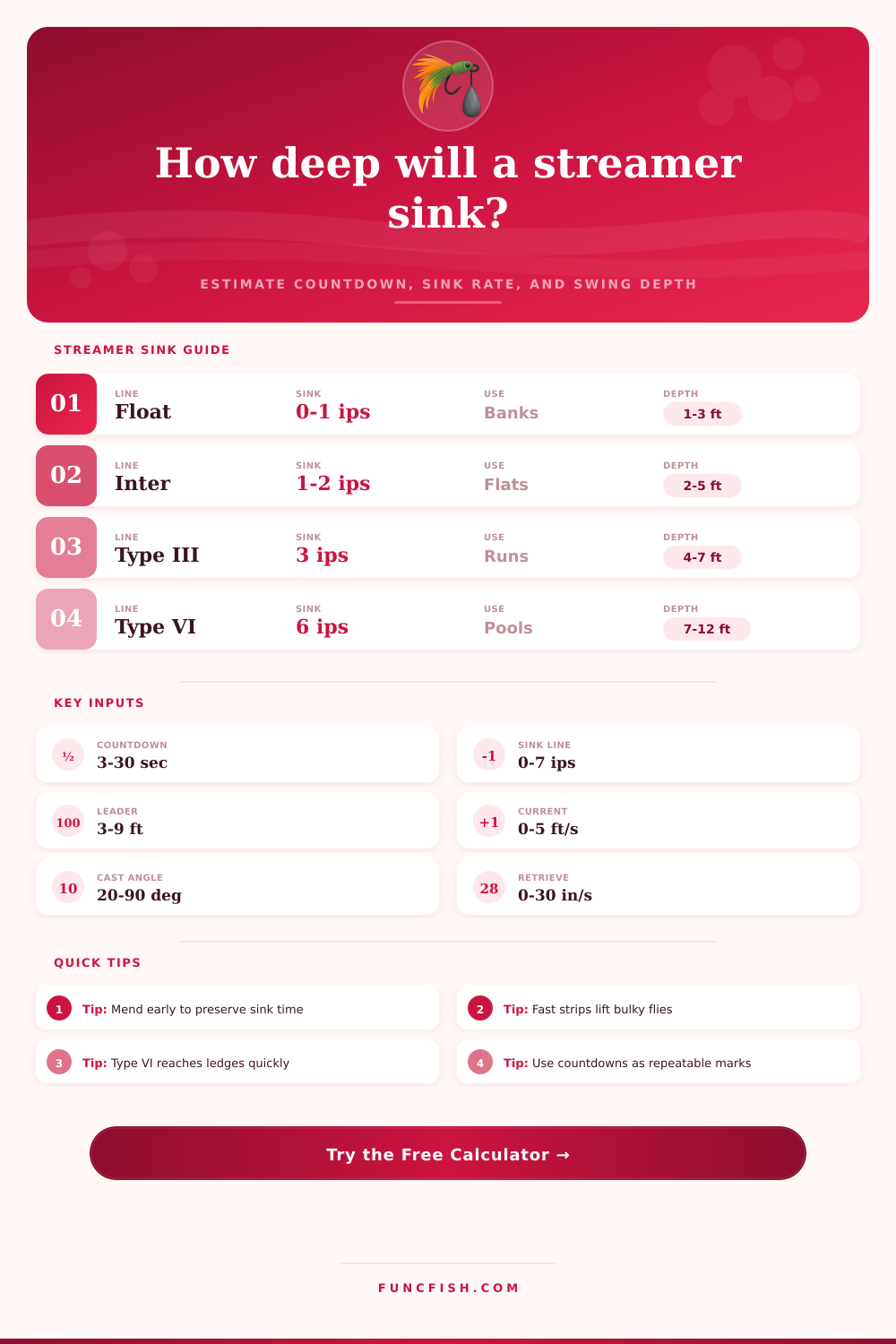
Estimate how deep a fly streamer will fish from sink-tip rate, weighted fly profile, countdown time, current speed, cast angle, and retrieve lift.
📌Scenario presets
⚙Sink-depth settings
Streamer depth estimate
Full breakdown
📋Sink system reference grid
Floating
Intermediate
Type III Tip
Type VI Tip
📐Streamer depth tables
| Sink system | Rated sink | Typical countdown | Useful water |
|---|---|---|---|
| Floating line | 0-1 ips with fly | 0-8 seconds | Banks, logs, skinny edges |
| Hover / slow intermediate | 0.5-1.0 ips | 5-20 seconds | Stillwater and soft seams |
| Intermediate full sink | 1.25-2.0 ips | 8-25 seconds | Flats, ponds, shallow lakes |
| Type III sink-tip | 3 ips | 8-25 seconds | Moderate runs and tailouts |
| Type VI sink-tip | 6 ips | 6-20 seconds | Deep buckets and ledges |
| Type VII full sink | 7 ips | 8-30 seconds | Lake shelves and heavy flow |
| Fly profile | Fly sink bonus | Drag factor | Best match |
|---|---|---|---|
| Unweighted marabou | 0.3 ips | High drag | Floating line banks |
| Beadhead woolly bugger | 0.8 ips | Medium drag | Trout runs and ponds |
| Conehead muddler | 1.1 ips | Medium-high drag | Broken banks and pools |
| Dumbbell Clouser | 1.8 ips | Medium drag | Bass and saltwater lanes |
| Weighted sculpin | 2.2 ips | Low-medium drag | Bottom-hugging trout work |
| Bulky tandem fly | 0.9 ips | Very high drag | Pike and big profile retrieves |
| Target species | Common zone | Line choice | Countdown cue |
|---|---|---|---|
| Brown trout | 2-8 ft | Type III or VI tip | Count to ledge height |
| Smallmouth bass | 3-10 ft | Intermediate to Type V | Touch rock, then strip |
| Largemouth bass | 1-6 ft | Floating or intermediate | Stay above weeds |
| Northern pike | 2-7 ft | Intermediate or Type III | Keep fly visible above grass |
| Striped bass | 3-12 ft | Full sink or Type VI | Follow the sweep depth |
| Lake trout edge | 8-20 ft | Type VI or VII | Long count before retrieve |
| Condition | Depth effect | Calculator setting | Adjustment note |
|---|---|---|---|
| Fast cross-current belly | Shallower | Lower mend efficiency | Use a steeper upstream cast |
| High rod tip | Shallower | Increase tip height | Drop the rod to keep depth |
| Long leader | Slightly shallower | Increase leader length | Shorten on heavy sink tips |
| Fast strip retrieve | Shallower | Increase retrieve speed | Add pauses to recover depth |
| Slack mend after cast | Deeper | Raise efficiency | Protect the first countdown |
| Bulky deer hair head | Shallower | Choose bulky fly | Use more line sink rate |
💡Practical checks
Tip: Treat the result as a repeatable fishing depth, not a lab depth. Current belly, fly drag, and rod-tip height can change the true path quickly.
Tip: When the calculator says you are just above target, use the same countdown for several casts before changing line, fly weight, or retrieve speed.
Drag is what’s important to river. It is not about your rating for sink tips. A sinking line will drop fast on dead water but if you leave any slack and let it float down the river or miss a single mend, the fly won’t continue to sink; it’ll begin to swim back towards you on the surface.
So anglers thinks they’re fishing deeper then they actually are. That means when they find fish they realize it’s close to shore and that the lure was suspended half-way through the water column. This is mistake of many, that there is a difference between how deep the lure should be based off its theoretical sink rate and how deep the lure is fishing.
Why Your Fly Does Not Sink Fast Enough
The reason for this is the listed inch-per-second sink rate: This number comes from a lab bucket with no leader on it and no current present. That’s not real life in any river. Add wind resistance to your retrieve, add a floating leader and/or a buoyant fly body and your actual sink rate are much lower.
Enter your countdown time into the above calculator along with your line type and it will do the math for you. Take the rated speed of your Type III or Type VI tip and subtract the lift from your retrieve speed and the drag from your current. This will give you an estimate of how deep fly will go once it hits the water.
People assume the sink rate of the line times the number of seconds equals depth. That’s not quite true. Angle are more important. When you make casts across current and let your line belly out, the water force push laterally on the line instead of downward, lifting the fly up.
That’s what the mend efficiency setting accounts for. The better the mend (keeping the line vertical and tight), the greater sink rate, as gravity takes over. With a sloppy mend, you get drag, which opposes your sink rate. Even if you count to 15 seconds, a poor mend mean you are likely only fishing at depth of a five second count.
The other factor that weighs heavily is profile of the fly. Bulky tandem flies such as marabou or deer hair has lots of surface area, catching any water resistance much like a parachute would. Even if weighted in the head, they will still sink slower than a sleek, equal-sized fly like a beadhead bugger. This page includes a reference table showing which flies affect your depth.
Often, when you are fishing for trout suspended close to the bottom, trying another fly can work better than going up a size in the sink tip. Swapping to something lighter with less drag lets you go down to a slower sinking line that can be fished easierer in shallow water.
The other thing that gets us is retrieval speed. As you pull the line, you create an upward force on the fly, lifting it with a faster strip. That is why a pause-and-strip retrieve works well for deeper fish. When you pause, the sink rate takes over and doesn’t have the opposing lift from a strip. So if you’re targeting depth in a swift current, slow your retrieve down. When the water is rushing by, it might seem like a bad idea, but letting the fly just sit there while it sinks will often get it into the strike zone faster then any frantic action.
Depth is another variable affected by how high you hold your rod tip. The higher you hold your rod, the more line is pulled down and off the water, creating some lift in the fly. Bringing the rod tip down to near the water surface removes this vertical aspect of the equation and frees up the line to sink easier. It is a little change but it is something to consider if you’re targeting a particular ledge.
All told, sinking streamers is a balancing act between gravity pulling it down, the current blowing it sideways, and your retrieve pulling it up. None of these can be taken away, only balanced. Before taking to the water use the tool’s presets to see how each scenario plays out. If the estimate says you are too deep, lighten your fly or quicken your retrieve. Too shallow? Shorten your leader or slow your strip.
The trick isn’t so much getting it down as fishing it exactly at the depth where fish hold and the current presents food. Get that equation right, and blank casts becomes strikes.