Float Fishing Depth Setting Calculator
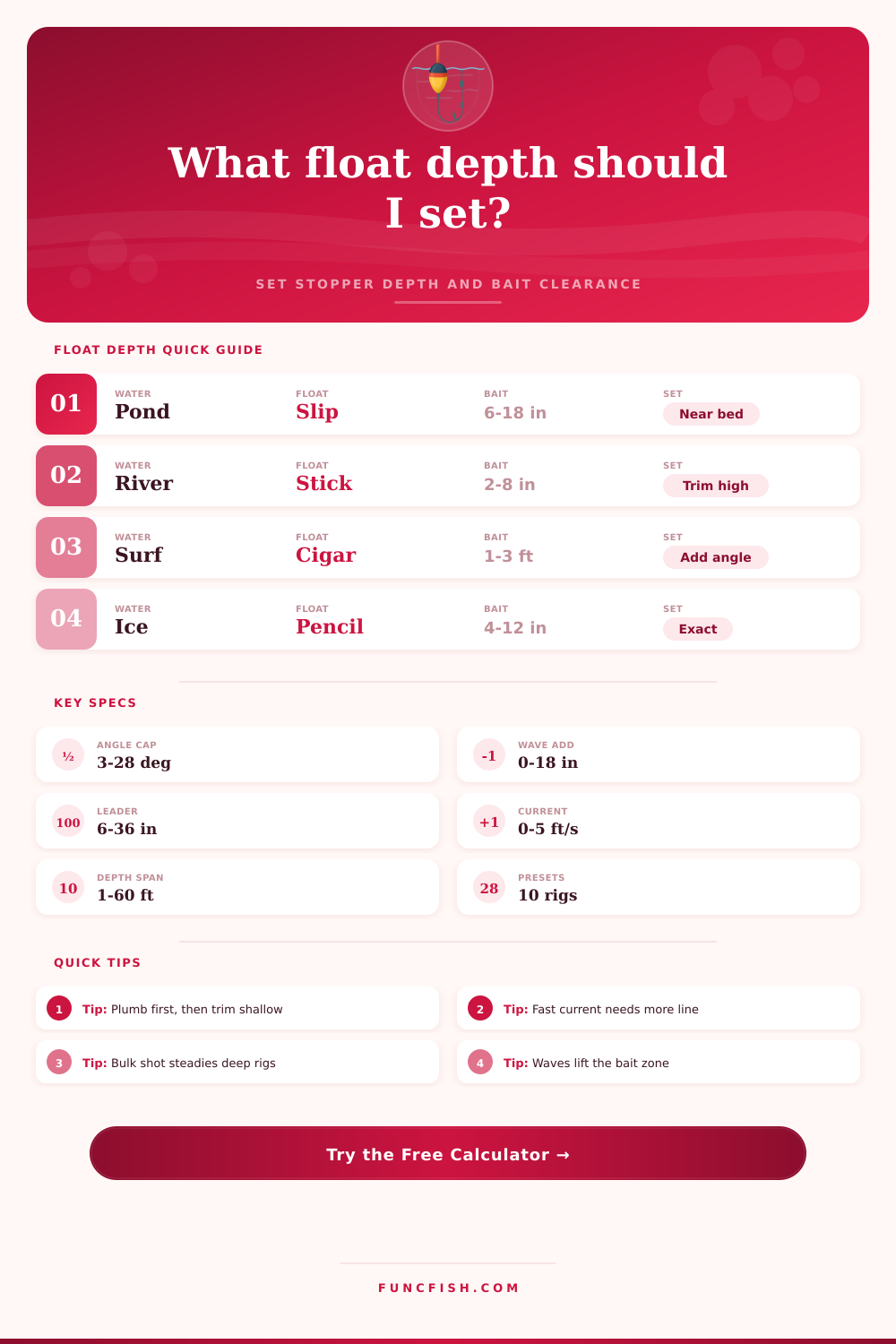
Calculate stopper depth, target bait position, line-angle loss, wave allowance, and shot station for slip floats, wagglers, stick floats, river trotting, ice floats, and surf floats.
📌Depth-setting presets
⚙Rig and water inputs
Bottom-oriented rigs subtract clearance and bottom variation from the plumbed depth, then add line angle and wave lift so the bait rides where intended.
Depth setting results
Calculation breakdown
🎣Float style gear grid
Slip Bobber
Stick Float
Waggler
Surf Cigar
🐟Species depth comparison grid
Trout and Steelhead
2-8 in upTrim shallower in fast runs. Bait should tick near bottom without hanging through every seam.
Crappie and Perch
Mark depthSet the hook bait slightly above the fish mark, because suspended panfish commonly rise to feed.
Walleye and Bass
6-24 in upUse a slip float to hover live bait over rock, weed tops, brush, or the outside edge.
Carp and Catfish
0-6 in upSet close to bottom, then add a small margin if debris, current bow, or wave lift is present.
📊Float style reference table
| Float type | Typical depth range | Best water | Depth-setting note |
|---|---|---|---|
| Slip bobber | 4-30 ft / 1.2-9.1 m | Lakes, docks, reefs | Use a stop knot and bead; add angle in wind. |
| Fixed balsa float | 1-6 ft / 0.3-1.8 m | Ponds, shallow margins | Limited by cast length and rod length. |
| Insert waggler | 3-14 ft / 0.9-4.3 m | Windy stillwaters | Pin line under surface to reduce wind bow. |
| Stick float | 2-8 ft / 0.6-2.4 m | Glides and runs | Set slightly shallow when holding back. |
| Avon or loafer | 3-12 ft / 0.9-3.7 m | Pushy rivers | Handles heavier bulk shot and bigger baits. |
| Pencil ice float | 1-20 ft / 0.3-6.1 m | Vertical ice hole | Little line angle; focus on exact sonar depth. |
| Foam cigar surf float | 4-18 ft / 1.2-5.5 m | Chop and tidal drift | Large wave allowance and current angle needed. |
| Pole float | 1-10 ft / 0.3-3.0 m | Canals, margins | Shot pattern controls fall and final depth. |
📏Species bite-zone table
| Species | Common float depth target | Clearance above bottom | Rigging emphasis |
|---|---|---|---|
| Trout | Current lane or pool shelf | 2-8 in / 5-20 cm | Natural drift, small angle, light droppers. |
| Steelhead | Bottom third of run | 4-12 in / 10-30 cm | Add current correction; avoid constant snagging. |
| Crappie | Brush top or sonar mark | 6-24 in / 15-61 cm | Keep bait above fish, not below them. |
| Bluegill | Weed edge or bed rim | 4-18 in / 10-46 cm | Short leader and small float improve bite reading. |
| Walleye | Reef edge, saddle, or break | 6-18 in / 15-46 cm | Slip float with bulk shot for live bait control. |
| Bass | Weed top, dock edge, brush | 12-30 in / 30-76 cm | Set above cover so bait can move without fouling. |
| Carp | Bottom or just above silt | 0-4 in / 0-10 cm | Small changes matter; watch lift bites. |
| Catfish | Channel lip or flat | 0-8 in / 0-20 cm | Allow for bait movement and heavier current bow. |
🌊Current, wind, and wave corrections
| Condition | Likely effect | Typical adjustment | Calculator treatment |
|---|---|---|---|
| Calm stillwater | Nearly vertical rig | 0-3% extra line | Small float drag and low wave lift. |
| Light wind drift | Bait rides a little high | 2-6% extra line | Wind adds to line angle estimate. |
| Moderate river flow | Float leads bait downstream | 5-12% extra line | Current and shot stability set angle. |
| Heavy push or tide | Large blowback | 10-22% extra line | Angle capped by rig style and tolerance. |
| Short chop | Float lifts and drops | 1/4-1/2 wave height | Wave allowance added before angle correction. |
| Long rolling swell | Stopper cycles through range | 1/3-2/3 wave height | Surf and cigar floats receive higher lift factor. |
⚖Shot pattern comparison table
| Pattern | Depth control | Best use | Depth setting impact |
|---|---|---|---|
| Low bulk shot | High | Deep stillwater and live bait | Reduces line angle; shot station is close to hook. |
| Even spread shot | Medium | Natural fall through water | Moderate angle; bait sinks slower into position. |
| Shirt-button drop | Medium | River trotting and maggots | Good fall control; trim shallow when holding back. |
| Olivette plus droppers | High | Long poles, canals, deep floats | Stable main depth with adjustable final droppers. |
| High bulk shot | Low-medium | Shallow control and slow fall | More bait swing; add a little depth in current. |
| Single split shot | Low | Simple panfish or ice rigs | Line angle depends strongly on wind and bait movement. |
| Slip sinker under float | Very high | Catfish, surf, strong tide | Holds depth well but needs larger wave allowance. |
💡Depth-setting notes
Plumbed-depth tip: If the bait snags every drift, do not only change bait size. Increase the clearance input by 2-4 in or 5-10 cm, then recalculate so the stopper, shot station, and depth window move together.
Angle-control tip: When the calculator shows a high line angle, first add submerged shot or switch to a slimmer float before setting much deeper. A stable rig gives cleaner bite indication and a truer bait depth.
Maybe they’ll bite but it will be a nothing tug? Maybe the float just sits there as your bait lies far away from any fish. Float fishing looks easy, tie on a bobber and wait. But it’s hard for a lot of folks to set up their right depth. Guess what, you don’t have to.
Know what’s going on with your rig in moving water. After entering your desired clearance and plumbed depth, the calculator do the math for you. That eliminates any confusing mental adjustments new float fishermen faces.
How to Set Your Bait Depth Correctly
What are you measuring? Why should you trust where it is positioned? How does it move before you? Those are questions you need answers to. When fished on a river, current take your line out of vertical. This creates an angle between the hook and the float that raises the bait off the bottom. Anglers will set their depth based off what the sonar reads, only to discover their worm is floating high in the middle of the water column.
The tool will estimate the additional line required to compensate for this drag. It can makes all the difference between fishing the seam and fishing the sky.
The float moves side-to-side as it is pushed by the wind, also increasing the line angle. Letting the wind affect your line makes you fish blind. You can be targeting three-feet of water but with bow in the line, bait may be hanging six-feet up. The reference table show how different float styles handles these forces.
Stick floats are not the same as slip bobbers. Select one that fits your conditions. Weight distribution drive fall speed and stability, which impacts missed bites and tangles. A bulked-up shot holds a vertical line in current; a spread pattern allow the bait to naturaly float downward in still water. This choice alters the rigs’ balance point, which impacts how high the stopper ride. The calculator adapts to this selection. If you change the shot pattern without adjusting the depth, you change your presentation without knowing it.
Surf or surf chop is a vertical change in depth caused by wave action. In surf or choppy lakes, each wave crest causes the float to bob up and down. If you set your float for average water level, it will be midwater on crests and hitting bottom on troughs. That makes no sense to the fish. To keep the feeding zone steady, you want to add some wave allowance. Just enough to hold the bait in place but not so much as to make it hard to cast. It is a very small tweak, but it can make a big difference in chaotic conditions.
The position of the bait also depends on the species that you are fishing for. Bait sitting directly on the bottom works well for trout, whereas suspended bait around cover might work best for panfish. The calculator will set tolerances and clearances for your intended target species. But remember, there’s no mind reader in this or any other tool. You should of start with these numbers, but tweak accordingly to real-world results from cast-to-cast.
Knowing what depth to set your bait at is a matter of knowing where your bait is and knowing why it’s there. It is a game of calculation, not guesswork. The numbers are right before you cast, less time questioning the missed bite and more time catching fish. Knowing how deep to run makes a difference.