🌕 Fishing Moon Phase Calculator
Calculate solunar activity scores, major & minor feeding periods, and lunar fishing ratings for any date and fishing scenario
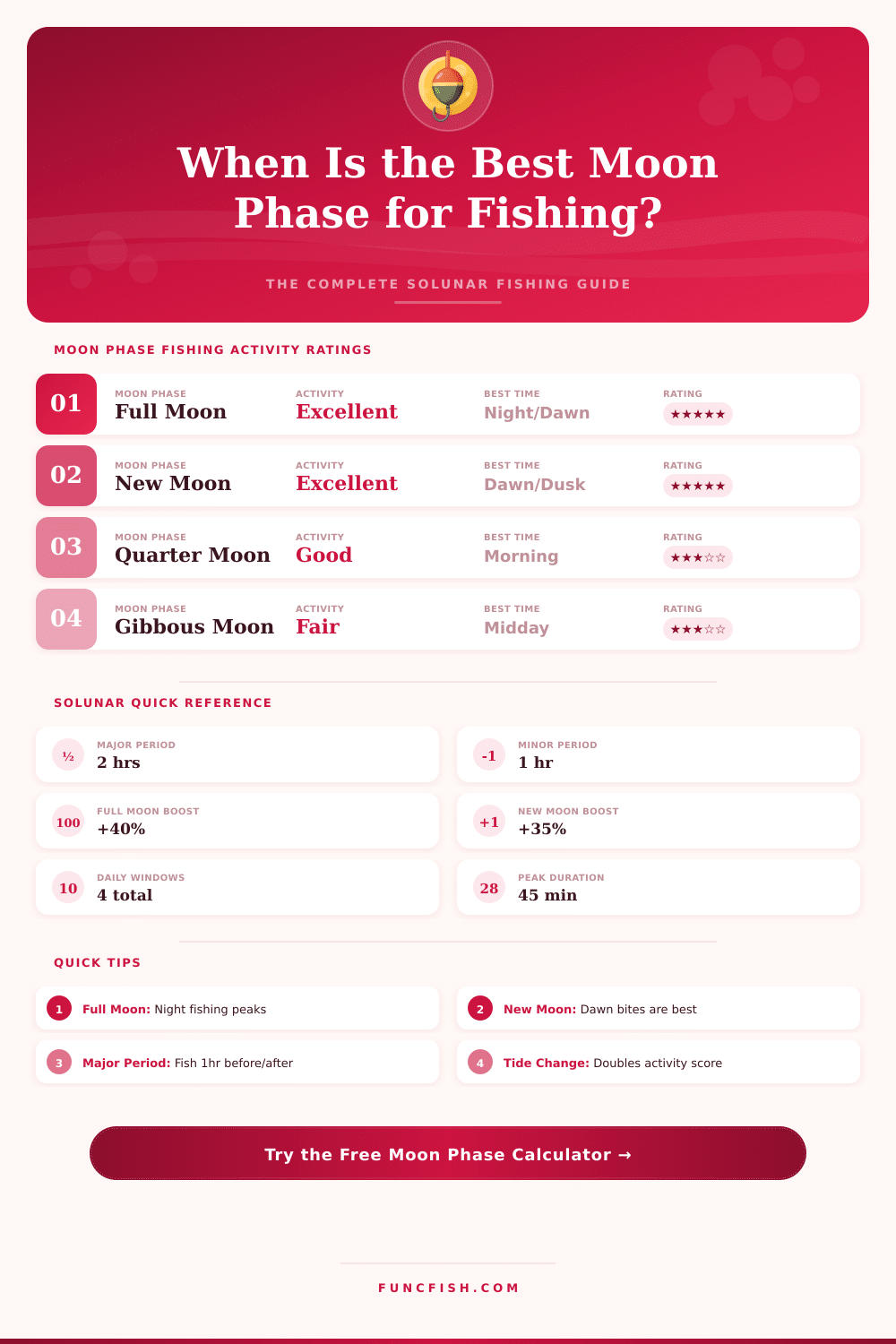
| Moon Phase | Illumination | Activity Level | Best Feeding Time | Solunar Score |
|---|---|---|---|---|
| 🌑 New Moon | 0% | Excellent | Dawn & Dusk | 95/100 |
| 🌒 Waxing Crescent | 1–49% | Good | Morning | 65/100 |
| 🌓 First Quarter | 50% | Moderate | Midday | 55/100 |
| 🌔 Waxing Gibbous | 51–99% | Good | Morning/Eve | 72/100 |
| 🌕 Full Moon | 100% | Excellent | Night & Dawn | 98/100 |
| 🌖 Waning Gibbous | 51–99% | Good | Morning | 70/100 |
| 🌗 Last Quarter | 50% | Moderate | Evening | 52/100 |
| 🌘 Waning Crescent | 1–49% | Fair | Variable | 58/100 |
| Species | Best Moon Phase | Preferred Time | Moon Response | Optimal Temp (°F / °C) |
|---|---|---|---|---|
| Largemouth Bass | Full / New | Dawn, Dusk | High | 65–75°F / 18–24°C |
| Smallmouth Bass | New / Full | Morning | High | 60–70°F / 15–21°C |
| Rainbow Trout | New Moon | Dawn | Very High | 50–65°F / 10–18°C |
| Brown Trout | Full Moon | Night | Very High | 52–64°F / 11–18°C |
| Walleye | Full / New | Dusk–Night | Very High | 55–68°F / 13–20°C |
| Catfish | Full Moon | Night | High | 70–85°F / 21–29°C |
| Redfish | New / Full | Incoming Tide | High | 65–80°F / 18–27°C |
| Northern Pike | Full Moon | Morning | Moderate | 55–67°F / 13–19°C |
| Crappie | New Moon | Morning | High | 62–72°F / 17–22°C |
| Striped Bass | Full Moon | Night | Very High | 58–72°F / 14–22°C |
| Period Type | Duration | When Occurs | Activity Boost | Best For |
|---|---|---|---|---|
| ⭐ Major Period 1 | 1.5–2 hrs | Moon overhead (transit) | +35 to +50% | All species |
| ⭐ Major Period 2 | 1.5–2 hrs | Moon underfoot (antipodal) | +30 to +45% | All species |
| Minor Period 1 | 45–75 min | Moon rising | +15 to +25% | Surface feeders |
| Minor Period 2 | 45–75 min | Moon setting | +10 to +20% | Bottom feeders |
| Tide Change | 30–60 min | High / low tide turn | +20 to +40% | Saltwater species |
| Golden Hour | 30–45 min | Sunrise / sunset | +20 to +35% | Predator species |
| Pressure Trend | Reading (inHg) | Fish Behavior | Strategy | Activity Rating |
|---|---|---|---|---|
| ↑ Rising Fast | 30.1–30.4+ | Active, feeding aggressively | Fast lures, top water | Excellent |
| ↑ Rising Slowly | 29.9–30.1 | Moderate activity | Normal presentation | Good |
| ↔ Stable High | 30.1+ | Feeding near structure | Slower presentation | Good |
| ↔ Stable Normal | 29.7–30.1 | Predictable patterns | Match the hatch | Moderate |
| ↓ Falling Slowly | 29.5–29.7 | Pre-front feeding frenzy | Fast lures, active | Very Good |
| ↓ Falling Fast | Below 29.5 | Deep / inactive | Deep slow presentations | Poor |
The moon does play a role in the behavior of fish. At new moon and full moon the tides reach their peak. This causes more movement in the water and changes in light that push fish to feed.
The small fish become more active and the big ones follow them closely. Also fish seem more active during moonrise and moonset, so plan a trip for those hours is useful.
How the Moon Affects Fish and Fishing
Full moon gives more light and more rough tides. Those tides do push the fish to more movement and feeding. Strong flows during big tides often change the feeding style for many predators.
On the other hand, some species eat less overnight under full moon, what can reduce their activity at midday. The common idea is that fish feed well under moonlight overnight, so they are less hungry and bite when anglers arrive in the morning.
New moon is a whole other case. Fish struggle to hunt in total darkness, so daytime Fishing during new moon often works more well. Some anglers find more spotted trout after a dark night.
The days around new moon, especially the growing or empty Moon Phase, can be very successful too.
The main times for fish movement come, when the moon stands directly above or below the Earth. Solar and lunar tables follow those major and minor periods, and lunar times work even better if they line up with main solar phase. In a Fishing timetable, the bigger dot or the broader strip shows better Fishing.
Despite more then half of studies using electronic tags, fish swim in deeper waters during growing moonlight. Only around five percent pointed to movement in less deep parts. It is worth recalling that, when choosing a place for a cast.
Moon Phase matters more for sea Fishing because of tides. Sea Fishing strongly depends on tides and Moon Phase. For freshwater Fishing the effect is less big.
A rough ranking of importance would be: place, season, water temperature, weather, Fishing pressure and lastly Moon Phase. Full moon also can lead to spawning activity in many species, especially bass during pre-spawn and spawncycle.
Weather and water conditions still beat everything else. If a cold front passes or water becomes murky after strong rain, Moon Phase matters much less. The two days before and after quarter moon are seen as bad for Fishing.
The moon is only one part in a complex net of factors that decide fishactivity. Even so, timing a trip to the right phase helps to raise chances.