🐟 Fish Age Calculator
Estimate the age of your catch by species, length & weight using real growth rate data
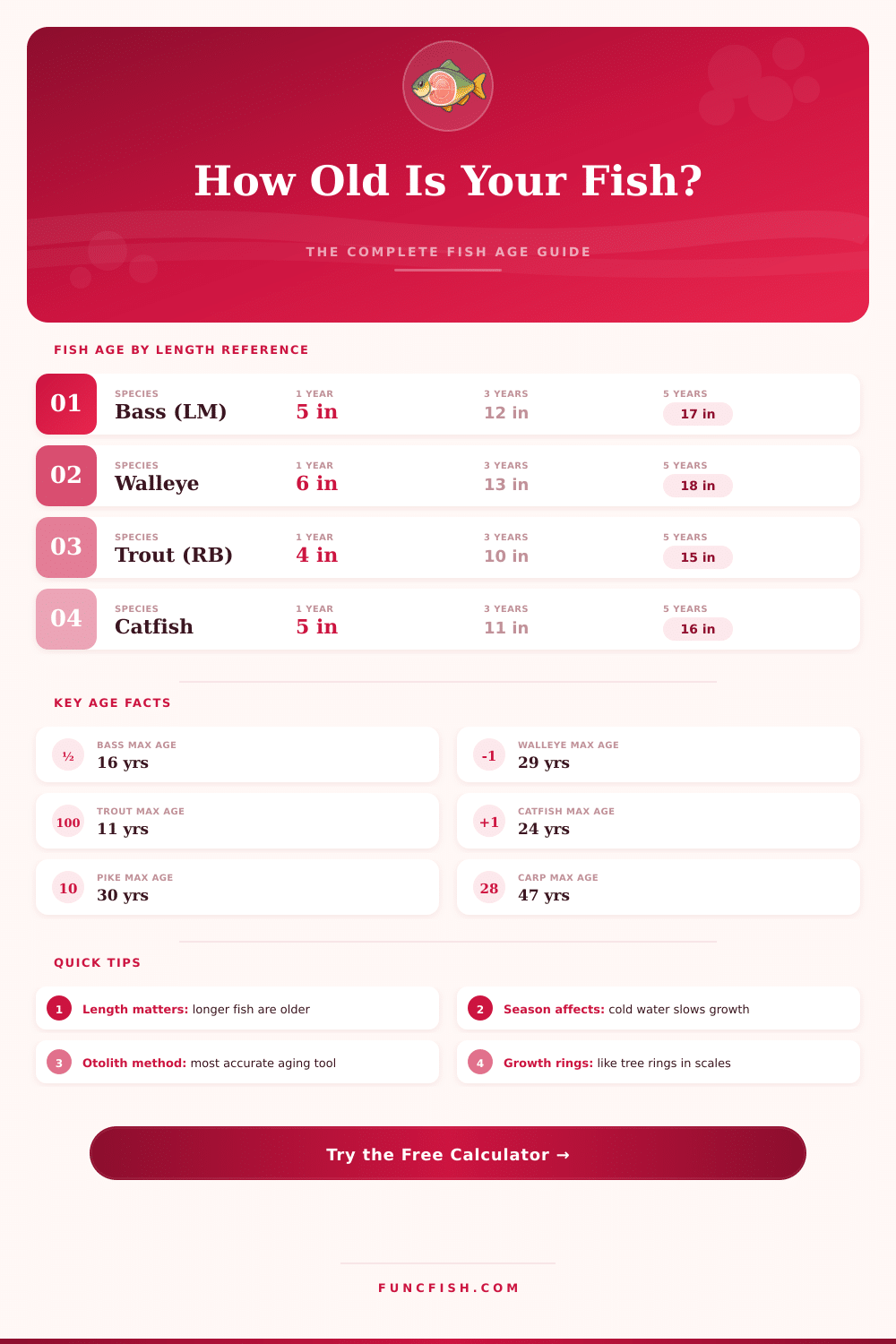
| Species | 1 Year | 2 Years | 3 Years | 5 Years | 7 Years | 10 Years |
|---|---|---|---|---|---|---|
| Largemouth Bass | 5″ | 9″ | 12″ | 17″ | 20″ | 22″ |
| Smallmouth Bass | 4″ | 8″ | 11″ | 15″ | 18″ | 20″ |
| Walleye | 6″ | 10″ | 13″ | 18″ | 22″ | 26″ |
| Rainbow Trout | 4″ | 8″ | 11″ | 15″ | — | — |
| Brown Trout | 5″ | 9″ | 12″ | 16″ | 20″ | — |
| Channel Catfish | 5″ | 9″ | 12″ | 16″ | 20″ | 24″ |
| Northern Pike | 7″ | 13″ | 17″ | 24″ | 29″ | 35″ |
| Bluegill | 3″ | 5″ | 6.5″ | 8″ | 9″ | — |
| Common Carp | 6″ | 11″ | 15″ | 20″ | 24″ | 28″ |
| Crappie | 3″ | 6″ | 8″ | 10″ | 11″ | — |
| Species | Avg Growth/Yr | Max Lifespan | Trophy Size | Typical Habitat |
|---|---|---|---|---|
| Largemouth Bass | 2–3 in/yr | 16 years | 22+ in (10+ lb) | Warm lakes, ponds |
| Smallmouth Bass | 1.5–2.5 in/yr | 18 years | 20+ in (7+ lb) | Rivers, cool lakes |
| Walleye | 2–3.5 in/yr | 29 years | 28+ in (13+ lb) | Northern lakes |
| Rainbow Trout | 2–3 in/yr | 11 years | 20+ in (8+ lb) | Cold streams |
| Brown Trout | 2–3 in/yr | 12 years | 24+ in (10+ lb) | Cold rivers |
| Channel Catfish | 2–3 in/yr | 24 years | 24+ in (15+ lb) | Rivers, lakes |
| Northern Pike | 4–6 in/yr | 30 years | 36+ in (20+ lb) | Northern lakes |
| Bluegill | 1–2 in/yr | 10 years | 10+ in (1.5+ lb) | Ponds, lakes |
| Common Carp | 2–4 in/yr | 47 years | 28+ in (20+ lb) | Slow rivers |
| Crappie | 1.5–2 in/yr | 12 years | 12+ in (3+ lb) | Lakes, reservoirs |
| Species | L∞ (Max Length, in) | k (Growth Rate) | t₀ (Age at L=0) | Notes |
|---|---|---|---|---|
| Largemouth Bass | 24 in (61 cm) | 0.28 | −0.5 | Faster in south |
| Smallmouth Bass | 22 in (56 cm) | 0.23 | −0.6 | Slower, cooler water |
| Walleye | 30 in (76 cm) | 0.25 | −0.8 | N. climate dependent |
| Rainbow Trout | 20 in (51 cm) | 0.32 | −0.3 | Hatchery vs. wild |
| Brown Trout | 24 in (61 cm) | 0.24 | −0.5 | Wild river fish |
| Channel Catfish | 28 in (71 cm) | 0.20 | −0.9 | Slow early growth |
| Northern Pike | 42 in (107 cm) | 0.22 | −1.0 | Rapid juvenile growth |
| Bluegill | 12 in (30 cm) | 0.35 | −0.2 | Small asymptote |
| Common Carp | 36 in (91 cm) | 0.18 | −1.2 | Very long-lived |
| Crappie | 14 in (36 cm) | 0.30 | −0.4 | Panfish, stunts easily |
Ageing Fish is not really different from ageing a tree… Both form layers of growth over time. As one can count the rings in the trunk of a tree Fish create marks of growth, that show exactly their Age.
Those marks stay and can be read to find the Age of the Fish.
How to Tell the Age of a Fish
The usual methods consist in looking at scales or checking otoliths, that is those little bones in the inner ear of the Fish. One commonly chooses scales, because they are easy to gather and read, especially if the patterns of growth show clearly. Otoliths fill up with biomineral and calcium carbonate, and they fascinate because specialists can apply radiocarbon dating to find the precise Age.
Though, scales and otoliths are not the only options. Rings of growth appear in vertebrae, spines of fins, the lens of the eye, teeth and bones of the lower jaw together with the chest girdle. The truth is, that all those parts grow rings according to the Age of the Fish, one layer per year, stacking one on the otehr during the time.
Some research groups tried two different methods to read otoliths, and they found, that using them whole gave the most precise results. The Fish, that they studied, reached maximum size in around 15 years of Age. What caught their interest, was the growth pattern.
It showed two phases, what means, that the Fish grew quickly in one life stage, then more slowly in another.
The handling of otoliths varies very much. One method includes enclosing them in resin before cutting them in thin slices. That stage matters, when one bothers to set the Age exactly.
The University of Georgia set up a whole workshop for such work, funded by Multi-State Conservation Grant thanks to the Association of Fish and Wildlife Agencies. Here they show prime photos of structures tied to Ages of Fish with known Ages, so that researchers can search by species.
For little Fish and certainly tender species, as atlantic herring and atlantic mackerel, that need attention, one takes them frozen hole and sends to the lab for later processing. More samples come from state research surveys and from observers of fishing, that work on interception ships.
Why does it matter to know the Age of Fish really? It is needed to estimate supplies and estimate, how populations adjust. If one knows the Ages of Fish from the same group, one can count death rates from fishing and natural causes.
Here the key point though: one should not simply assume, that the biggest Fish is the oldest. That would be to basically say, that every person more than six feet tall must have at least 100 years.
As Fish Age, they grow bigger and move more slowly, what makes them easier prey for hunters. Most wild Fish never die because ofold Age (they get eaten before).