🐟 Bass Length to Weight Calculator
Estimate largemouth, smallmouth & spotted bass weight from length using proven formulas
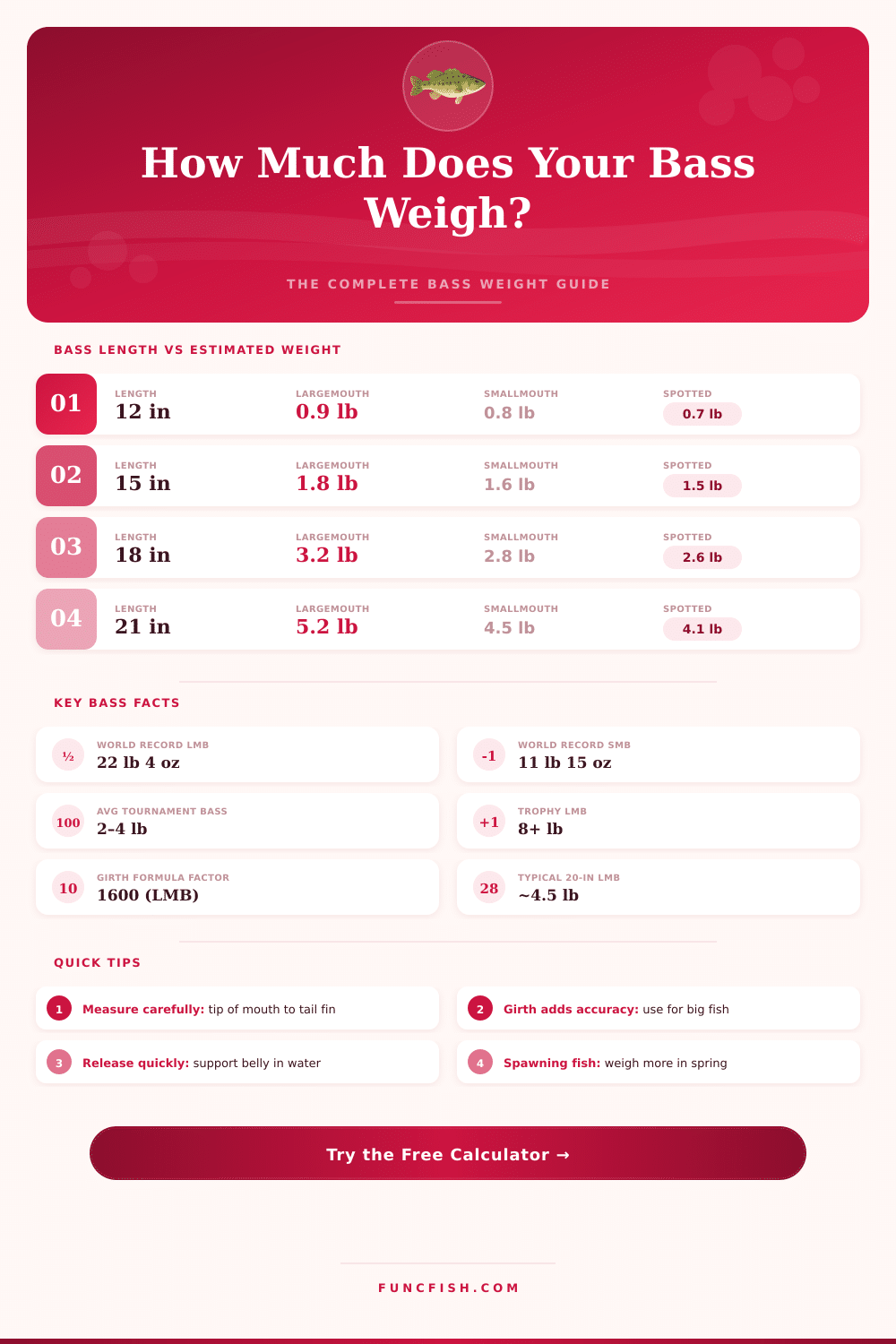
| Length (in) | Length (cm) | Largemouth (lb) | Smallmouth (lb) | Spotted Bass (lb) | Metric (kg) |
|---|---|---|---|---|---|
| 10" | 25.4 cm | 0.5 lb | 0.4 lb | 0.4 lb | 0.20 kg |
| 12" | 30.5 cm | 0.9 lb | 0.8 lb | 0.7 lb | 0.38 kg |
| 14" | 35.6 cm | 1.5 lb | 1.3 lb | 1.2 lb | 0.60 kg |
| 15" | 38.1 cm | 1.8 lb | 1.6 lb | 1.5 lb | 0.77 kg |
| 16" | 40.6 cm | 2.3 lb | 2.0 lb | 1.9 lb | 0.95 kg |
| 17" | 43.2 cm | 2.8 lb | 2.5 lb | 2.3 lb | 1.13 kg |
| 18" | 45.7 cm | 3.4 lb | 3.0 lb | 2.8 lb | 1.42 kg |
| 19" | 48.3 cm | 4.0 lb | 3.6 lb | 3.4 lb | 1.63 kg |
| 20" | 50.8 cm | 4.8 lb | 4.3 lb | 4.0 lb | 1.95 kg |
| 21" | 53.3 cm | 5.6 lb | 5.0 lb | 4.7 lb | 2.27 kg |
| 22" | 55.9 cm | 6.5 lb | 5.8 lb | 5.5 lb | 2.63 kg |
| 24" | 61.0 cm | 8.5 lb | 7.6 lb | 7.2 lb | 3.45 kg |
| Species | World Record | Trophy Weight | Typical Length | Length at Record |
|---|---|---|---|---|
| Largemouth Bass | 22 lb 4 oz | 8+ lb | 12–22 in | ~28–29 in |
| Smallmouth Bass | 11 lb 15 oz | 5+ lb | 10–20 in | ~25–26 in |
| Spotted Bass | 11 lb 4 oz | 4+ lb | 10–18 in | ~23–24 in |
| Condition | Description | Typical Girth/Length Ratio | Weight Adjustment |
|---|---|---|---|
| Poor / Lean | Post-spawn, stressed fish | ~0.60–0.65 | –10% to –15% |
| Average | Healthy, normal body | ~0.68–0.72 | No adjustment |
| Good | Well-fed, pre-spawn | ~0.73–0.78 | +5% to +8% |
| Excellent | Trophy, deep-body fish | ~0.80+ | +10% to +15% |
| Est. Weight | Rod Power | Line (Mono/Braid) | Hook Size |
|---|---|---|---|
| Under 1 lb | Ultra-light / Light | 4–8 lb / 10 lb braid | #1 – 1/0 |
| 1–3 lb | Medium-Light / Medium | 8–12 lb / 15–20 lb braid | 1/0 – 3/0 |
| 3–6 lb | Medium / Medium-Heavy | 12–17 lb / 20–30 lb braid | 3/0 – 5/0 |
| 6+ lb | Heavy / Extra-Heavy | 17–25 lb / 30–65 lb braid | 5/0 – 7/0 |
Most anglers find themselves in a state where they caught bass, but do not have a good heavy scale. That happens always. The good news?
It is possible to get a pretty reliable idea about the Weight of that fish only using some simple measures.
How to Estimate Bass Weight
The easiest method is to use a flexible measure to check the Bass Length of the fish, then compare it with a standard chart of Bass Length and Weight. So you will get an approximate reading that is based only on the physical length. The reason is, that if you caught a fat fish or a female that has not yet spawned then a bit higher rating makes sense, because such fish usually carry more mass.
For a more exact result, here is a formula that considers both length and girth. The math works like this: one takes the length, squares it, then multiplies it by the girth and divides the total by 1 200. Both values must be in inches, and the girth simply is the circumference around the thickest parts of the fish.
The result gives the Weight in pounds. It seems more difficult than it really is, when one uses a flexbile measure.
There is also the relative Weight, which helps to estimate how a particular fish beats the standard for its size. One divides the actual Weight by what a healthy bass of that length should have, and then multiplies by 100. For instance, a 20.5-inch bass of 4.2 pounds, one can compare that with benchmark values that the wildlife agency uses.
A normal 22-inch fish, for example, usually reaches around 6.21 pounds according to those charts.
Why do some bass weigh more than others, even if they have the same length? The diet and the overall physical structure matters a lot. Some fish simply look much bigger, despite equal length, which confuses folks.
Also the season plays a big role. Bass caught in spring can weigh much more then one from summer.
Sadly, photos do not help for exact Weight guesses. Without a real scale, the eye guess from a picture is only a gamble. A fat 20-inch largemouth bass could reach around 7 pounds, although that is probably a bit high.
A good fighter that really gives resistance usually beats 3 pounds, and here the physical structure starts to make a real difference.
The length stays stable, but the Weight does not. Season, recent food and water quality all change the mass. But the long bass does not shrink.
Because of that, anglers who practice catch and release commonly skip the scale and only measure, it is faster and gets the fish out of their hands quicker. Different calculators give different results, which is worth knowing. If one puts the same values into several formulas, the difference can go from 8.88 to 10.5 pounds.
These tools are handy, of course, but theywork with guesses, not with exact numbers.