🐟 Walleye Length Girth Weight Calculator
Estimate walleye weight from length & girth measurements — imperial & metric supported
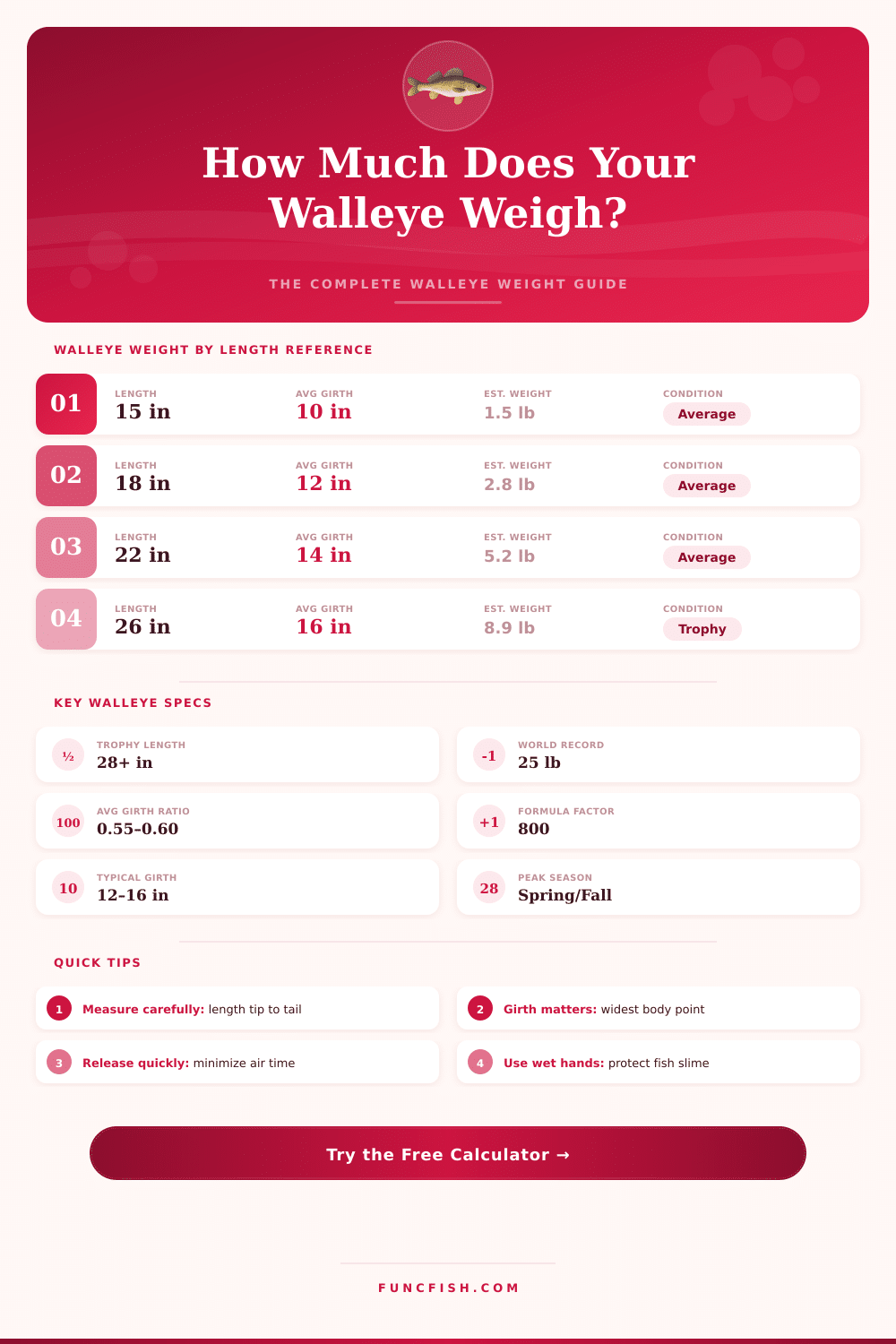
| Length (in) | Length (cm) | Avg Girth (in) | Est. Weight (lb) | Est. Weight (kg) | Classification |
|---|---|---|---|---|---|
| 12 | 30.5 | 8.5 | 1.1 | 0.5 | Sub-Legal |
| 14 | 35.6 | 9.5 | 1.6 | 0.7 | Small |
| 15 | 38.1 | 10.0 | 1.9 | 0.86 | Keeper |
| 17 | 43.2 | 11.5 | 2.8 | 1.27 | Keeper |
| 18 | 45.7 | 12.0 | 3.2 | 1.45 | Good |
| 20 | 50.8 | 13.0 | 4.2 | 1.90 | Good |
| 22 | 55.9 | 13.5 | 5.0 | 2.27 | Very Good |
| 24 | 61.0 | 14.5 | 6.3 | 2.86 | Trophy Class |
| 26 | 66.0 | 15.5 | 7.9 | 3.58 | Trophy Class |
| 28 | 71.1 | 16.5 | 9.4 | 4.26 | Master Angler |
| 30 | 76.2 | 17.5 | 11.3 | 5.12 | Master Angler |
| 32 | 81.3 | 18.5 | 13.2 | 5.99 | World Class |
| Length (in) | Standard /800 (lb) | Pennell /900 (lb) | Length Only /2700 (lb) | Wisconsin /3500 (lb) |
|---|---|---|---|---|
| 15 | 1.88 | 1.67 | 1.25 | 0.96 |
| 18 | 3.24 | 2.88 | 2.16 | 1.67 |
| 20 | 4.23 | 3.76 | 2.96 | 2.29 |
| 22 | 5.04 | 4.48 | 3.95 | 3.05 |
| 24 | 6.39 | 5.68 | 5.12 | 3.95 |
| 26 | 7.88 | 7.00 | 6.51 | 5.02 |
| 28 | 9.52 | 8.46 | 8.13 | 6.27 |
| 30 | 11.25 | 10.00 | 10.00 | 7.71 |
| Fish Condition | Girth / Length Ratio | Example (22" Fish) | Season Typical |
|---|---|---|---|
| Post-Spawn / Thin | 0.50 – 0.53 | 11.0 – 11.7 in | Spring |
| Below Average | 0.54 – 0.56 | 11.9 – 12.3 in | Early Summer |
| Average | 0.57 – 0.60 | 12.5 – 13.2 in | Summer |
| Above Average | 0.61 – 0.64 | 13.4 – 14.1 in | Fall |
| Fat / Trophy | 0.65 – 0.70 | 14.3 – 15.4 in | Late Fall |
Get crisp skin on fish fillets is more hard than one thinks. When the fillet touches warm surface it usually curls upward. That causes uneven cook and soft skin.
Using fish weight, one can press the fillet down and keep it flat. Like this the skin becomes crisp, while the flesh cooks even. The weight gives equal pressure over the whole surface.
Keep Fish Skin Crispy and How to Weigh Fish
At first sight, fish weight looks like a hamburger press. One famous model is the stainless steel weight by Josh Niland, that became popular quickly in United States and Canada. Some compare it to a little old iron, which is simply a metal block with handle.
This weight weighs a lot for its size and cleans easily.
Now, guessing the real weight of fish is a whole other thing. For whole fish there is a simple rule. One multiplies the lenght by the girth, then again by the girth, and divides by 800.
The girth and length measure in inches, and the result one gets in pounds. For instance, if the girth is 15 inches and length 29 inches, one only plugs those values in. The number 800 one can adjust higher or down, depending on whether the fish weighs more or less than average.
When girth measures lack, one uses default of 0.58 times the length instead.
Also hear there are charts for length against weight, but they not always match. Long but slim fish and short but fat fish can have different weight, even if their lengths match. For species like walleye, guessing only by length not always helps well.
Length commonly matters more than weight as measure of size, because weight changes, but the length of fish never shrinks.
Fish can lose weight after capture. Blood loss, vomit and waste all add up. But mostly the loss of water is the main cause.
Because fish live in water, they always control the water balance in their bodies through a process called osmosis.
Because of that, weigh fish on the spot with a hanging scale works well. One model runs on two AAA batteries and has a lit LCD screen with a hook. A scale with a built-in lip grip is another favorite option.
One clips the grip right to the center of the bottom jaw. If the scale has only a hook, one can add a separate pair of lip grips and remove their weight with the tare function. Spring scales one keeps in a waterproof case and sprays with WD-40 to makethem last.
Rust can destroy a fishing scale in months, if one leaves it open in a tackle box.