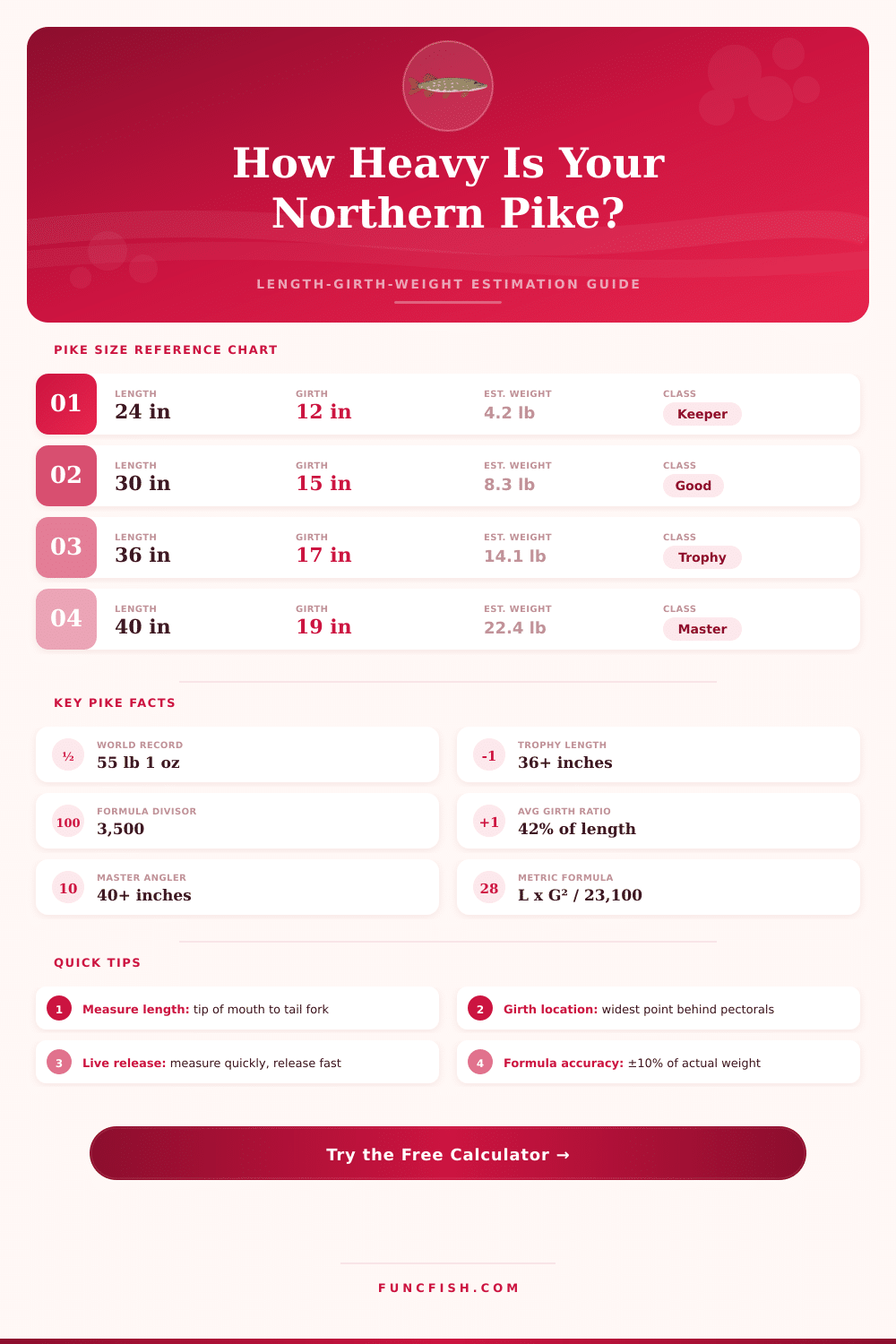
🐟 Northern Pike Length-Girth-Weight Calculator
Estimate your pike's weight from length & girth measurements — imperial & metric supported
| Length (in) | Length (cm) | Avg Girth (in) | Est. Weight (lb) | Est. Weight (kg) | Size Class |
|---|---|---|---|---|---|
| 18 | 45.7 | 9.5 | 2.3 | 1.04 | Juvenile |
| 20 | 50.8 | 10.2 | 3.0 | 1.36 | Juvenile |
| 24 | 61.0 | 11.5 | 4.5 | 2.04 | Keeper |
| 28 | 71.1 | 13.0 | 6.8 | 3.08 | Keeper |
| 30 | 76.2 | 14.0 | 8.4 | 3.81 | Good |
| 33 | 83.8 | 15.2 | 10.9 | 4.95 | Good |
| 36 | 91.4 | 17.0 | 14.9 | 6.76 | Trophy |
| 38 | 96.5 | 17.8 | 17.1 | 7.76 | Trophy |
| 40 | 101.6 | 18.8 | 20.1 | 9.12 | Master |
| 42 | 106.7 | 19.5 | 22.9 | 10.39 | Master |
| 45 | 114.3 | 20.8 | 28.8 | 13.06 | Master |
| 48 | 121.9 | 22.0 | 34.6 | 15.69 | Elite |
| 52 | 132.1 | 23.5 | 43.9 | 19.91 | Elite |
| Formula | Equation | Best For | Accuracy |
|---|---|---|---|
| Standard Pike | L x G² / 3500 | General use, all sizes | ଘ% |
| Ontario DNR | L x G² / 3200 | Canadian lakes, larger pike | ଗ% |
| Gabelhouse | -5.255 + 3.166 x log(L) | Length-only, no girth | 넕% |
| Length-Only Est. | 0.000128 x L³ | Quick field estimate | 넠% |
| Metric Standard | L x G² / 23100 | European/metric measurements | ଘ% |
| Species | Typical Weight Range | Trophy Weight | Formula Divisor | Girth Ratio |
|---|---|---|---|---|
| Northern Pike | 2–20 lb (0.9–9 kg) | 30+ lb (13.6+ kg) | 3,500 | ~42% of length |
| Muskellunge | 5–30 lb (2.3–13.6 kg) | 50+ lb (22.7+ kg) | 3,500 | ~44% of length |
| Tiger Muskie | 4–25 lb (1.8–11.3 kg) | 40+ lb (18.1+ kg) | 3,500 | ~43% of length |
| Chain Pickerel | 0.5–4 lb (0.2–1.8 kg) | 6+ lb (2.7+ kg) | 3,500 | ~38% of length |
| Walleye | 1–10 lb (0.5–4.5 kg) | 15+ lb (6.8+ kg) | 2,700 | ~36% of length |
Whether you can reach ideal crispness of the skin on a fish slice? That results more complex than one could believe. In the first seconds, when the slice touches the hot pan, it clearly tends to curl upward.
That curling entirely clutters the cooking process, ultimately you receive uneven heated meat and skin, that simply refuses to crisp correctly. Using a fish press, one can settle this problem, because it presses the slice flatly against the surface, so the skin can well crisp, during the internal meat cooks likewise through everything. The pressure spreads equally above the whole area, without some warm places.
How to make fish skin crispy and weigh a fish
First visually, one could wrongly identify it with a press for hamburgers. Josh Niland created a professional looking version from stainless steel, that ships relatively soon in United States and Canada and some users noticed, that it reminds of an old style tool for pressing meats, that type, that based only on massive metal block with added handle. The object weighs surprisingly a lot regarding its size and easily cleans without any trouble.
But there is more than only that kitchen aid for weighing fishes. Actually, exactly estimating the weight of fish requires a bit of math. Trout fishers use a usual formula: one multiplies the length by means of the square of the girth, later divides by means of 800.
Both measurements are in inches, and the result one receives in pounds in the finish. Assume a fish long 29 inches with 15-inch girth, that method delivers relibale approximation. The divider itself can adjust a bit upward or down, depending on that, whether your fish is denser or thinner than average.
If you can not measure the girth easily, occasionally one falls back on a simple rule: 0,58 times the length as replacement.
Even so, trust only in length does not suffice for accuracy. A skinny fish and a plump same-long copy will not weigh almost likewise. Ratings based alone on length can err extremely four particular species.
Moreover, fishes commonly lose weight after capture. They bleed, vomit, empty, everything such occasions. But the main cause?
Loss of water. Fishes always struggle to preserve internal water balance by means of regulation, hence the weight just after exit from water differs from that even after some hours.
For weighing in the nature, a portable digital hanging scale is the most practical option. Many models already include a grip for the lip, that closes flatly at the middle part of the bottom jaw. Whether your scale has only a hook, then one takes an independent lip grip and removes its weight from the whole.
One reliable type limits to roughly 110 pounds, operates by means of two AAA batteries and has a shining screen with grip, thatdoes not slip.
In certain species, estimating length helps to estimate weight roughly. Weight adjusts according to inside of the fish, but length? It stays stable.