🐟 King Salmon Weight Calculator
Estimate Chinook salmon weight from length & girth — imperial & metric results instantly
| Fork Length | Girth | Est. Weight (lb) | Est. Weight (kg) | Classification |
|---|---|---|---|---|
| 24 in (61 cm) | 14 in (36 cm) | ~5.9 lb | ~2.7 kg | Small / Jack |
| 28 in (71 cm) | 16 in (41 cm) | ~9.0 lb | ~4.1 kg | Average |
| 32 in (81 cm) | 18 in (46 cm) | ~13.0 lb | ~5.9 kg | Average |
| 36 in (91 cm) | 21 in (53 cm) | ~19.8 lb | ~9.0 kg | Good |
| 40 in (102 cm) | 23 in (58 cm) | ~26.5 lb | ~12.0 kg | Large |
| 44 in (112 cm) | 26 in (66 cm) | ~37.2 lb | ~16.9 kg | Trophy |
| 48 in (122 cm) | 29 in (74 cm) | ~50.5 lb | ~22.9 kg | Master Angler |
| 52 in (132 cm) | 32 in (81 cm) | ~66.6 lb | ~30.2 kg | Near-Record |
| Est. Weight | Rod Power | Line Strength | Leader | Hook Size |
|---|---|---|---|---|
| Under 10 lb (4.5 kg) | Medium | 10–15 lb (4.5–6.8 kg) | 12–15 lb fluorocarbon | #2 – #1 |
| 10–20 lb (4.5–9 kg) | Med-Heavy | 15–25 lb (6.8–11.3 kg) | 20 lb fluorocarbon | 1/0 – 2/0 |
| 20–35 lb (9–16 kg) | Heavy | 25–40 lb (11.3–18.1 kg) | 30 lb fluorocarbon | 2/0 – 3/0 |
| 35–55 lb (16–25 kg) | X-Heavy | 40–60 lb (18.1–27.2 kg) | 40 lb fluorocarbon | 3/0 – 4/0 |
| 55+ lb (25+ kg) | XX-Heavy | 60–80 lb (27.2–36.3 kg) | 60 lb fluorocarbon | 4/0 – 5/0 |
| Fishery / Region | Avg. Weight | Trophy Weight | Record / Notes |
|---|---|---|---|
| Kenai River, Alaska | 20–40 lb (9–18 kg) | 60+ lb (27+ kg) | World record home: 97.5 lb |
| Columbia River, OR/WA | 15–30 lb (7–14 kg) | 45+ lb (20+ kg) | Strong spring & fall runs |
| Great Lakes (MI/NY) | 12–25 lb (5.4–11 kg) | 35+ lb (16+ kg) | Planted Chinook; stocked |
| Sacramento River, CA | 10–20 lb (4.5–9 kg) | 40+ lb (18+ kg) | Winter run Chinook |
| Puget Sound, WA | 15–28 lb (7–13 kg) | 40+ lb (18+ kg) | Ocean & river fishing |
| Cook Inlet, Alaska | 25–50 lb (11–23 kg) | 70+ lb (32+ kg) | Prime salt-water Chinook |
Getting perfectly crisp skinned fish is more difficult than one would think. When the fillet touches the hot oil, it can jump upward and cause uneven cooking together with soft loose skin, that none wants. The fish weight helps to settle that, because it presses the fillet flat against the pan so the skin becomes crisp while the flesh cooks evenly below.
How does it work? Quite simply, the weight gives steady pressure over the whole surface of the fillet and ensures that everything stays in touch with the warm floor. At first sight, it reminds of the press for hamburgers, but this device is designed specially for fish, what matters a lot.
Fish weight: making crispy skin and weighing your catch
Some home cooks try to improvise by means of rolling pans or any heavy stuff that they have nearby. Even so that method has clear flaws. Those home solutions commonly are uneven, spread the wieght badly or even react with the food itself.
On the contrary, a real fish weight is clean and shaped, while it spreads the pressure evenly. One famous version from stainless steel (linked to Josh Niland) costs around 165 dollars. It is very dense for its size and easy to clean, because stainless material does not rust or hurt tender meat.
Here is a weird fix: search in old stores for ancient clothes irons. The old model is simply solid metal with a handle. That maybe is useful in a rush, although it is knot done exactly like a professional fish weight.
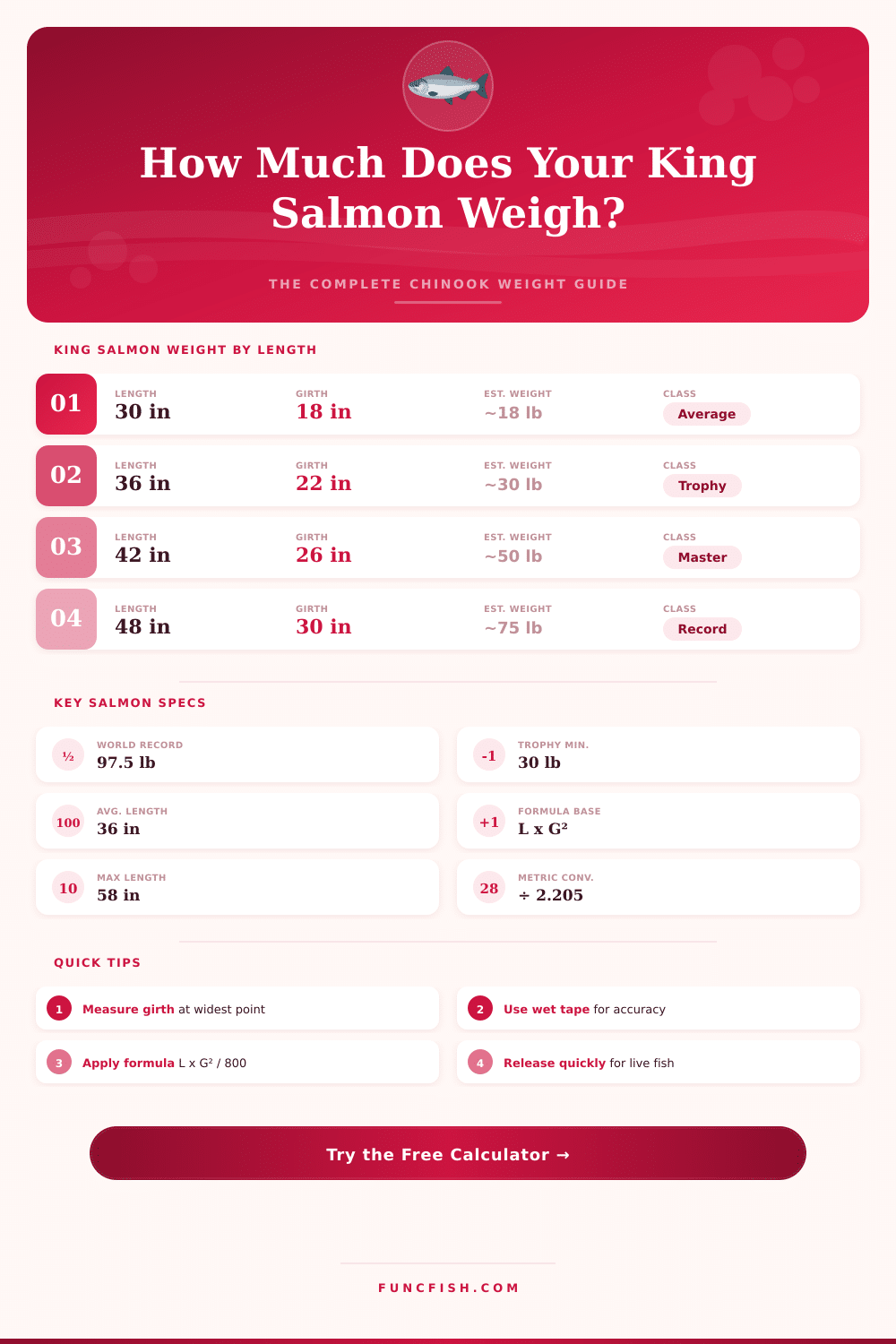
Now, “fish weight” appears in a totally other sense, when fishers want to estimate the size of the catch. For that there are math rules. One usual calculation for trout multiplies the length by the girth, then again by the girth, and finally divides by 800.
Those numbers adjust according to the species, because some fishes weigh more than average or less. If you cannot measure the girth easily, many use 0.58 times the length as a near calculation.
The problem is that those rules do not always work. A long and slim trout just as long as a short and thick one can have totally different weight. Only the length does not give the full picture, especially for species like king salmon, whose body shape changes a lot.
For real weighing, use a scale with a built in lip handle, that does the task easy. The handle grips the bottom jaw. If your scale has only a hook, you buy a separate lip grip and simply subtract its weight from the result.
One good model weighs up to 110 pounds and comes with a good handle plus built in measuringtape.
Many fishers prefer to estimate the length instead of the weight. The idea is that weight changes, but length stays fixed. Ultimately, quickly returning the fish to the water matters more than precise weighing on a scale, though.