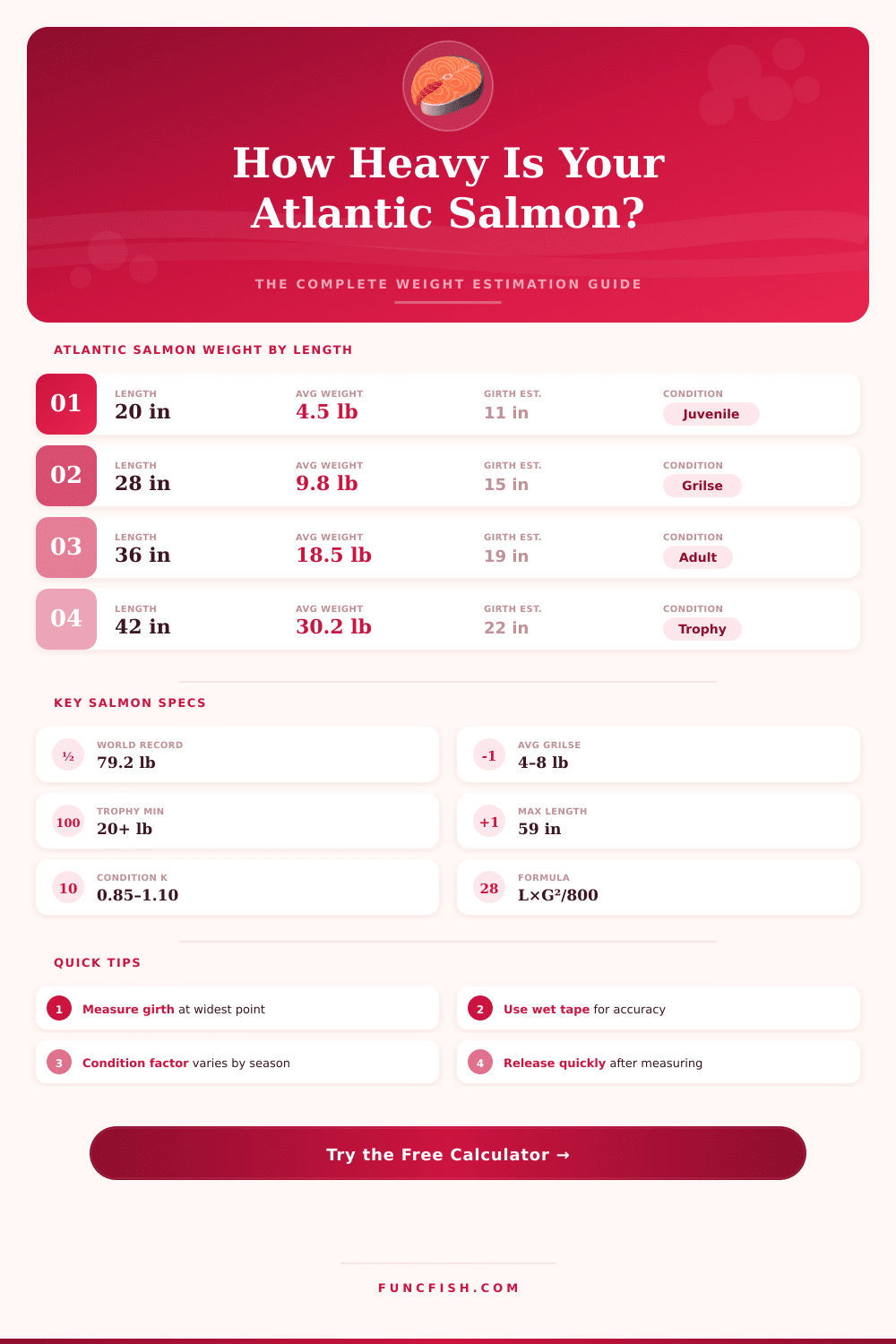
🐟 Atlantic Salmon Weight Calculator
Estimate your Atlantic salmon's weight from length & girth measurements using proven formulas
| Fork Length (in) | Fork Length (cm) | Est. Girth (in) | Est. Weight (lb) | Est. Weight (kg) | Class |
|---|---|---|---|---|---|
| 16 | 40.6 | 9.6 | 1.8 | 0.8 | Parr/Smolt |
| 20 | 50.8 | 11.0 | 3.0 | 1.4 | Small Grilse |
| 24 | 61.0 | 13.0 | 5.1 | 2.3 | Grilse |
| 28 | 71.1 | 15.0 | 7.9 | 3.6 | Grilse |
| 30 | 76.2 | 16.0 | 9.6 | 4.4 | Grilse/Adult |
| 34 | 86.4 | 17.5 | 13.0 | 5.9 | Adult |
| 36 | 91.4 | 18.5 | 15.4 | 7.0 | Adult |
| 40 | 101.6 | 20.5 | 21.0 | 9.5 | Large Adult |
| 44 | 111.8 | 22.0 | 26.6 | 12.1 | Trophy |
| 48 | 121.9 | 24.0 | 34.6 | 15.7 | Trophy |
| 52 | 132.1 | 25.5 | 42.2 | 19.1 | Trophy |
| 56 | 142.2 | 27.0 | 51.0 | 23.1 | Record Class |
| Fish Type | Typical Length | Typical Weight | Condition Factor | Notes |
|---|---|---|---|---|
| Grilse (1SW) | 20–28 in / 51–71 cm | 3–8 lb / 1.4–3.6 kg | 0.95–1.00 | 1 sea-winter fish |
| 2-Sea-Winter | 28–36 in / 71–91 cm | 8–18 lb / 3.6–8.2 kg | 1.00–1.05 | Most common adult |
| 3-Sea-Winter | 36–44 in / 91–112 cm | 18–30 lb / 8.2–13.6 kg | 1.00–1.05 | Prime trophy fish |
| MSW (4+) | 44–56 in / 112–142 cm | 30–60 lb / 13.6–27.2 kg | 1.02–1.08 | Very rare, record class |
| Kelt (Post-Spawn) | 28–44 in / 71–112 cm | 5–14 lb / 2.3–6.4 kg | 0.70–0.85 | Emaciated, thin body |
| Landlocked Salmon | 14–26 in / 36–66 cm | 1–8 lb / 0.5–3.6 kg | 0.85–0.95 | Sebago/Ouananiche |
| Farmed Atlantic | 22–32 in / 56–81 cm | 6–15 lb / 2.7–6.8 kg | 1.05–1.15 | Stockier body shape |
| Body Condition | Girth/Length Ratio | Example: 30 in Fish | Expected Girth | Condition Factor |
|---|---|---|---|---|
| Thin / Kelt | 0.44–0.48 | 30 in | 13.2–14.4 in | 0.75–0.82 |
| Below Average | 0.48–0.52 | 30 in | 14.4–15.6 in | 0.82–0.90 |
| Average | 0.52–0.56 | 30 in | 15.6–16.8 in | 0.90–1.00 |
| Good | 0.56–0.60 | 30 in | 16.8–18.0 in | 1.00–1.05 |
| Excellent / Sea-Run | 0.60–0.65 | 30 in | 18.0–19.5 in | 1.05–1.12 |
Get crisp skin on fish seems easy, until you truly try that. When the fish touches the warm oil, it starts crisp well but soon it starts curling up. Then everything goes wrong; truly wrong.
The skin cooks uneven, becomes soft everywhere, and at last you have a ruined plate. The reason is, that the clamped parts of the fish do not touch the pan, so the skin never has chance to crisp right.
How to Make Fish Skin Crispy
Here comes the fish press. It does one basic task: press the fish against the bottom of the pan, so that the skin truly crisps and the whole cooks equally. Does that not sound logical?
Even so many folks believe, that one can use a newspaper weight for hamburgers. No truly, a good fish press is specially made, and it makes a big difference.
Maybe you will ask, whether one can simply take an iron pan or some random weight instead. Here is the problem: such options commonly are too heavy, spread the pressure uneven or even react with the fish. A good fish press is diferent.
It is comfortable, spreads the pressure equally over the fish, and made from stainless steel, so it does not rust, does not colour the food or damage anything tender.
One good choice is the stainless steel model by Josh Niland, that comes in some versions, including the Rainbow. The price is around 165 dollars, and it ships quickly through United States and Canada. What makes it good, is its high density (a lot of weight in a little body).
Besides that, it is easy to clean after use.
If that price seems too high, there is another way, that is worth looking into. Search old style metal weights (the simple type), that is only solid metal with a handle, without any electronics. Thrift shops and yard sales sometimes have them for little money, and they work surprisingly well for a fraction of the cost.
Now, finding the wait of fish without a scale is a whole other challenge. One formula, that works well for trout, multiplies the length by the girth, then divides by 800. You can adjust that 800 number higher or lower, depending on if your fish is heavier or lighter than normal.
No measure of girth? Estimate it using 0.58 times the length.
But here is where it gets hard, those formulas are not perfect. Long and slim fish, just like thick and shorter ones, can weigh totally different even at same length. Atlantic salmon are famous for that.
So length gives you more reliable info than weight for guessing the size of fish. Weight changes with food, but length stayspermanent.
For the best result, take a scale with a built in lip grip and attach it to the center of the bottom jaw of the fish. No grip on your scale? Attach a separate lip grip to the hook and simply subtract its weight from the result.
The best rule: return the fish to the water right after the measurement.