🐟 Bluegill Weight Calculator
Estimate bluegill weight from length & girth — imperial & metric supported
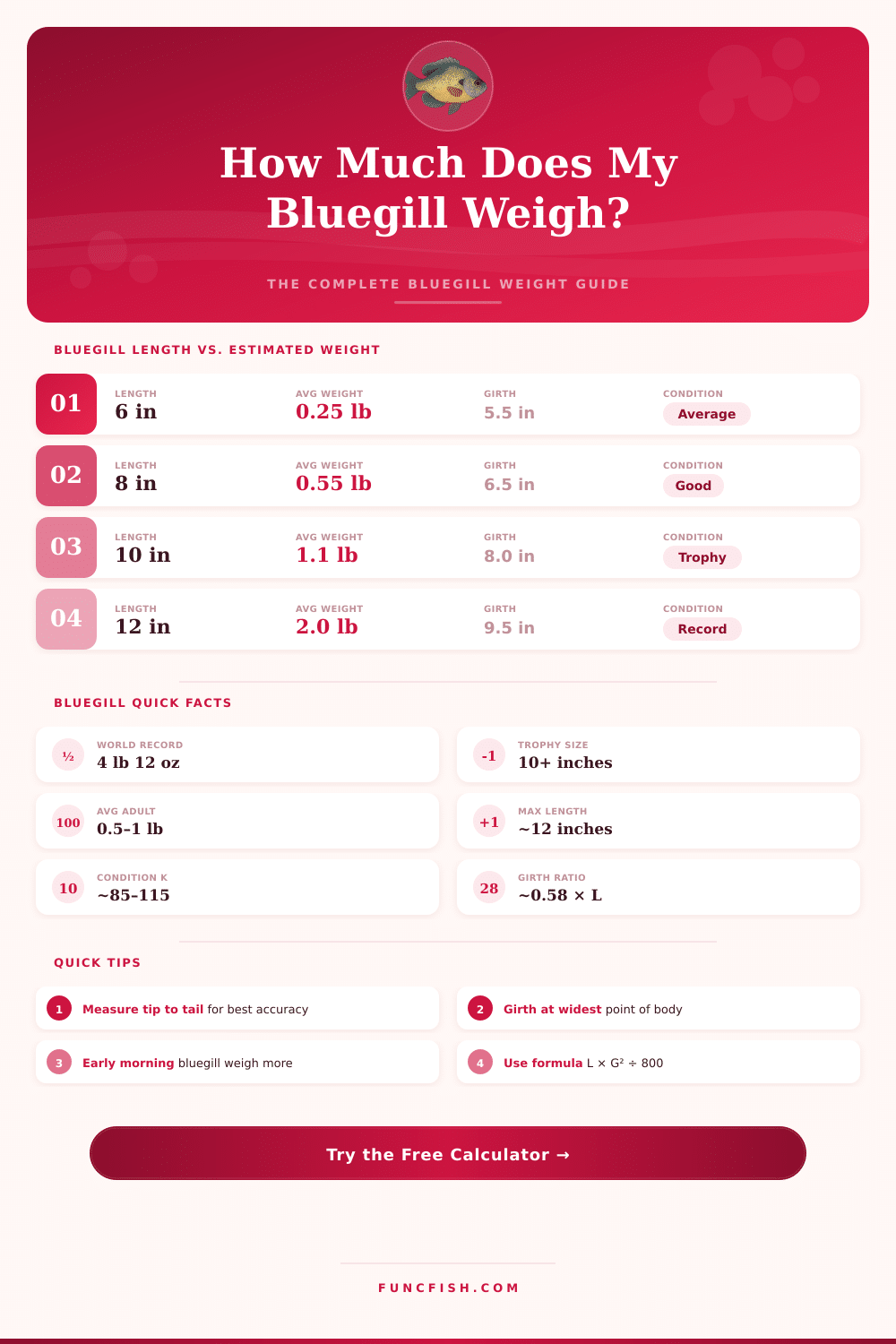
| Length (in) | Length (cm) | Est. Weight (lb) | Est. Weight (g) | Est. Girth (in) | Classification |
|---|---|---|---|---|---|
| 4 | 10.2 | 0.09 | 41 | 2.8 | Juvenile |
| 5 | 12.7 | 0.17 | 77 | 3.5 | Juvenile |
| 6 | 15.2 | 0.29 | 132 | 4.2 | Sub-Adult |
| 7 | 17.8 | 0.47 | 213 | 4.9 | Adult |
| 8 | 20.3 | 0.71 | 322 | 5.6 | Adult |
| 9 | 22.9 | 1.02 | 463 | 6.3 | Quality |
| 10 | 25.4 | 1.41 | 640 | 7.0 | Trophy |
| 11 | 27.9 | 1.90 | 862 | 7.7 | Trophy |
| 12 | 30.5 | 2.48 | 1125 | 8.4 | Record Class |
| Condition Class | Wr Range | Weight Multiplier | What It Means |
|---|---|---|---|
| Poor / Lean | < 80 | 0.88x | Crowded or food-limited population |
| Below Average | 80–89 | 0.94x | Slightly underfed or recovering |
| Average | 90–99 | 1.00x | Typical healthy bluegill population |
| Good | 100–109 | 1.07x | Well-fed, good forage base |
| Excellent | 110–119 | 1.14x | Outstanding habitat and forage |
| Outstanding | 120+ | 1.22x | Exceptional lake with low pressure |
| Species | Typical Weight | Trophy Weight | Max Length | Formula Divisor |
|---|---|---|---|---|
| Bluegill | 0.25–1.0 lb | 1.5+ lb | 12 in | 800 |
| Redear Sunfish | 0.5–1.5 lb | 2.0+ lb | 14 in | 780 |
| Pumpkinseed | 0.2–0.8 lb | 1.2+ lb | 11 in | 820 |
| Green Sunfish | 0.1–0.5 lb | 0.75+ lb | 10 in | 850 |
| Crappie (Black) | 0.5–1.5 lb | 2.5+ lb | 15 in | 900 |
| Yellow Perch | 0.25–1.0 lb | 1.5+ lb | 13 in | 875 |
| Rock Bass | 0.2–0.75 lb | 1.0+ lb | 10 in | 840 |
| Water Type | Avg Condition Factor | Growth Rate | Trophy Potential |
|---|---|---|---|
| Farm Pond (managed) | 105–120 | Fast | Very High |
| Natural Lake | 90–105 | Moderate | High |
| Reservoir | 95–110 | Moderate–Fast | High |
| River / Large Stream | 85–100 | Moderate | Moderate |
| Creek / Small Stream | 80–95 | Slow–Moderate | Low–Moderate |
| Gravel Quarry | 90–108 | Slow | Moderate–High |
Get crisp skin on fish is much more hard than many folks assume. When the piece touches the warm pan, it mostly starts curling upward. Because of that curling the whole bit cooks unevenly, and result flat, sad skin instead of that crisp bark, that each wants.
The fish press settles exactly this problem. It presses the piece flatly against the pan, so that the skin well becomes while the insides cook equally. This device spreads the pressure evenly above the whole surface, keep it down, so the skin indeed becomes crisp and the meat inside stays juicy and well cooked.
Make Fish Skin Crispy and Weigh Your Fish
In the first place, the fish press looks like a hamburger press, what makes sense. Indeed it is professional level from stainless steel, designed specially for fish bits. Josh Niland created one of the most popular models, that costs around 165 dollars.
The thing weighs almost 4 pounds, around 1.8 kilos, if you like metric. Exactly that mass does, that it works like this well; it is quite heavy for keeping the pieces flat during cooking, without beating them too strongly.
Here where everything becomes a bit confusing: fish Weight have entirely other meaning, when you genuinely fish outside. Counting the Weight of fish is a problem, with that fishers fight daily. For whole fish exists a reliable formula: length times girth times girth, later share the result by means of 800.
Both sizes in inches give the Weight in pounds. For instance, for fish long 29 inches with 15-inch girth, plug the numbers and receive the guess.
Even so that divider 800 is not absolute rule. One can raise it or lower it according to the species, if the caught fish is denser or slimmer then the average. The truth is, that such calculations never will be perfect.
Actually the form of fish affects a lot the Weight. Some are slim and sleek, while others have thick bodies and are dense. Depending on the diet.
Whether it well ate, recently spawned or swam long ways, everything alters the ratio between length and mass.
If you genuinely need to weigh the catch, take digital scales with a lip grip attached. The grip clamps the bottom jaw of the fish center. No grip available?
Hook scales work also; simply hook it to the lip, zero out the Weight of the device before. The commonly used hanging scales last around 110 pounds and usually come with measuring tape andbatteries included.
Guessing the Weight of fish from photos is another hardship. That extremely skinny 31-inch pike could seem to weigh 8 or 9 pounds according to long looks, but actually it maybe has only 3 or 4. The heaviest fish not always is the longest.
Fish grow differently, depending on water and food available, what explains the whole crowd of differences in sizes.