🎣 Lead Core Line Depth Calculator
Calculate exact trolling depth based on line segments, speed, and lure type
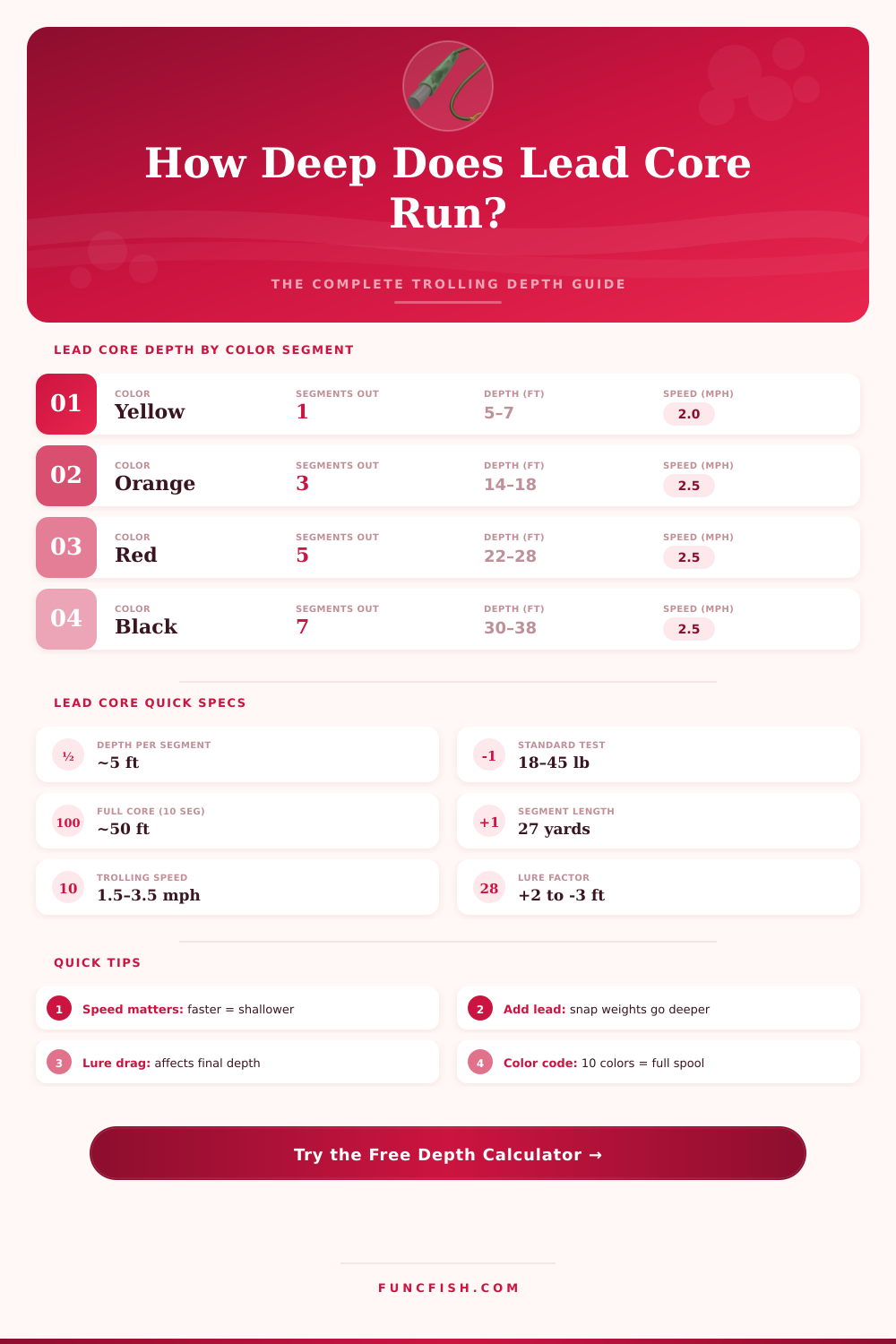
| Segments (Colors) | Line Out (yards) | Approx Depth 18 lb (ft) | Approx Depth 27 lb (ft) |
|---|---|---|---|
| 1 | 27 | 5–7 | 6–8 |
| 2 | 54 | 9–12 | 11–14 |
| 3 | 81 | 13–17 | 15–20 |
| 4 | 108 | 17–22 | 20–26 |
| 5 | 135 | 22–28 | 25–32 |
| 6 | 162 | 26–33 | 30–38 |
| 7 | 189 | 30–38 | 35–44 |
| 8 | 216 | 34–43 | 39–49 |
| 9 | 243 | 38–47 | 43–54 |
| 10 | 270 | 42–52 | 47–58 |
| Lure Type | Drag Factor | Depth Adjustment | Best For |
|---|---|---|---|
| Spoon | Low | +1 to +2 ft deeper | Trout, Salmon |
| Worm Harness | Low | +1 ft deeper | Walleye |
| Crankbait | Medium | Baseline (0 ft) | Walleye, Bass |
| Spinner / Spinnerbait | Medium-High | −1 to −2 ft shallower | Bass, Pike |
| Dodger + Fly | High | −2 to −3 ft shallower | Kokanee, Trout |
| Flasher + Fly | Very High | −3 to −5 ft shallower | Chinook Salmon |
| Musky Crankbait | High | −2 to −4 ft shallower | Muskellunge, Pike |
| Species | Target Depth Range | Rec. Line Weight | Rec. Segments |
|---|---|---|---|
| Walleye | 10–30 ft (3–9 m) | 18–27 lb | 3–6 |
| Chinook Salmon | 30–60 ft (9–18 m) | 36–45 lb | 7–10 |
| Coho Salmon | 20–40 ft (6–12 m) | 27–36 lb | 5–8 |
| Lake Trout | 25–50 ft (7.6–15 m) | 27–36 lb | 5–9 |
| Rainbow Trout | 8–20 ft (2.4–6 m) | 18 lb | 2–4 |
| Kokanee Salmon | 15–35 ft (4.5–11 m) | 18–27 lb | 3–6 |
| Muskellunge | 8–25 ft (2.4–7.6 m) | 36–45 lb | 2–5 |
| Northern Pike | 6–20 ft (1.8–6 m) | 27–36 lb | 2–4 |
| Striped Bass | 15–35 ft (4.5–11 m) | 27–36 lb | 3–7 |
| Speed (mph) | Speed (km/h) | Depth Change Factor | Approx Depth (ft) |
|---|---|---|---|
| 1.5 | 2.4 | +20% deeper | 26–34 |
| 2.0 | 3.2 | +10% deeper | 24–31 |
| 2.5 | 4.0 | Baseline | 22–28 |
| 3.0 | 4.8 | −10% shallower | 20–25 |
| 3.5 | 5.6 | −20% shallower | 18–22 |
| 4.0 | 6.4 | −30% shallower | 15–20 |
When you identify where the thermocline is at a specific depth, such as 28 feet, you has to make sure that your lead core line reaches that depth in order to catch the walleye that lives within that thermocline. Lead core lines is used in trolling because lead core lines will allow you to sink to the correct depth and allow you to place your lures in a vertical pattern in the water column. Each color of lead core line represents approximately 30 feet of depth in the water, but the actual depth of the lure will not necessarily match that measurement.
The speed of the boat that is trolled with the lead core line will impact the actual depth at which the lead core line will travel through the water. Therefore, you cant solely rely upon the number of colors of lead core line that you use to determine the depth of your lure. In order to find the correct depth for your lure, you must consider the conditions of the water in which you are trolling.
How to Get Your Lure to the Right Depth Using Lead Core Line
For example, in calm waters you can travel at approximately 2 mph. When traveling at this slower rate, the heavier the lead core line, the more effective it will sink through the water. If you use a spoon as your lure, you will not pull the lead core line upwards as the spoon will flutter through the water.
However, if you use a crankbait as your lure the crankbait will create drag upon the water which will create an effect that pulls the lead core line to shallower depths. The length of your leader can also impact the depth of your lure. If using a standard leader of 25 feet, you can use a 40 foot leader if the water is clear and the fish are more wary of angler.
Using a leader that is too short will cause the fish to feel the movement of the lead line, but if it is too long you can lose control of the lure that you are trolling with. As with the example above with using a spoon versus a crankbait, the speed of your boat will also impact the depth that your lead core line will travel in the water. If you decrease your boat speed to under 1.8 mph, your lead core line will sink to deeper depths in the water.
However, 10 colors of lead core line may not travel to depths of 40 feet if the lead core line is too light in weight. However, if you increase your boat speed to 2.4 mph, your lead core line will sink to shallower depths in the water due to the effect of hydrodynamic lift that results from the increased boat speed. Additionally, crosswind and currents may also impact the lead core line.
For instance, if your boat makes a turn, the lines will stretch unevenly. To fix this effect upon the lead core lines you can use shorter leaders on your inside rods, or you can reduce the speed at which your boat makes its turns. The weight of the lead core line that you use will also impact the depth of the lead core line.
For instance, if the water is very deep you can use lead core lines that are 12 pounds and under or 18 pound and under to allow for more finesse in fishing for the walleye. For deeper waters you can use lead core lines that are 45 pounds and under or 60 pounds and under. The weight of the lead core line you use also determines the type of lure that you should use when trolling.
For instance, if you are using a heavy meat rig you will have issues if you use a light lead core line. Additionally, if you use a light fly for your lure you will have issues if you use a heavy lead core line. Other factors in the water that can impact the depth and behavior of the lead core line includes the chop on the water’s surface.
For example, if the water has light chop on the water’s surface the end of the lead core line will be lifted. This lifting of the lead core line will cause the depth of the lure to be shallower by a few feet. Additionally, if the boat makes hard turns the inside lead core lines will rise towards the water’s surface more quickly than those lead core lines on the outside of the boat’s turn.
Additionally, the profile of the lure will also affect where the lead core line will travel. For instance, spoons are more forgiving of different boat speeds than other types of lures. Meat rigs require more even pull from the boat than other lures so that the meat rigs do not porpoise.
When fishing with lead core lines one common mistake that occurs is adding more color of lead core line than is necessary in order to reach the desired depth of the lure, but before adjusting the boat speed. For example, if the lure needs to go to 40 feet of depth and your lead core line only has 6 colors, adding more colors to the lead core line prior to adjusting the boat speed will cause issues with the lead core lines becoming tangled around the rod tip. Instead, adjust the boat speed to ensure it will reach the desired depth with the lead core line, and only then add more colors to the lead core line.
Additionally, you will want to record the results of your fishing effort and mark the depths at which you found the best success with your tactics. Therefore, you can ensure that the lead core line will reach the depths of the fish that you are seeking when you properly adjust the boat speed, leader length, lead core line weight, and colors.