🎣 Shock Leader Calculator
Calculate the correct shock leader strength and length for surf casting, beach fishing, and heavy tackle setups
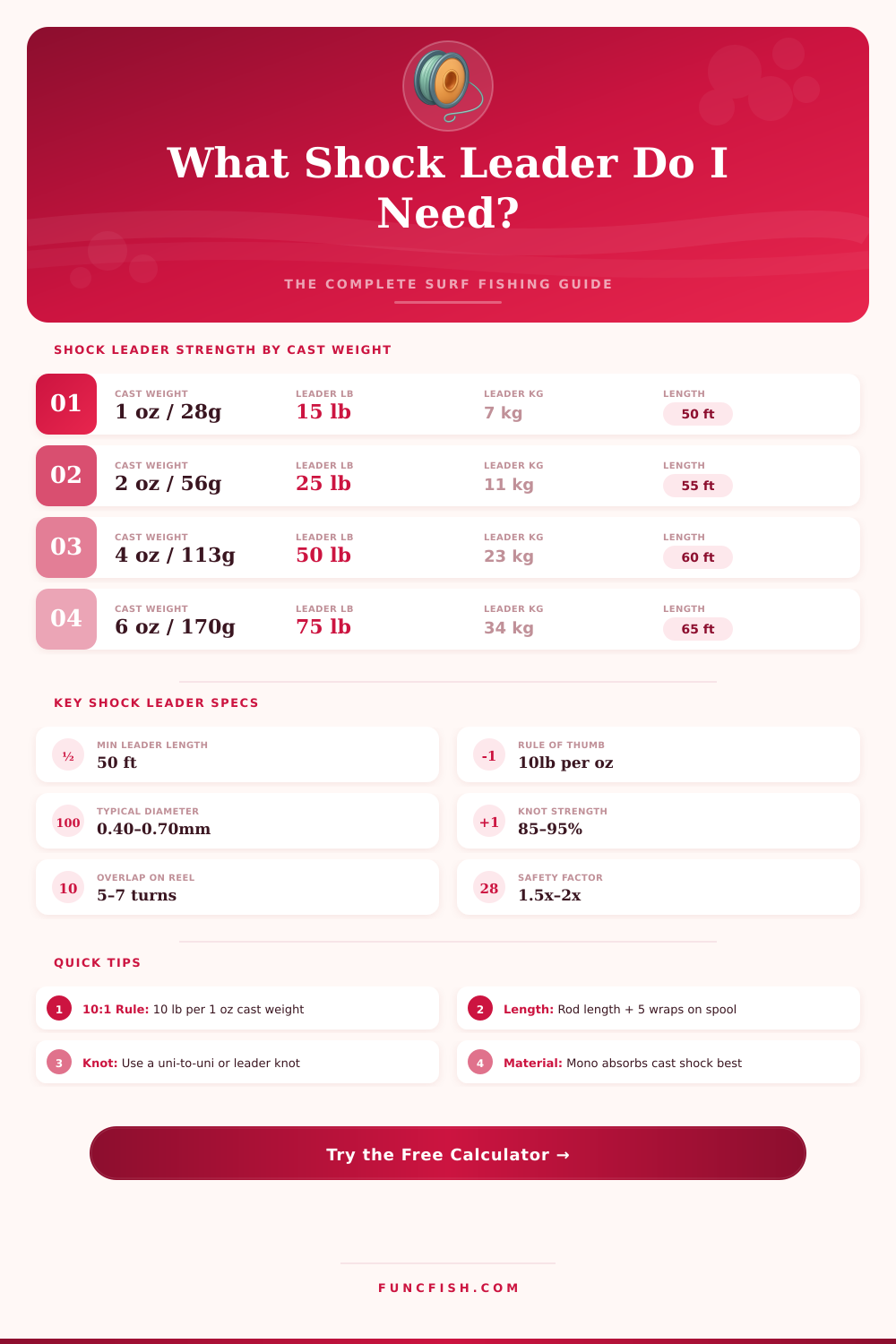
| Sinker Weight (oz) | Sinker (g) | Min Leader (lb) | Min Leader (kg) | Leader Diameter (mm) |
|---|---|---|---|---|
| 1 oz | 28 g | 15 lb | 6.8 kg | 0.35–0.40 mm |
| 2 oz | 57 g | 25 lb | 11.3 kg | 0.45–0.50 mm |
| 3 oz | 85 g | 35 lb | 15.9 kg | 0.50–0.55 mm |
| 4 oz | 113 g | 50 lb | 22.7 kg | 0.55–0.60 mm |
| 5 oz | 142 g | 60 lb | 27.2 kg | 0.60–0.65 mm |
| 6 oz | 170 g | 75 lb | 34.0 kg | 0.65–0.70 mm |
| 8 oz | 227 g | 100 lb | 45.4 kg | 0.70–0.80 mm |
| 10 oz | 283 g | 120 lb | 54.4 kg | 0.80–0.90 mm |
| Target Species | Typical Weight | Sinker Size | Leader Strength | Leader Material |
|---|---|---|---|---|
| Whiting | 0.5–1.5 kg | 1–2 oz | 15–20 lb | Mono / Fluoro |
| Bream | 0.5–2 kg | 2–3 oz | 20–30 lb | Fluoro |
| Flathead | 1–5 kg | 2–4 oz | 25–50 lb | Mono / Fluoro |
| Snapper (shore) | 2–8 kg | 3–5 oz | 40–60 lb | Hard Nylon |
| Striped Bass | 3–15 kg | 3–6 oz | 40–80 lb | Mono |
| Mulloway / Jewfish | 5–20 kg | 4–8 oz | 60–100 lb | Hard Nylon |
| Cod (rock) | 3–12 kg | 5–10 oz | 80–120 lb | Mono / Wire |
| Shark (shore) | 10–50+ kg | 6–10 oz | 100–200 lb | Wire / Coated |
| Material | Stretch | Abrasion Resist. | Visibility | Best Use |
|---|---|---|---|---|
| Monofilament | High (20–30%) | Good | Low–Medium | General surf casting |
| Fluorocarbon | Low (3–5%) | Excellent | Very Low | Clear water, wary fish |
| Hard Nylon | Low (8–12%) | Excellent | Medium | Rocky terrain, abrasion |
| Copolymer | Medium (12–18%) | Very Good | Low | Versatile all-rounder |
| Coated Braid Leader | Very Low (<2%) | Good | Medium | Tournament casting |
| Nylon-Coated Wire | None | Excellent | High | Toothy species |
| PVDF Fluorocarbon | Very Low (2–4%) | Outstanding | Near-Zero | Finesse & rocky ledges |
| Lead-Core Specialist | Low | Very Good | Medium | Deep rock ledges |
A shock leader is a specific section of fishing line that are attached to the main line. Furthermore, this section is design to absorb the physical stress that a heavy weight creates when casting. When a person cast a heavy sinker, the sinker creates a high amount of forces that is exerted on the tip of the fishing rod.
This force can often snap the main line of the fishing rod. To prevent this from occurring, angler use a shock leader. Shock leaders are thicker and more strong than the main line of a fishing rod.
How to Choose and Use a Shock Leader
Additionally, the shock leader act as a buffer between the heavy sinker and the main line of the fishing rod. The weight of the sinker that anglers use can have a significant impact on the shock leader that is attached to the fishing rod. For instance, if anglers use a light sinker, then only a thin shock leader are required.
However, if the sinker that anglers use are heavy, then the shock leader will have to be thick and strong. The style of the cast that anglers use will impact the shock leader because different casting style create different amounts of force on the shock leader. For instance, a pendulum cast will create more force on the shock leader then an overhead cast.
Thus, a shock leader that is cast in a pendulum cast will require more breaking strength. Additionally, the length of the fishing rod that anglers utilize will have an impact on the length of the shock leader that is use. Long fishing rods will require longer shock leaders so that the knots does not get jammed in the guides of the fishing rod.
Another factor that will impact the type of shock leader that anglers use is the environment in which they will fish. For instance, if anglers are fishing in sandy areas, then a slimmer shock leader can be used. However, if the anglers are fishing in area near rocks or reefs, then the shock leader will need to be thicker to prevent it from getting caught on these rocks.
When fishing lines get caught on rocks, this is known as abrasion. If fishing lines are subject to abrasion, the shock leader will break. Lastly, the materials that are used for shock leaders has specific benefits that make them desirable by anglers.
For instance, monofilament shock leaders will stretch more than other shock leaders and absorb some of the shock that is created when the anglers cast their lines. Fluorocarbon shock leaders will resist abrasion but will be thicker at the knots thus requiring more length for the shock leader to pass through the guides of the fishing rod. The knots used for attaching the shock leader to the main line are important.
Anglers must use a slim knot so that the knot pass through the guides of the fishing rod. Any bulky knot may cause the line to snag on the guides. This will eventually reduce the distance that the angler can cast their line.
An FG knot is a slim knot but is often used for braid main line. Additionally, the knot must be tied correct since a poorly tied knot will have less strength than a well tied knot. In determining the strength of the shock leader that an angler should use, there are specific ratio that can be used.
The strength of the shock leader should be two to three times the strength of the main line of the fishing rod. The length of the shock leader should be between 1.8 and 2.5 times the length of the fishing rod. By using these ratios and calculations, anglers can ensure that their shock leaders is long enough to allow for a smooth transition between the shock leader and the main line.
Anglers must also consider the diameter of the main line when selecting a shock leader. For instance, if the main line is a thin braid, then the shock leader will have to transition smooth to that thin braid. However, if the main line is a thick monofilament, then the shock leader will have to accommodate the bulk of that monofilament.
Thus, if the diameter of the main line is ignored, there is the potential for the connection between the shock leader and the main line to become a point of failure in the fishing line. Overall, a shock leader is a necessary addition to the fishing rod for those who want to cast heavy weight. Thus, when selecting a shock leader, the weight of the sinker, the style of the cast, the length of the fishing rod, and the environment in which they will be fishing have to be considered.
A shock leader that is selected for heavy sinker must be strong enough to prevent the snapping of the main line. Furthermore, the shock leader must be slim enough to pass through the guides of the fishing rod. By selecting the proper diameter and strength for the shock leader relative to the main line, the angler will be able to increase the distance that they can cast their line and prevent the snapping of their fishing line altogether.