🎣 Wacky Rig Calculator
Find the perfect hook size, weight, and leader length for your wacky rig setup
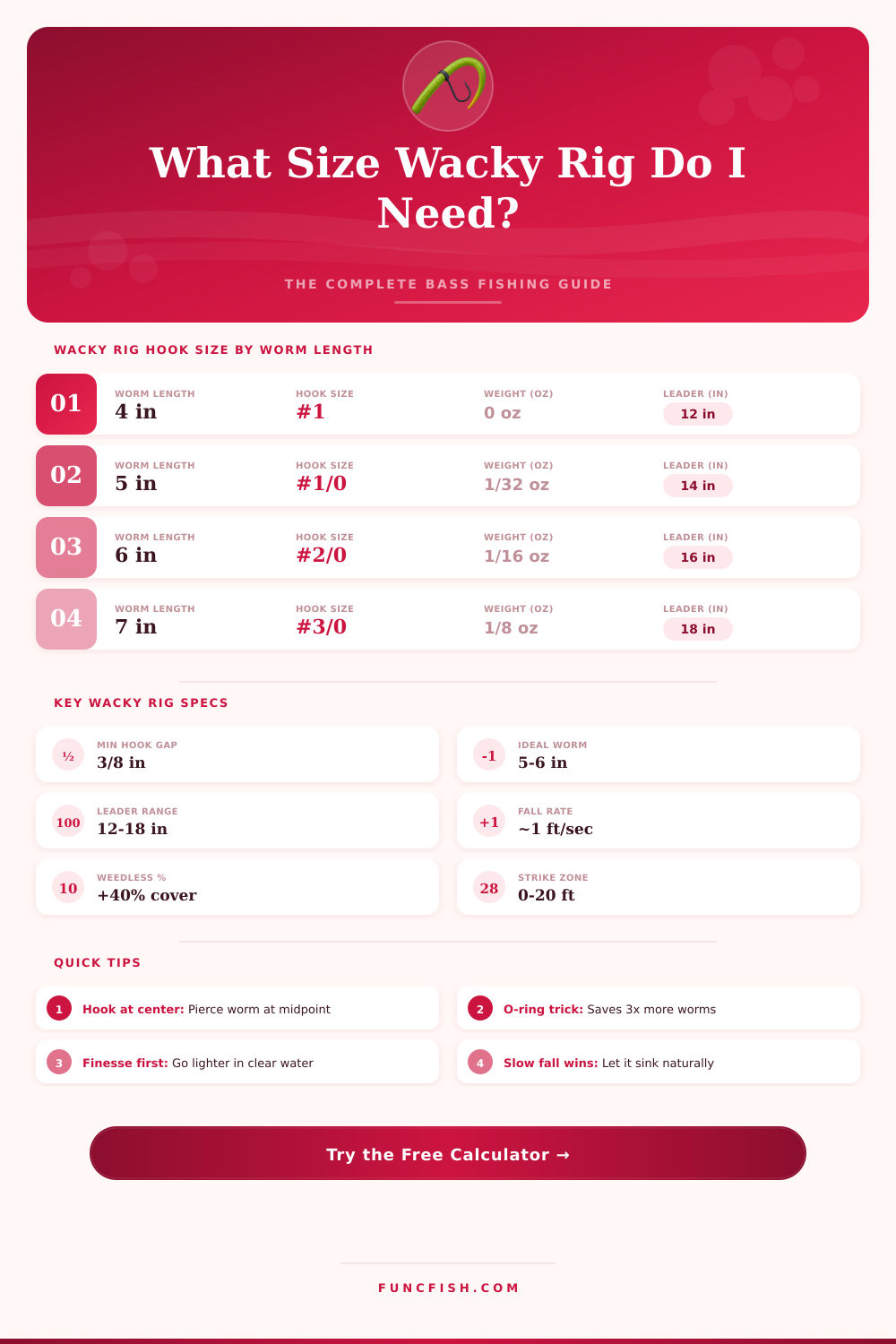
| Worm Length | Hook Size | Hook Gap | Nail Weight | Leader (in) | Line Test |
|---|---|---|---|---|---|
| 3 in (7.6 cm) | #1 | 3/8 in (9.5 mm) | None | 10-12 in | 4-6 lb |
| 4 in (10.2 cm) | #1 | 3/8 in (9.5 mm) | None / 1/32 oz | 12-14 in | 6-8 lb |
| 5 in (12.7 cm) | #1/0 | 1/2 in (12.7 mm) | 1/32 oz (0.9 g) | 14-16 in | 8-10 lb |
| 6 in (15.2 cm) | #2/0 | 5/8 in (15.9 mm) | 1/16 oz (1.8 g) | 15-18 in | 10-12 lb |
| 7 in (17.8 cm) | #3/0 | 3/4 in (19 mm) | 1/8 oz (3.5 g) | 16-20 in | 12-15 lb |
| 8 in (20.3 cm) | #4/0 | 7/8 in (22 mm) | 1/8 oz (3.5 g) | 18-24 in | 14-17 lb |
| 10+ in (25+ cm) | #5/0 | 1 in (25.4 mm) | 3/16 oz (5.3 g) | 20-30 in | 17-20 lb |
| Species | Typical Weight | Worm Size | Hook Size | Line Test |
|---|---|---|---|---|
| Largemouth Bass | 1-8 lb (0.5-3.6 kg) | 5-7 in | #1/0 - #3/0 | 10-15 lb |
| Smallmouth Bass | 1-5 lb (0.5-2.3 kg) | 4-6 in | #1 - #2/0 | 8-12 lb |
| Spotted Bass | 0.5-4 lb (0.2-1.8 kg) | 4-5 in | #1 - #1/0 | 8-10 lb |
| Trout (Rainbow) | 0.5-3 lb (0.2-1.4 kg) | 3-4 in | #1 - #2 | 4-8 lb |
| Walleye | 1-6 lb (0.5-2.7 kg) | 4-6 in | #1 - #2/0 | 8-12 lb |
| Crappie/Panfish | 0.25-1.5 lb (0.1-0.7 kg) | 2-3 in | #4 - #1 | 4-6 lb |
| Pike / Pickerel | 2-15 lb (0.9-6.8 kg) | 6-10 in | #2/0 - #5/0 | 15-20 lb |
| Rig Style | Depth 0-5 ft | Depth 5-15 ft | Depth 15+ ft | Fall Rate |
|---|---|---|---|---|
| Standard Wacky | No weight | 1/32 oz (0.9 g) | 1/16 oz (1.8 g) | ~0.5-1 ft/sec |
| Weedless Wacky | No weight | 1/32 oz (0.9 g) | 1/8 oz (3.5 g) | ~0.5-1 ft/sec |
| Neko Rig | 1/16 oz (1.8 g) | 1/8 oz (3.5 g) | 3/16 oz (5.3 g) | ~1.5-2 ft/sec |
| Shakey Head Wacky | 1/16 oz (1.8 g) | 1/8 oz (3.5 g) | 1/4 oz (7 g) | ~1-1.5 ft/sec |
The wacky rig is a fishing method used to catch bass by utilize a soft plastic worm and a hook. To effective use a wacky rig, a person must ensure that the component of the wacky rig are appropriately matched to the environment in which they is fishing. If the components of the wacky rig are not appropriately matched to the environment, the wacky rig may become snagged on objects in the environment or may sink too quick.
A person must consider several factor when setting up a wacky rig, including the cover density in the area, the diameter of the worm, the strength of the line, the profile of the worm, and the depth of the water. The cover density in the area in which a person is fishing will impact the movement of the wacky rig. If the area includes little cover, a person can use a larger diameter worm because it will flutter for a longer period of time.
How to Set Up a Wacky Rig for Bass Fishing
If the area includes heavy cover, such as branch or grass, a person should use a worm with a smaller profile so that the worm will not get snagged on the cover. The diameter of the worm impacts the sinking of the worm in still water; the thicker the worm, the more slower it will sink in still water. However, thick worms can be more difficult to control in areas where there is movement in the water caused by the wind.
A person should choose the strength of the line according to the environment in which a person is fishing. For instance, a person can use a light line, such as 6-pound test line, for areas where the water are very clear so that the wacky rig will glide naturaly through the water. An alternative to using a light line is to use a heavier line, such as 15-pound test line, which can be used in environments that include wood or other heavy cover.
The profile of the worm should match the size of the hook. For instance, if a person use a slim worm, a person should use a finesse hook with a small gap. For thicker worms, such as ribbed worms, a person should use a hook with a wider gap, such as a 2/0 extra gap hook.
A person must ensure that the hook and worm do not become too crowded with each other; the hook should not interfere with the movement of the worm. If the hook interferes with the worm, the worm will not move natural through the water, and the bass will not bite on the wacky rig. The depth and clarity of the water can determine the fall rate of the wacky rig.
For instance, if a person is fishing for bass around docks, which are typically three to five feet deep, the wacky rig should sink quickly so that it remains in the strike zone for the bass. In areas like flats that are eight to nine feet deep, a slower rate at which the wacky rig falls will help to keep the bait in the strike zone for the fish. In clear water, a person should use a weightless wacky rig or one with inserts that are very light in weight to allow the wacky rig to pause in the water; in murky water with stained water, a person should add a nail weight to the worm to allow the wacky rig to sink natural through the water.
The movement of the water and the movement of the wind will also impact the wacky rig. In still water, a wacky rig will move natural through the water; however, in areas with movement in the water, the wacky rig may require additional weight when it is cast to ensure that it does not drift away from the fishing location. In some instances, a person may use O-rings or bands to compress the body of the worm so that the hook will penetrate the fish more easy.
Additionally, a person can use nail inserts to increase the rate at which the wacky rig moves through grass. A person can use presets for the components of the wacky rig. For instance, in clear water near docks, a person may use a 4.5-inch slim worm on a 1/0 finesse hook.
In areas with heavy cover and stained water, a person may use a 5.5-inch worm on a 2/0 gap hook. These presets are formed based off the physics of the water in which the person is fishing. For instance, a person may input the length and diameter of the worm that they will be using and the depth at which they will be fishing to receive a fit score for the wacky rig.
A high score indicates that the components of the wacky rig are appropriately matched to the fishing environment; a low score suggests that the person should adjust the size of the worm or the size of the hook. The most common mistake with the wacky rig is adding too much weight to the setup too quickly. If the wacky rig tends to roll through the water, it may have a too large hook gap; using a smaller hook gap could help even if the rig is still too heavy.
The next most common mistake is ignoring the line twist. In situations with the wind, using a nail weight is better then a ring that is bulky in size. In other instances, a person should observe the way in which the wacky rig moves when it is cast into the air; if it performs a helicopter motion through the air, a person should use a lighter wacky rig setup.
Youll find that more people makes this mistake than youd think. It could of been avoided if they paid more attention to teh setup.