🎣 Tokyo Rig Calculator
Calculate ideal weight, leader length, hook size & line strength for your Tokyo Rig setup
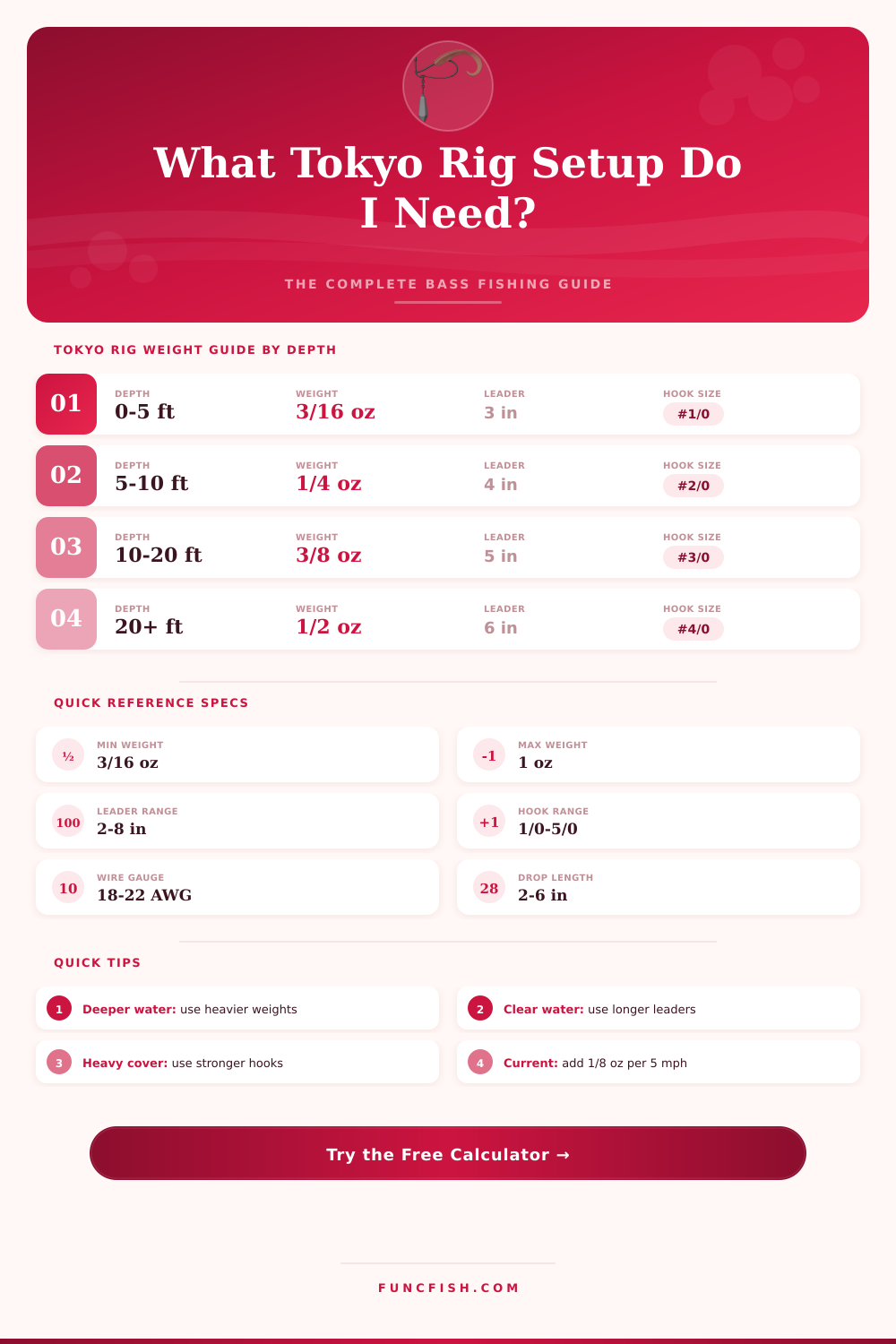
| Depth | No Current | Mild Current | Strong Current | Metric (No Current) |
|---|---|---|---|---|
| 0–5 ft | 3/16 oz | 1/4 oz | 3/8 oz | 5.3 g |
| 5–10 ft | 1/4 oz | 3/8 oz | 1/2 oz | 7.1 g |
| 10–15 ft | 3/8 oz | 1/2 oz | 3/4 oz | 10.6 g |
| 15–20 ft | 1/2 oz | 5/8 oz | 3/4 oz | 14.2 g |
| 20–30 ft | 5/8 oz | 3/4 oz | 1 oz | 17.7 g |
| 30+ ft | 3/4–1 oz | 1 oz+ | 1.5 oz+ | 21.3+ g |
| Species | Typical Weight | Hook Size | Weight (oz) | Leader (in) | Line (lb) |
|---|---|---|---|---|---|
| Largemouth Bass | 1–8 lb | 3/0–4/0 | 3/16–1/2 | 3–5 | 12–20 |
| Smallmouth Bass | 0.5–4 lb | 2/0–3/0 | 1/8–3/8 | 3–4 | 8–15 |
| Walleye | 1–6 lb | 1/0–2/0 | 1/4–3/8 | 4–6 | 8–14 |
| Pike / Muskie | 3–25 lb | 4/0–6/0 | 3/8–3/4 | 5–8 | 20–50 |
| Catfish | 2–30 lb | 4/0–6/0 | 1/2–1 | 4–6 | 20–40 |
| Striped Bass | 3–40 lb | 4/0–6/0 | 1/2–1 | 5–8 | 20–50 |
| Trout | 0.25–3 lb | 1–1/0 | 1/16–3/16 | 2–4 | 4–10 |
| Panfish | 0.1–1 lb | Size 1–1/0 | 1/16–1/8 | 2–3 | 2–6 |
| Line Type | Sensitivity | Stretch | Abrasion Resistance | Best Use |
|---|---|---|---|---|
| Braided (30 lb) | Excellent | None (0%) | Moderate | Deep water, heavy cover |
| Fluorocarbon (15 lb) | Very Good | Low (2–4%) | Excellent | Clear water, rocky bottom |
| Monofilament (12 lb) | Good | High (15–30%) | Good | Open water, finesse |
| Braid + Fluoro Leader | Excellent | Very Low | Excellent | Most Tokyo rig scenarios |
A Tokyo rig is a fishing setup that use a weight and a hook that are connected by a short wire leader. The purpose of the Tokyo rig is to keep the bait hovering above the bottom of the water column so that the bait does not get snagged on any cover that may be on the bottom of the water column. Many traditional fishing rigs cause the bait to drag along the bottom of the water column, which can cause the bait to get snagged on grass, wood, or rocks.
The Tokyo rig prevents the bait from getting snagged because the weight of the rig sits below the bait on the hook. When the fisherman casts the rig into the water, the weight hits the bottom of the water column first, and the bait remains suspended above the weight. The length of the wire leader for a Tokyo rig is important, and the fisherman should adjust the length of the wire leader according to the types of cover that is present in the water.
How to Set Up a Tokyo Rig
If the wire leader is too short, the bait will hit the bottom of the water column as soon as the weight of the rig hits the bottom, and the bait can get snagged on the bottom. If the wire leader is too long, the bait will swing back and forth in a pendulum fashion when the fisherman retrieve the rig, and the bait will get snagged on the stems of plants or on the pebbles on the bottom of the water column. If the water column features alot of grass or dock limbs, the fisherman should use a short wire leader that is two to three inches in length.
In areas of the water that have rocks or shells on the bottom, the fisherman can increase the length of the wire leader to allow the bait to have more movement in relation to the bottom without continually hitting it with the bait. The type of bait that is used for a Tokyo rig should be matched to the type of hook that is used for the rig. If the bait that is used for the rig is chunky and has appendages, the gap of the hook should be wide to allow the hook to easily penetrate the bait.
If the bait that is used for the rig is a slim worm, the point of the hook should be tight to allow the hook to easily penetrate the bait. If the bait and hook do not match, the hook will not be able to hook the fish properly. An ineffective hook will result in lost fish.
Additionally, another important factor for a Tokyo rig is the rig’s ride height. This is the distance between the hook and the weight. Buoyant bait such as swimbaits need to have a higher ride height so that the bait will not hit on the shell on the bottom.
However, frogs will have a better chance of successfully finding the bottom of the water with a lower ride height to pass through the thick vegetation mats on the bottom. Other factors that can impact the effectiveness of a Tokyo rig is the condition of the water and the type of material that the weight of the rig is made out of. In still water, a fisherman can use lighter weights such as a quarter ounce.
However, in water where there is movement caused by tides and winds, the weight of the rig must be heavier to ensure that the weight of the rig will land on the bottom of the water column. The movement of the water will otherwise displace the weight of the rig. Tungsten is a type of material that can be used to make the weight of the rig because its small profile in the water allows the rig to sneak up on fish without making too much noise.
However, lead will make more noise as it moves through the water. Steel is very durable so that the weight will not get damaged as it comes in contact with rocks in the water. Many fisherman make the mistake of becoming too complicated in the setup of their Tokyo rigs by using the same type of weight for every type of fishing situation.
For example, many fisherman will use a half ounce weight for their Tokyo rigs in all situations. However, the weight that is used will vary with the depth of the water and the type of bait that is being used for the rig. For instance, if the fisherman is fishing in an area of the river that is known to have lots of grass, the three-eighths ounce weight with a two-and-a-half inch wire leader can be used.
In contrast, in an area of the water that is eighteen feet deep and has strong currents, a five-eighths ounce weight with a four inch wire leader will be used. Different species of fish require the adjustment of a Tokyo rig according to the habitat in which the different types of fish live. For instance, because largemouth bass live in areas with lots of grass and docks, the wire drop for the bait should be heavier to allow the bait to remain free of the grass.
Smallmouth bass live in areas with rocks so a shorter wire leader will allow the fisherman to feel the pebbles on the bottom of the water. Pike and snakehead fish have teeth so the fisherman should use stout hooks with wide gaps for the bait to avoid damaging the bait by the teeth of the fish. The type of cover that is in the water should be considered first when rigging a Tokyo rig.
The type of cover will dictate the type of weight and wire leader that is used in the rig. If the rig is continually snagging on grass, the fisherman should shorten the wire leader by half an inch before the weight is adjusted. Shortening the wire leader will stop the snags caused by the grass much more effectively than changing the weight of the rig.
By following these steps when rigging a Tokyo rig, the Tokyo rig will allow the bait to remain above the weight of the rig and to move through the water without continually getting snagged on any cover.