
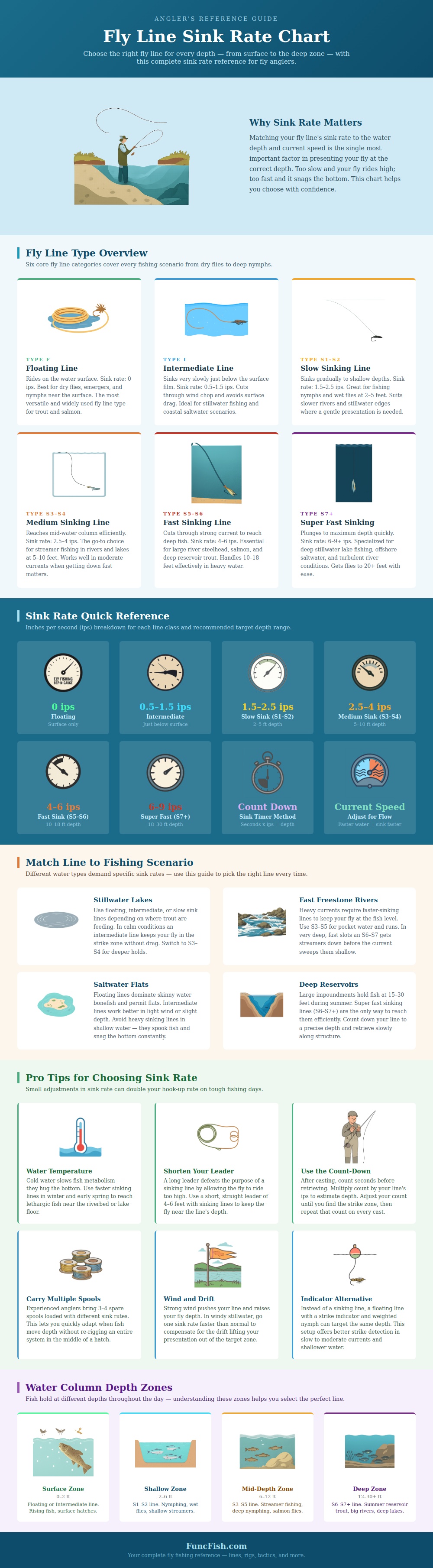
A sink rate mismatch happen when the sink rate of a fly fishing lines does not match the depth of the fish that is present in the water. A sink rate mismatch can happen due to the line sinking too slow or too quickly. If the sink rate of a fly fishing line is too slow, then the fly will remain too high within the water column.
Additionally, if the sink rate are too fast, the fly will travel too deep into the water column. In order to ensure that the line and fly reaches the fish, it is necesary to match the sink rate of the line to the depth of the water and the position of the fish. Floating lines is designed to remain on the surface of the water.
Match Line Sink Rate to Fish Depth
These lines are helpful when the fish are staying near the surface of the water and when dry fly are used to target the fish. Intermediate lines are designed to sink just below the surface of the water. These lines are helpful in situations where wind may be moving the fishs line, and when streamers are to be used to target fish in the area with subtle currents near the surface of the water.
Sinking lines are designed to reach the deeper portion of the water. Lines that sink slow are used to target nymphs in water with moderate currents. Lines that sink to the middle of the water are used in areas with moderate currents to target streamers.
Fast sinking lines and super fast sinking lines is used to target fish in areas with heavy currents. These lines will allow the line to quickly reach areas where fish may be near ledge or the bottom of a water reservoir. The speed of the currents in the water will impact the sink rate of the line.
In areas with fast currents, the forces of the water will push the line upstream. This will cause the line to bow out of the water, which will raise the position of the fly within the water column. To compensate for this, the angler should of utilized a sink rate that is more faster than the rates used in areas with calm water.
The count-down method can be used to determine the depth of the fly. With the line cast and paused, the angler will count the number of second between pausing the line and retrieving it. Multiplying this number by the inches per second rates of the fly fishing line will provide the angler with the depth of the fly.
The temperature of the water impact the depth of the fish within the water column. In cool water, the fish will be near the bottom of the water column. A fast sinking line will be used to target these fish.
In warm summer water, the fish will tend to move to deeper portion of the water. In this instance, a fast sinking line will once again be used. In shallow water, such as flats, only floating line will be used to avoid snagging on coral or startling the fish.
Using multiple spools on a fly fishing rod allows the angler to have various type of lines. Each rod will have one spool with a floating line, a second spool with an intermediate line, and the third spool will have various sinking lines. This will allow the angler to quickly change lines according to the condition in the area where fishing will occur.
Using indicators with a floating line will allow weighted nymph to be targeted in shallow areas. However, this will reduce the angler ability to control the depth at which the fly travel in the water. The water column can be divided into different zone.
The area near the surface of the water is where fish will rise to eat. Shallow waters are where fish will eat nymphs. The middle of the water column is where streamers can be targeted.
Deep waters are where the fish will be located at depth in the water column. A specific type of line should be used based on the depth at which the fish reside. By ensuring that the sink rate of the line match the zone where the fish are located, anglers will find that the line can reach the fish more effective.