🧊 Ice Auger Size Calculator
Find the perfect auger diameter for your target species — instant imperial & metric results
15.2 cm
20.3 cm
25.4 cm
30.5 cm
| Species | Avg. Girth (in / cm) | Min. Hole (in / cm) | Rec. Auger Size |
|---|---|---|---|
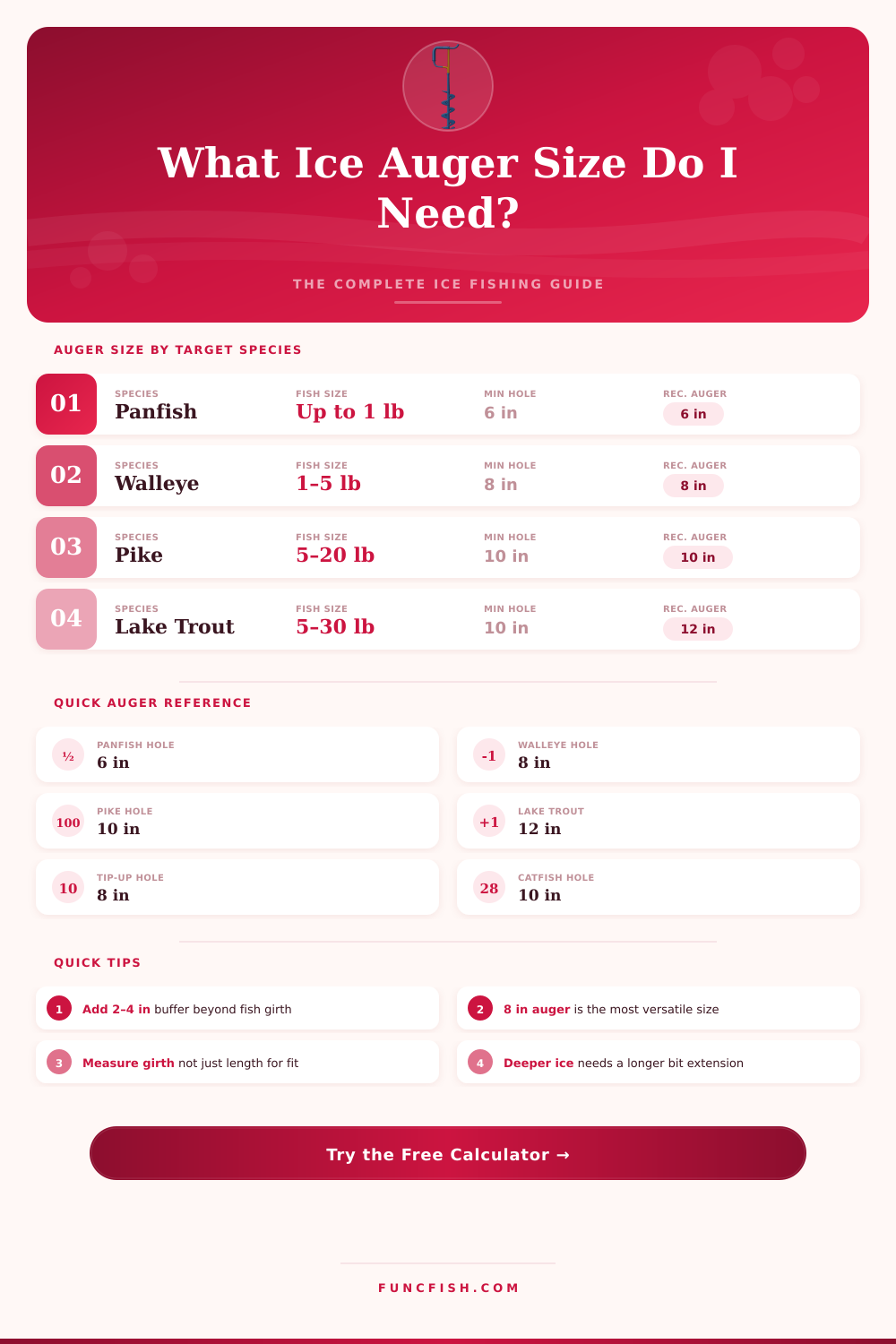
| Bluegill | 5–7 in / 13–18 cm | 6 in / 15 cm | 6 in (15 cm) |
| Crappie | 6–8 in / 15–20 cm | 6 in / 15 cm | 6 in (15 cm) |
| Yellow Perch | 5–8 in / 13–20 cm | 6 in / 15 cm | 6 in (15 cm) |
| Walleye | 9–13 in / 23–33 cm | 8 in / 20 cm | 8 in (20 cm) |
| Largemouth Bass | 12–16 in / 30–41 cm | 8 in / 20 cm | 8–10 in (20–25 cm) |
| Rainbow Trout | 10–14 in / 25–36 cm | 8 in / 20 cm | 8 in (20 cm) |
| Lake Trout | 14–20 in / 36–51 cm | 10 in / 25 cm | 10–12 in (25–30 cm) |
| Northern Pike | 12–18 in / 30–46 cm | 10 in / 25 cm | 10 in (25 cm) |
| Chinook Salmon | 16–22 in / 41–56 cm | 10 in / 25 cm | 10–12 in (25–30 cm) |
| Muskellunge | 18–24 in / 46–61 cm | 12 in / 30 cm | 12 in (30 cm) |
| Auger Type | Max Diameter | Best Ice Thickness | Holes / Charge or Tank |
|---|---|---|---|
| Hand Auger | Up to 8 in (20 cm) | Up to 12 in (30 cm) | Unlimited (manual effort) |
| Electric Auger | Up to 10 in (25 cm) | Up to 24 in (61 cm) | 40–80 holes per charge |
| Gas / Power Auger | Up to 12 in (30 cm) | 36+ in (91+ cm) | 100+ holes per tank |
| Manual Lathe Drill | Up to 6 in (15 cm) | Up to 10 in (25 cm) | Unlimited (manual effort) |
| Diameter (in) | Diameter (cm) | Hole Area (sq in) | Best Use Case |
|---|---|---|---|
| 4 in | 10.2 cm | 12.6 sq in | Tip-up guides, small panfish |
| 6 in | 15.2 cm | 28.3 sq in | Panfish, crappie, perch |
| 8 in | 20.3 cm | 50.3 sq in | Walleye, bass, trout — all-purpose |
| 10 in | 25.4 cm | 78.5 sq in | Pike, salmon, lake trout |
| 12 in | 30.5 cm | 113.1 sq in | Muskie, very large lake trout |
When you choose an ice auger, you must consider three main features: the diameter of the auger, the length of the auger, and the power of the auger. You must choose the correct diameter for the types of fish that you are trying to catch. You must also choose the correct length of the ice auger based off the thickness of the ice.
Additionally, you must choose the correct power of the motor to the size of the auger so that the motor can turns the auger without stopping. The diameter of the ice augers will depend on what type of fish you are trying to catch. For instance, panfish will fit through a five-inch hole, so a five inch ice auger will be sufficient to catch panfish.
How to Choose the Right Ice Auger
Walleye will require a six-inch auger so that the fish has enough room to move there line as they swim through the hole in the ice. Pike will require an eight-inch ice auger because the pike fish is much larger and require more room to be landed. For spearing fish, someone recommends an ice auger that is ten inches or larger so that there is enough room for decoys to be placed into the hole in the ice.
Small ice augers is easier to maneuver, and they will produce fewer chips in the ice. However, they may be too small for the fish that you are trying to catch. An oversized ice auger will be more difficult to maneuver because it will create more ice chips with the ice.
Another main factor to consider with ice augers is the texture of the ice. Black ice is clear and will be easy to cut with an ice auger because the ice will offer very little resistance to the bit of the auger. However, if the ice is in slush it will be more difficult to cut because the slush can enter the ice auger and the slush can begin to climb the shaft of the auger.
In these instances, you will need to use an auger with a longer shaft so that the slush does not enter the ice auger. Additionally, if the ice is layered it will be more difficult to cut because the ice is of vary thickness. Using a wider ice auger will assist in cutting the layers of thick ice.
If the ice is covered in snow, this will add to the weight of the ice and can make it more difficult to operate the ice auger. The power of the motor will need to be strong enough to turn the bit of the auger through the ice. An eighteen volt drill will be lighter and better for small diameters but the batteries will drain quickly when using an 18 volt drill to cut large holes in slush ice.
Forty volt augers will have more power to cut larger holes in the ice. A gas powered auger will create even more power to cut large holes in the ice. If the power of the motor is too low for the size of the auger bits, the motor will struggle to turn the bit in the ice and may fail altogether.
In addition to the features of the ice auger, the handles of the auger must have enough clearance to allow the user to maneuver the handles without touching the slush with there hand. If the handles of the ice auger do not provide enough clearance to avoid contact with the slush, the user will have to kneel in the slush to use the auger. Additionally, the length of the ice auger must be longer than the thickness of the ice that is present.
If someone is to use the auger in slush ice, it is also recommended to provide extra length to the ice auger. Depending on the time of year and the type of fish that you are targeting, there are different uses of ice augers. For instance, in the early season, using a small ice auger will allow you to quick scout the area for fish.
In the middle of the winter, using a six-inch ice auger will allow you to catch walleye. When using an ice auger, make sure that it is well matched to the power source. For example, a six-inch ice auger with a strong battery will be better then an eight-inch ice auger with a weak battery.
Lastly, warming the bit of the ice auger prior to use will make it easy for the bit to shed slush trapped within the ice. You should of checked the bits size first. Its important to have the right tool for the job so you dont have a bad time out there.