Red Snapper Weight Calculator
Estimate red snapper weight from total or fork length, girth, body depth, reef zone, depth band, body condition, and measurement confidence, then match a practical rig and line class.
1 Reef Snapper Presets
2 Measurements and Reef Context
Red Snapper Estimate
Full Calculation Breakdown
3 Snapper Formula Reference
Length Curve
Reef Girth
Body Depth
Confidence
4 Reference Tables
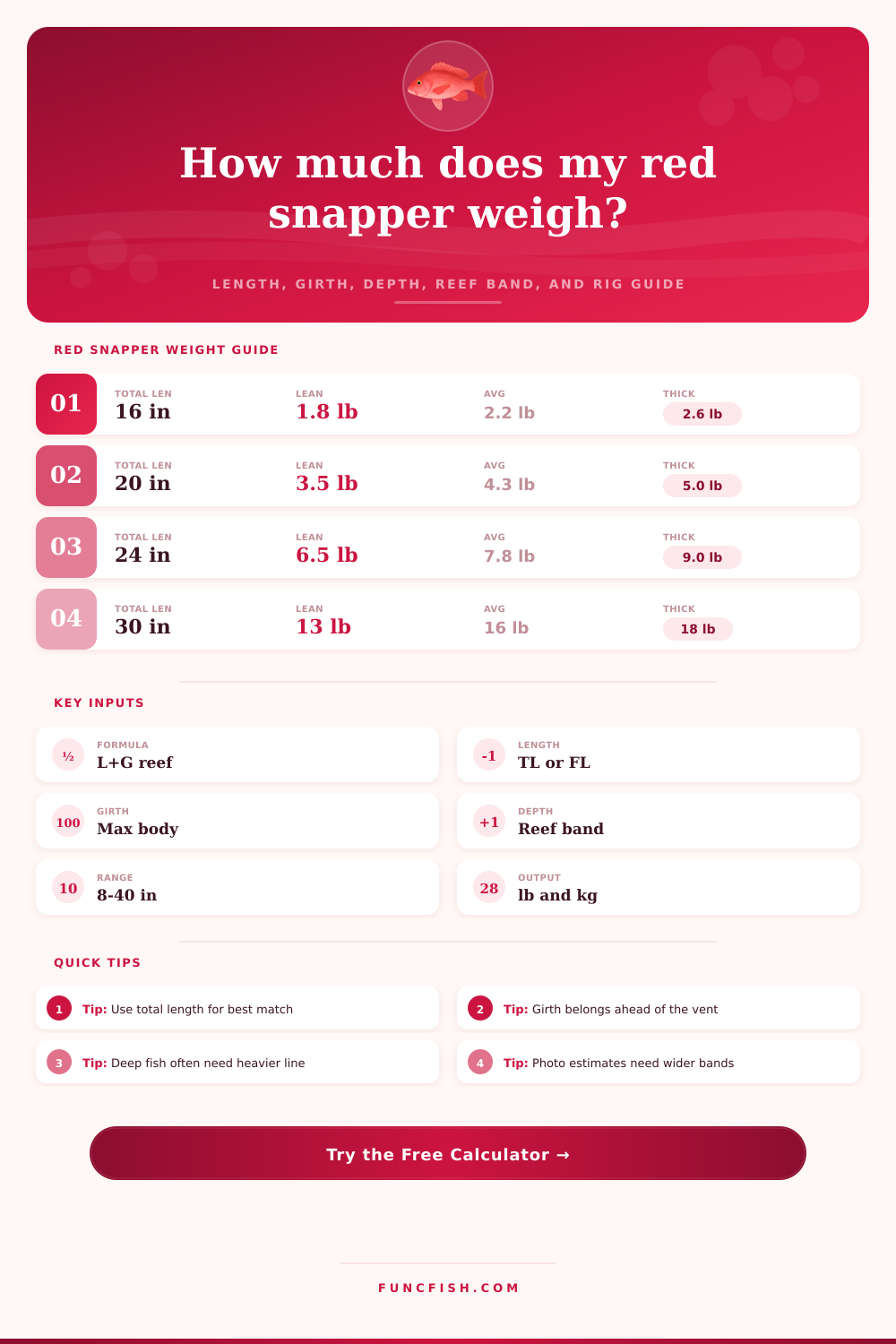
| Total length | Typical girth | Average weight | Heavy shape |
|---|---|---|---|
| 14 in / 36 cm | 9.2 in / 23 cm | 1.5 lb / 0.7 kg | 1.8 lb / 0.8 kg |
| 18 in / 46 cm | 12.0 in / 30 cm | 3.1 lb / 1.4 kg | 3.7 lb / 1.7 kg |
| 22 in / 56 cm | 14.7 in / 37 cm | 5.9 lb / 2.7 kg | 6.9 lb / 3.1 kg |
| 26 in / 66 cm | 17.2 in / 44 cm | 9.7 lb / 4.4 kg | 11.3 lb / 5.1 kg |
| 30 in / 76 cm | 19.8 in / 50 cm | 15.0 lb / 6.8 kg | 17.5 lb / 7.9 kg |
| 34 in / 86 cm | 22.4 in / 57 cm | 22.2 lb / 10.1 kg | 25.9 lb / 11.7 kg |
| Reef zone | Depth band | Weight effect | Gear note |
|---|---|---|---|
| Sand patch | 20-60 ft / 6-18 m | Slightly lighter | Light leader works when relief is low |
| Patch reef | 40-100 ft / 12-30 m | Neutral baseline | Use abrasion margin around rock |
| Natural ledge | 60-160 ft / 18-49 m | Thicker average | Fast first-turn pressure helps |
| Wreck | 80-220 ft / 24-67 m | Heavy shoulders | Leader class rises for structure |
| Deep reef edge | 180-350 ft / 55-107 m | More variable | Braid and heavier sinker control matter |
| Weight class | Main line | Leader | Hook or jig range |
|---|---|---|---|
| Under 4 lb / 1.8 kg | 15-20 lb braid or mono | 20-30 lb fluoro | 2/0-4/0 circle or 60-100 g jig |
| 4-8 lb / 1.8-3.6 kg | 20-30 lb braid | 30-40 lb fluoro | 4/0-5/0 circle or 100-150 g jig |
| 8-15 lb / 3.6-6.8 kg | 30-40 lb braid | 40-50 lb fluoro | 5/0-7/0 circle or 150-220 g jig |
| 15-25 lb / 6.8-11.3 kg | 40-50 lb braid | 50-60 lb fluoro | 7/0-8/0 circle or 220-300 g jig |
| 25 lb+ / 11.3 kg+ | 50-65 lb braid | 60-80 lb fluoro | 8/0-10/0 circle or 300 g+ jig |
| Measurement style | Best input | Expected spread | Use case |
|---|---|---|---|
| Careful tape with girth | TL, girth, body depth | About +/- 8% | Deck tape before icing |
| Good length and fair girth | TL plus approximate girth | About +/- 11% | Fast crew estimate |
| Quick deck measurement | Length and condition | About +/- 14% | Moving boat or rough tape |
| Photo or rail estimate | Scaled length only | About +/- 22% | Photo comparison or memory |
This tool estimates weight from shape measurements only and keeps the output focused on fish size, rig class, and line matching.
5 Rig Comparison Grid
Knocker Rig
Compact bottom setup for moderate relief and quick bait control.
Fish Finder Rig
Sliding sinker rig for larger bait and natural presentation over reef.
Vertical Jig
Best when depth, current, and sonar marks favor metal presentation.
Heavy Wreck
Shorter leader and higher drag margin when structure is close.
6 Measurement Tips
Length and girth tip: Red snapper weight changes quickly with girth. If the fish is arched, straighten the tape line and mark the confidence as quick or photo rather than forcing a precise number.
Gear matching tip: The line recommendation is structure adjusted. A 10 lb fish over a clean sand patch can use lighter leader than the same fish beside wreckage or a sharp ledge.
In order to accurately estimate the weights of a red snapper, you need to take a look at several different measurements. The length of the red snapper is a start in determining its weight, but not the best starting point. The girth of the red snapper is often the most important measurement in determining its weight.
Many peoples makes the mistake of only measuring the length of the red snapper. This can result in inaccuracies in the weight estimations because a red snapper with a thick body will weigh more then a red snapper with a thin body of the same length. In order to estimate the weight of a red snapper, you must measure several different aspect of the red snapper.
How to Estimate the Weight of a Red Snapper
First, you can measure the length of the red snapper from the nose to the tip of its tail. In addition to the length measurement, you can also measure the fork length of the red snapper, which is the distance from the nose to the fork in the tail. Fork length is always shorter than total length, however.
You should also measure the girth of the red snapper, which is the distance around the red snapper at its thickest part in the area ahead of the vent. The weight of the red snapper come primarily from the body area from the snappers belly to its chest. Finally, you should also measure the body depth of the red snapper, which is the distance from the back of the red snapper to its belly, but measured in a straight line; the dorsal fin should be ignored in this measurement.
In some cases, the environment in which a red snapper lives will change the shape and size of the red snapper, which changes the estimation of its weight. For instance, red snapper species that live in shallow water and sandy patches in the ocean is typically leaner than red snapper from deeper waters. Lean red snapper will weigh less than thick red snapper with the same length.
Additionally, red snapper that live near ledges and wrecks are often thicker than red snapper that live in other area of the ocean. This is due to the abundance of food around these ledges and wrecks. Finally, red snapper species that live between depths of 60 and 120 feet has a specific growth pattern due to the abundance of food in these depths.
The type of fishing gear that you use will depend upon the size and the location of the red snapper. If you are fishing for a 10-pound red snapper species in areas with clean bottoms, you will use a lighter fishing leader. However, if your fishing locations are near wrecks, you will need to use a heavier fishing leader with abrasion resistance.
You need this type of fishing leader if you are fishing near wrecks because red snapper may become entangled in the steel or rock structures. Additionally, you can use different type of fishing rigs depending upon the type of red snapper that you are fishing for. For instance, you can use a knocker rig to catch red snapper in shallow waters, while a fish finder rig can be used to catch red snapper near the ledges.
If the red snapper you are catching weigh between 0 and 4 pound, you should of used a 20-pound main line and 2/0 fishing hooks. For red snapper that weigh 25 pounds or more, use a 65-pound braid with 10/0 hooks. There are a few common mistake when estimating the weight of a red snapper.
One of the biggest is focusing only upon the length of the red snapper to calculate the weight. In reality, a red snapper with a full belly can weigh 20% more than a red snapper of the same length but with a thinner body. Additionally, it is a mistake to measure the girth of the red snapper too far to the back of the species.
The weight of the red snapper begins to decrease as the girth measurement moves away from the thickest part of the red snapper. Another mistake is to rush the process of measuring the girth of a red snapper that is in motion on a fishing deck. In these instances, the measurement can be inaccurate, potentially inflating the weight of the red snapper by 30%.
Finally, if the fishing gear that you use isnt strong enough for the red snapper that you are attempting to catch, you will lose the red snapper if it becomes entangled in an underwater ledge.