Fly Reel Line Capacity Calculator
Estimate backing capacity from arbor class, spool width, spool depth, backing diameter, fly line weight, head length, running line, sink tip, and rim margin.
🎣Fly reel presets
⚙Reel and line settings
Fly reel capacity forecast
Full breakdown
📋Arbor and backing quick grid
Small Arbor
Mid Arbor
Large Arbor
XL Arbor
📊Reference tables
| Reel preset | Line wt | Arbor | Width | Depth | Backing target |
|---|---|---|---|---|---|
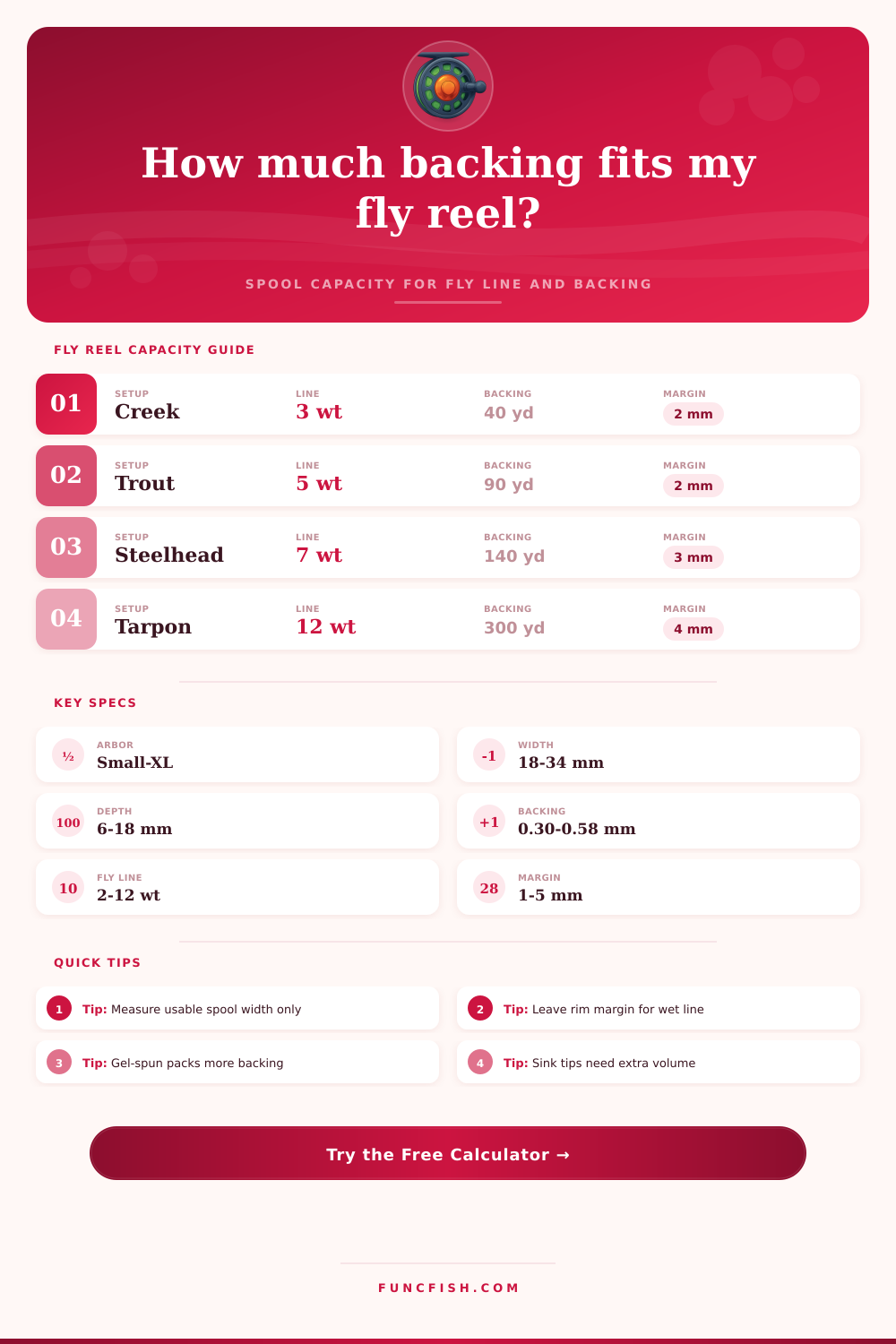
| 3 wt Creek Click | 3 wt | Small | 0.62 in / 15.7 mm | 0.25 in / 6.4 mm | 35-55 yd |
| 4 wt Dry Fly | 4 wt | Mid | 0.75 in / 19.1 mm | 0.30 in / 7.6 mm | 55-75 yd |
| 5 wt Trout WF | 5 wt | Large | 0.95 in / 24.1 mm | 0.38 in / 9.7 mm | 80-110 yd |
| 6 wt Sink Tip | 6 wt | Large | 1.02 in / 25.9 mm | 0.42 in / 10.7 mm | 75-105 yd |
| 7 wt Steelhead | 7 wt | Large | 1.08 in / 27.4 mm | 0.48 in / 12.2 mm | 125-160 yd |
| 8 wt Bonefish | 8 wt | XL | 1.12 in / 28.4 mm | 0.50 in / 12.7 mm | 175-225 yd |
| 8 wt Bass Bug | 8 wt | Large | 1.08 in / 27.4 mm | 0.44 in / 11.2 mm | 90-130 yd |
| 9 wt Pike | 9 wt | Large | 1.15 in / 29.2 mm | 0.52 in / 13.2 mm | 140-180 yd |
| 10 wt Salmon | 10 wt | XL | 1.22 in / 31.0 mm | 0.58 in / 14.7 mm | 180-240 yd |
| 12 wt Tarpon | 12 wt | XL | 1.35 in / 34.3 mm | 0.66 in / 16.8 mm | 250-350 yd |
| Backing type | Diameter | Strength class | Capacity effect | Best reel use |
|---|---|---|---|---|
| 20 lb Dacron | 0.018 in / 0.46 mm | Trout | Baseline | 3-6 wt freshwater |
| 30 lb Dacron | 0.022 in / 0.56 mm | Salt / salmon | About 67% of 20 lb | 7-10 wt |
| 50 lb Dacron | 0.026 in / 0.66 mm | Heavy | About 48% of 20 lb | Big game reels |
| 30 lb gel-spun | 0.012 in / 0.30 mm | Thin | About 225% of 20 lb | Small spools |
| 50 lb gel-spun | 0.015 in / 0.38 mm | Strong thin | About 144% of 20 lb | Saltwater |
| 65 lb gel-spun | 0.017 in / 0.43 mm | Heavy thin | About 112% of 20 lb | Tarpon / tuna |
| Fly line weight | 30 ft grain standard | Typical head dia. | Run line dia. | Common head length |
|---|---|---|---|---|
| 3 wt | 100 grains | 0.035 in / 0.89 mm | 0.026 in / 0.66 mm | 32-40 ft |
| 4 wt | 120 grains | 0.039 in / 0.99 mm | 0.028 in / 0.71 mm | 34-42 ft |
| 5 wt | 140 grains | 0.044 in / 1.12 mm | 0.032 in / 0.81 mm | 38-48 ft |
| 6 wt | 160 grains | 0.049 in / 1.24 mm | 0.034 in / 0.86 mm | 35-45 ft |
| 7 wt | 185 grains | 0.054 in / 1.37 mm | 0.036 in / 0.91 mm | 38-50 ft |
| 8 wt | 210 grains | 0.060 in / 1.52 mm | 0.038 in / 0.97 mm | 38-50 ft |
| 10 wt | 280 grains | 0.070 in / 1.78 mm | 0.043 in / 1.09 mm | 35-45 ft |
| 12 wt | 380 grains | 0.082 in / 2.08 mm | 0.048 in / 1.22 mm | 30-40 ft |
| Reel / backing / line comparison | Spool bias | Backing choice | Fly line load | Capacity warning |
|---|---|---|---|---|
| Small arbor trout | More depth | 20 lb Dacron | WF 3-5 floating | Usually forgiving |
| Large arbor trout | Less depth | 20 lb Dacron | WF 5-6 plus tip | Watch sink tips |
| Steelhead cassette | Wide spool | 30 lb Dacron | 7 wt spey-style head | Bulky heads reduce backing |
| Saltwater large arbor | Fast retrieve | 50 lb gel-spun | 8-10 wt tropical | Thin backing helps |
| Big game XL arbor | Large core | 65 lb gel-spun | 11-12 wt tarpon | Keep larger rim margin |
💡Capacity checks
Tip: Use the narrowest inside spool width, not the outside frame width. Pillared spools and porting can reduce real line volume.
Tip: A sink tip or heavy shooting head can take the same spool volume as several dozen yards of thin gel-spun backing.
When you prepares a fly reel for fishing, you must decide how much backing to put on the fly reel. The amount of backing on a fly reel is a critical detail because the amount of backing determine how much fly line the fly reel can hold. If there is to little backing on a fly reel, the strength of a fish can easily pull the fishing line off of the fly reel and result in a loss of the line.
However, if there is too much backing on a fly reel, the line will be too close to the edge of the fly reel spool; this will make the line feel heavies when the angler begins to cast the line. A fly reel consist of a spool and an arbor. The arbor is the center part of the reel; the spool is the part of the fly reel that hold the line.
How Much Backing to Put on a Fly Reel
The backing and the fly line will fill the space between the arbor and the edge of the spool. There will be different amount of this space on different fly reels. This is due to the width of the spool, the depth of the spool, and the diameter of the arbor.
A small arbor will give more space for the line but will allow for a slower retrieval of the line from the fly reel. Conversely, a large arbor will take up more of the fly reel but allow for a faster retrieval of the line. The diameter of the backing will determine how much length of line can be stored on the fly reel.
If the angler use gel-spun backing, it will allow for more yard of line to be stored on the fly reel than if the angler uses Dacron backing. Gel-spun backing will be of more use to the angler if using a fly reel with a small spool since there is less space for the line. However, if the angler uses gel-spun backing, the gel-spun backing could cut into teh gel-spun backing if it is not wound even under heavy pressure.
Dacron is thicker than gel-spun but more reliable regardless of how the line is wound. The fly line will take up some of the space on the fly reel. A weight-forward floating line have a thick head with the fly line but the rest of the line is thin.
The thick head takes up space on the fly reel but loads the fishing rod with the weight of the line. The thin portion of the line is the portion that connect the head to the backing on the reel. If the angler uses a sink tip or shooting head line, the volume of the line will increase.
This is due to the larger diameter of a sink tip and shooting head. For these reasons, there will be less space for the backing on the fly reel. Another factor that affect how much backing should be placed on a fly reel is the rim margin.
The rim margin is the space between the top of the line on the fly reel and the edge of the fly reel’s spool. There should be a margin of space to allow for the wet fly line to not bind against the edge of the fly reel. Furthermore, there should be enough space for the fly line to swell if it absorb water from the water column.
Many angler will aim for a few millimeter of space to allow for the fly line to not contact the edge of the fly reel. Another factor that go into determining how much backing to load into a fly reel is packing efficiency. Packing efficiency refer to how much line is wound on the fly reel.
If the line is loosely wound on the fly reel, there will be air between the coils of the line. This will result in less total yardage of line on the fly reel. If the line is wound with more even pressure on the line, the packing will be more efficient, and the total yardage will be more.
Temperature will have an effect on the stiffness of the line and the behavior of the sink tip. Stripping the line too fast or in jerky motion will create an uneven layer of line on the fly reel. This will take up some of the total capacity of the fly reel.
Anglers should of check the setup of the fly reel after fishing trip to ensure that the line is wound correctly on the reel. The goal of winding a fly reel is to create a balanced fly reel. A balanced fly reel will have enough backing to ensure that the line does not run out but have enough margin on the rim to ensure the line does not bind to the edge of the fly reel.
The measurement of the spool, the diameter of the backing, the volume of the fly line, and the margin of the rim will allow the angler to calculate the correct amount of backing to load into the fly reel. Once the angler has calculated the volume of the line that should be loaded, they can use their judgment to create the perfect setup for the type of fishing that they will perform.