Trolling Weight Calculator
Estimate trolling weight, line-out adjustment, running depth, and drag load from target depth, speed, line out, lure dive, line diameter, current, lure drag, and species.
📌Trolling presets
⚙Trolling depth and tackle
Trolling weight match
Suggested trolling weight and depth estimate will appear here.
Full breakdown
🧵Trolling rig and species comparison grid
Inline Weight
Snap Weight
Three-Way
Planer
📊Trolling reference tables
| Weight style | Best use | Depth factor | Drag factor | Typical sizes |
|---|---|---|---|---|
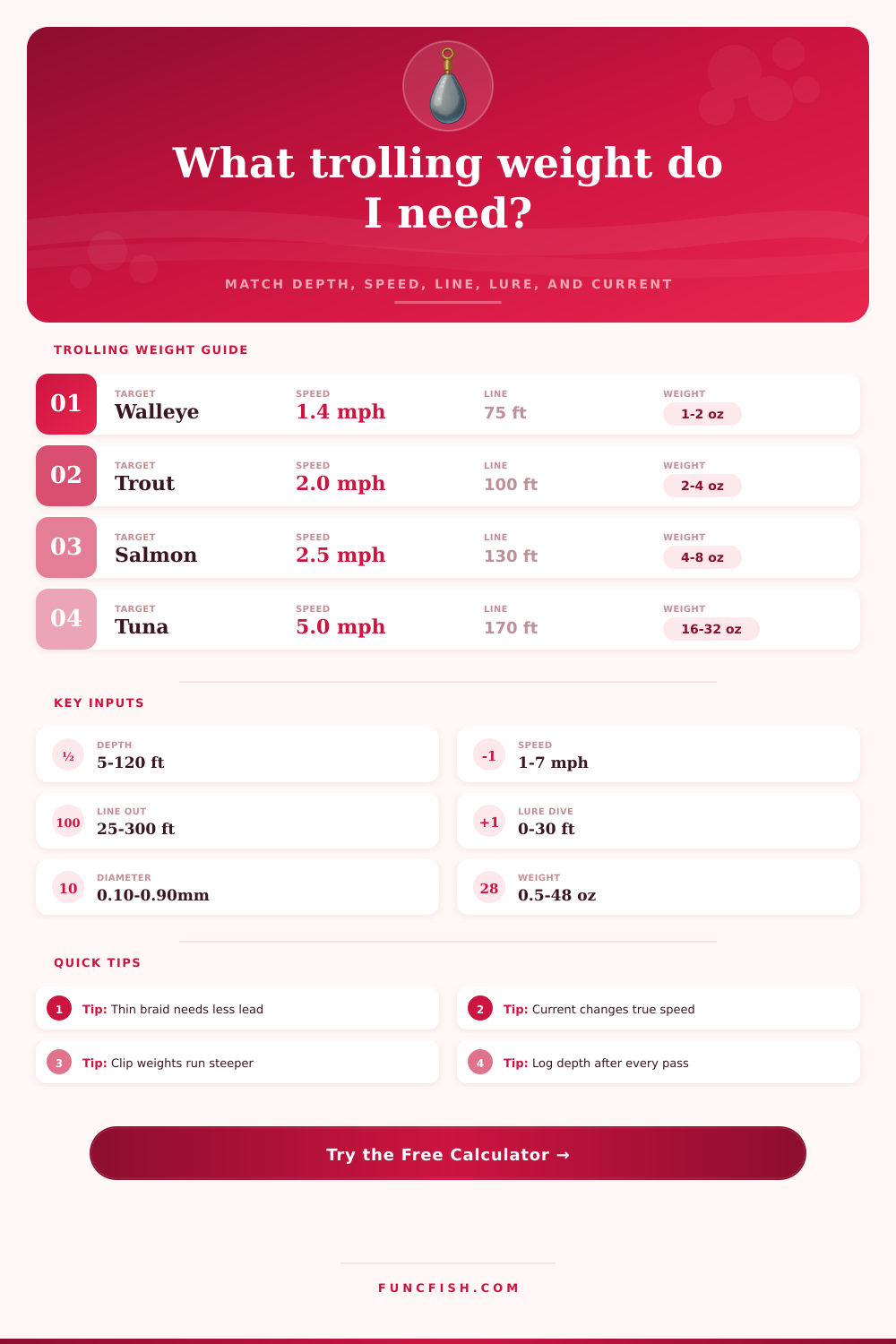
| Inline keel weight | Walleye, trout, shallow structure | 1.00x | 0.92x | 0.5-4 oz / 14-113 g |
| Clip-on trolling weight | Fast depth changes and suspended fish | 1.12x | 1.00x | 1-8 oz / 28-227 g |
| Snap weight | Open-water salmon and crankbait trolling | 1.18x | 1.03x | 2-12 oz / 57-340 g |
| Rubber core weight | Quick fine tuning on mono | 0.92x | 1.05x | 0.5-6 oz / 14-170 g |
| Three-way sinker rig | Precise bottom or contour trolling | 1.25x | 1.10x | 3-16 oz / 85-454 g |
| Mojo / parachute weight | Striper trolling with large profile lures | 0.86x | 1.32x | 8-32 oz / 227-907 g |
| Torpedo trolling weight | Deep salmon and trout presentations | 1.30x | 0.96x | 4-16 oz / 113-454 g |
| Planer / diving plate | High-speed offshore trolling | 1.62x | 1.48x | 12-48 oz / 340-1361 g |
| Species target | Common speed | Depth window | Load window | Useful rig cue |
|---|---|---|---|---|
| Walleye | 1.2-2.2 mph / 1.9-3.5 km/h | 8-35 ft / 2.4-10.7 m | 1-5 oz / 28-142 g | Inline or snap weight |
| Brown / rainbow trout | 1.8-2.8 mph / 2.9-4.5 km/h | 10-60 ft / 3-18 m | 2-8 oz / 57-227 g | Spoon behind keel weight |
| Kokanee | 1.0-1.8 mph / 1.6-2.9 km/h | 10-45 ft / 3-14 m | 0.5-4 oz / 14-113 g | Gentle load protects hooks |
| Great Lakes salmon | 2.0-3.2 mph / 3.2-5.1 km/h | 25-100 ft / 8-30 m | 4-16 oz / 113-454 g | Torpedo or snap weight |
| Lake trout | 1.4-2.4 mph / 2.3-3.9 km/h | 35-120 ft / 11-37 m | 6-20 oz / 170-567 g | Three-way near bottom |
| Striped bass | 2.5-4.0 mph / 4-6.4 km/h | 15-60 ft / 5-18 m | 8-32 oz / 227-907 g | Mojo weight handles profile |
| Tuna | 4.5-7.0 mph / 7.2-11.3 km/h | 10-80 ft / 3-24 m | 12-48 oz / 340-1361 g | Streamlined heavy weight |
| Wahoo | 6.0-10.0 mph / 9.7-16.1 km/h | 10-60 ft / 3-18 m | 16-48 oz / 454-1361 g | Planer carries depth at speed |
| Line material | Diameter drag | Stretch / feel | Depth behavior | Best match |
|---|---|---|---|---|
| Monofilament | Baseline 1.00x | High stretch | More belly at speed | General trolling and forgiving strikes |
| Braid | Low 0.72x | Low stretch | Runs deeper with less weight | Snap weights and long leads |
| Fluorocarbon | Moderate 1.08x | Medium stretch | Slightly dense, clear leader use | Clear-water trout and walleye |
| Wire line | High 1.18x | No stretch | Cuts but loads rod hard | Deep trout and toothy fish control |
| Lead core | Heavy 1.34x | Soft feel | Own sinking rate adds depth | Segmented lake trolling passes |
| Copper trolling line | Very high 1.48x | Low stretch | Strong sink plus heavy drag | Deep salmon and trout spreads |
| Lure drag profile | Drag factor | Depth effect | Common examples | Adjustment note |
|---|---|---|---|---|
| Spoon / fly | 0.82x | Runs clean and deep | Spoons, flies, hoochies | Use lighter weight first |
| Stickbait | 0.96x | Modest dive and pull | Floating minnows | Account for built-in dive |
| Crankbait | 1.10x | Bill adds pull | Shad cranks, minnow baits | Weight may damp lure action |
| Deep diver | 1.26x | High bill resistance | Deep plugs and mag cranks | Use longer lead before more lead |
| Flasher / dodger | 1.42x | Heavy pulse load | Dodger, paddle, flasher fly | Check rod load and release tension |
| Umbrella / spreader | 1.68x | Very high resistance | Umbrella rigs, multi-lure bars | Expect large weights or planers |
| High-speed lure | 0.90x | Streamlined at speed | Jet heads, bullets, wahoo lures | Speed dominates depth demand |
💡Trolling setup checks
Tip: Treat the result as a starting pass, then record the exact weight, line counter reading, speed, current direction, and fish marks that produced bites on your boat.
Tip: If the drag score is high, reach depth with thinner line, a more efficient weight style, or more line out before simply adding heavier lead.
Trolling weight is one of the major components of trolling. The trolling weight that you choose will determine how deep your lure will go. Along with determining the trolling speed and how much line to pay out, anglers must also choose a trolling weight that will allow there lure to reach the location of the fish instead of being moved by choppy waters or the movement of the current.
The math behind calculating the appropriate trolling weight for a given lure and fishing scenario is complex due to the various variables that exists in the water. For instance, spoons will require a different trolling weight when used with braided line as opposed to monofilament line. Crankbaits that dive deep into the water will require a different trolling weight then crankbaits that do not dive as deep into the water.
How to Choose the Right Trolling Weight
Additionally, the speed of the current will alter the actual speed that the lure is travelling through the water. Each of these variables may seem small and insignificant to the fishing operation as a whole, but they do have an impact upon the depth at which the lure is travelling. Before determining the trolling weight that will be employed in the water, there are a variety of other tasks that must be performed.
The depth at which the fish are using the water must be determined. The trolling speed that the target species can best tolerate must be determined. Additionally, the amount of drag that the lure create must be determined.
If using an umbrella or flashermount rig, more weight will be required to pull the lure downward as the rig creates more drag upon the fishing line. If using a slim spoon or a meat bait, less trolling weight will be required as the drag upon the fishing line is less. Additionally, the diameter of the line will impact trolling weight.
If using thicker line, more trolling weight will be required since the thicker line will create more resistance in the water and pull the fishing rig towards the surface. Braided line will create less resistance in the water, but will allow for any surge of the line to be felt at the fishing rod tip. Current direction will also have an impact upon the trolling operation.
If trolling with the current, the line will move at a greater speed through the water than if trolling against the current. Additionally, any cross currents will make the line move laterally through the water. Lastly, wind will push the boat, which may cause the boat speed to read higher on the boats GPS than the actual speed of the fishing line through the water.
Each of these factors will not be seen on a depth chart of the water, but they will impact the depth at which the trolling line run. Current is one of the variables that must be accounted for in the trolling process, and that is done by treating the speed of the lure as the true speed of the fishing operation. The style of the trolling weight can also impact the characteristics of the lure in the water.
For instance, inline keels tend to travel in a relatively clean manner in the water. Snap and clip-on weights allow anglers to change the depth at which the bait travels without having to retie the line to a different weight. Three-way rigs place the sinker closer to the ocean floor, but allow the lure to remain above the sinker.
Which may be beneficial for staying above rocks in the ocean floor. Finally, planers and diving plates use the pressure of the water to determine the depth of the lure in the water, though they do create drag at higher speeds. Each of these trolling weights has one advantage over the others, but also loses some of its advantages in comparison to the other trolling weights.
The species of fish that are targeted may require specific trolling weights and speeds to encourage the fish to bite. For instance, fish species like walleye and trout may require different trolling weights and speeds then species like salmon and lake trout. Salmon and lake trout live in deeper waters than walleye and trout, and they can better tolerate the heavier trolling weights required to move the fishing line to the deep locations in which they live.
Striped bass and tuna are fish species that can better tolerate the larger profiles of the lures that are often used to target these species, but the line and trolling weight must match the size of the lure. The load score is used to determine if the trolling line and trolling weight are correctly set up for the lure that is being used. Low load scores indicate that the fishing line may be fighting the fishing hook, but very high load scores may indicate that the trolling weight is too heavy for the species of fish that is being targeted.
Beyond trolling weight, there are a variety of other considerations for fishing scenarios. The line-out adjustment is one factor that can have a great impact upon trolling success. The amount of line that is paid out will impact the depth of the trolling line.
Anglers can use a calculator to determine the angle at which the line is cast into the water, and the amount of line that should be paid out to reach the desired depth. Though the calculations provide a good estimation of the depth at which the fishing line will run, there are other factors in fishing that cannot be accounted for in the calculation. For instance, water temperature may alter the location in which the fish are traveling through the water.
Additionally, the noise made by the boat or the prop wash created by the boat may also impact the willingness of fish to take the lure. Thus, the calculation behind trolling weight is just a point of starting the trolling process, and not the end of trolling for the fish species that are being targeted. Beyond noting the trolling weight that is used, the trolling speed, and the amount of line that is paid out, anglers should also note the depth at which the fish were spotted.
These notes can then be used to account for specific features of the fishing boat, the line, and the lures that are used when trolling for specific species of fish. Anglers that troll in the same areas and target the same species of fish will eventually begin to recognize what trolling setup works best for specific scenarios. Thus, these written notes become a form of calculator for each individual fisherman.
The mathematical tool will shorten the amount of time that it takes for an angler to make their first guess as to the proper trolling weight. Yet, over time, each angler will develop an internal sense of when a trolling weight is too light or too heavy for a specific species of fish. Thus, each angurator will be able to adjust the lead weight prior to the fish beginning to stop biting.
In this way, each angler will employ trolling weight as a tool with intention.