Mahi Mahi Lifespan Calculator
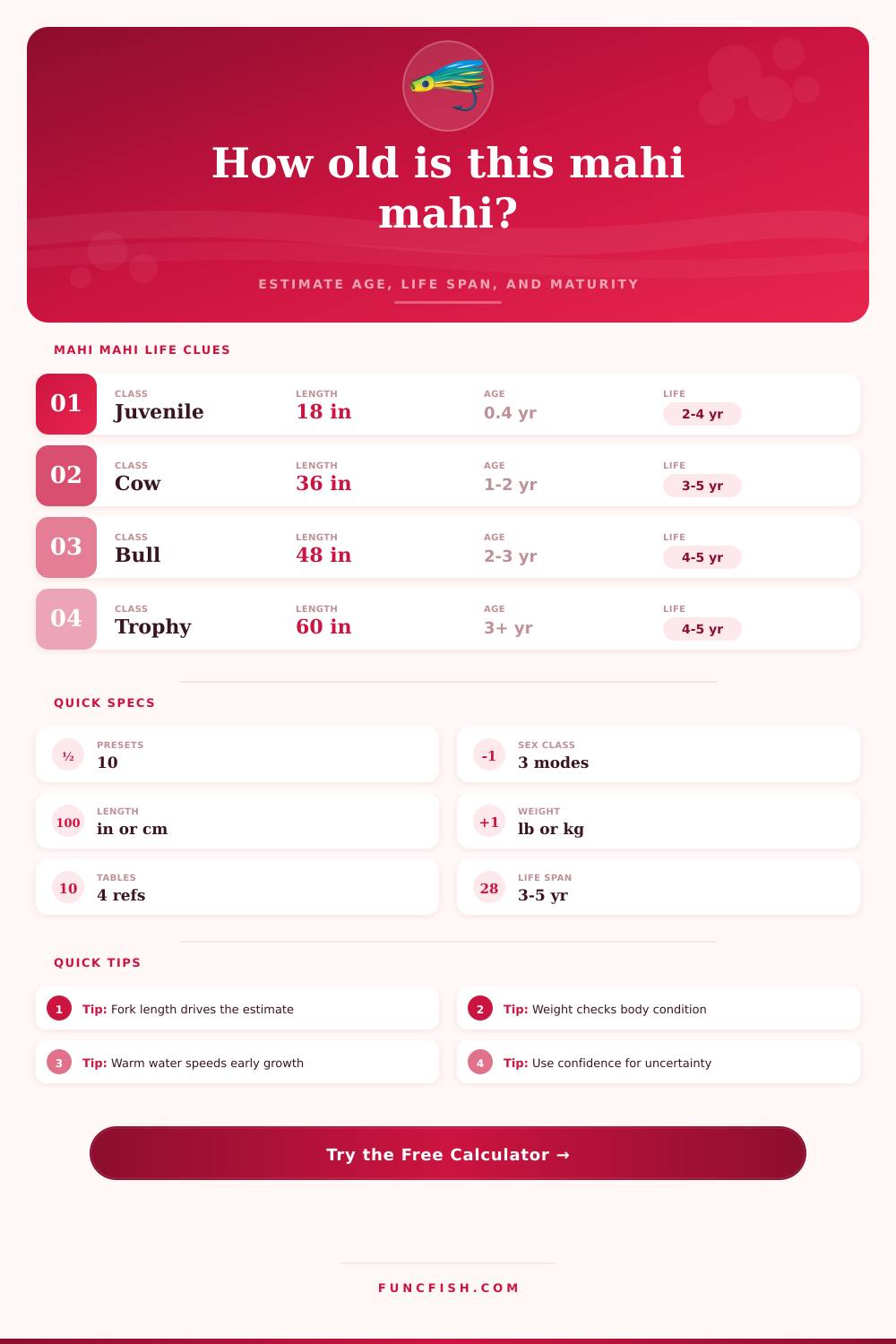
Estimate mahi mahi age, likely remaining lifespan, maturity stage, body condition, and confidence from sex class, fork length, weight, ocean temperature band, growth zone, maturity stage, and measurement quality.
📌Mahi mahi presets
⚙Calculator inputs
Mahi mahi lifespan estimate
Results are a field estimate based on fast pelagic growth patterns. Local productivity, spawning history, and genetics can shift individual fish above or below the range.
Calculation breakdown
📊Model factor grid
Male bull class
Female cow class
Prime water
High confidence
📏Mahi mahi size, age, and lifespan reference
| Fork length class | Typical weight | Estimated age band | Life-stage signal |
|---|---|---|---|
| 12-20 in / 30-51 cm | 1-4 lb / 0.5-1.8 kg | 0.2-0.6 years | Juvenile school fish; rapid daily and weekly growth dominates the estimate. |
| 21-32 in / 53-81 cm | 5-14 lb / 2.3-6.4 kg | 0.6-1.2 years | Maturing mahi; body depth and sex class start to matter more. |
| 33-45 in / 84-114 cm | 15-35 lb / 6.8-15.9 kg | 1.2-2.4 years | Prime adult range; many fish have spawned or are ready to spawn. |
| 46-60 in / 117-152 cm | 36-70 lb / 16.3-31.8 kg | 2.3-4.0 years | Large adult, often male; remaining lifespan narrows quickly. |
| 61+ in / 155+ cm | 70+ lb / 31.8+ kg | 3.5+ years | Rare old trophy; confidence depends heavily on exact fork length. |
🌡Temperature and growth zone modifiers
| Factor | Calculator setting | Age effect | Reason in model |
|---|---|---|---|
| Cool edge | 68-73°F / 20-23°C | Older for same length | Cooler water slows growth, so a same-size fish may have taken longer to reach that length. |
| Prime bluewater | 74-82°F / 23-28°C | Younger for same length | Warm productive current edges support the fast growth expected from mahi mahi. |
| Hot stressed water | 89°F+ / 32°C+ | Older, lower confidence | High temperatures can reduce feeding efficiency and make length-only reads less reliable. |
| FAD or debris | Floating cover zone | Younger if robust | Concentrated forage around structure can produce heavy, fast-growing fish. |
| Upwelling edge | Cooler nutrient edge | Slightly older | Productivity may be high, but cooler temperatures often moderate growth speed. |
🧬Sex, maturity, and condition reference
| Observation | What it suggests | Calculator adjustment | Confidence note |
|---|---|---|---|
| Male bull with high forehead | Often larger at older adult sizes | Uses a larger asymptotic length and 5-year model cap | Best for clearly developed adult males, not small school fish. |
| Female cow, rounded profile | May mature early and top out smaller | Uses a slightly lower maximum length and lifespan cap | Weight and maturity stage help separate adult cows from fast juveniles. |
| Thin long fish | Condition trails expected weight | Adds age slightly and lowers confidence | Useful when forage was poor or fish has recently spawned. |
| Robust deep-bodied fish | Condition exceeds expected weight | Allows faster growth and slightly younger estimate | Confidence rises when weight matches the selected growth zone. |
| Post-spawn worn fish | Adult with depleted condition | Raises maturity age floor and expands result range | Use this only when the fish shows clear spent condition. |
🚤Pelagic species comparison grid
| Pelagic species | Growth style | Common lifespan | Calculator lesson |
|---|---|---|---|
| Mahi mahi / dorado | Very fast early growth | About 3-5 years | Fork length is powerful, but maturity and condition change the final range. |
| Wahoo | Fast predator growth | Roughly 5-6 years | Same length can be older than mahi because wahoo grow on a different curve. |
| Yellowfin tuna | Fast but longer-lived | Often 6-8 years | Weight gain and age separate more slowly than in mahi mahi. |
| Skipjack tuna | Rapid schooling growth | About 3-5 years | Similar short-life logic, but species shape and weight curve differ. |
| Sailfish | Fast billfish growth | Often 10+ years | Do not transfer mahi age rules to billfish; lifespan scale is much longer. |
📋Confidence band reference
| Confidence setting | Typical input quality | Age range width | Best use |
|---|---|---|---|
| Low | Both length and weight estimated from a photo or deck mark | Wide, about +/- 0.7 years | Use for quick trip notes when the exact fork length is unknown. |
| Medium | One measured input and one estimated input | Moderate, about +/- 0.45 years | Good for dockside estimates with a known weight or known length. |
| High | Measured fork length and scale weight | Tighter, about +/- 0.25 years | Best everyday setting for careful angler logs and tournament notes. |
| Lab-grade | Measured fish with otolith, sample, or local age data nearby | Tightest, about +/- 0.15 years | Use when the field estimate is being compared with biological records. |
💡Calculator notes
Total length can overstate mahi size because the tail tips add extra length. Fork length gives the growth model a cleaner input and keeps large bulls from being pushed too old.
A heavy fish at the same fork length may be growing fast in rich water, while a thin or post-spawn fish may read older with a wider confidence band.
Mahi mahi fish species grows at a fast rate. Because of the fast rate of growth of mahi mahi fish, it is often difficult to determine the age of the mahi mahi. A person who sees a mahi mahi fish that is large may think that the fish is old, but the size of the fish could actualy be that of a young mahi mahi fish that grew quick due to ideal water conditions.
Alternatively, a person who sees a mahi mahi that is small may think the mahi mahi is young, but it could be an old fish that did not grow good due to the poor quality of the water. The age of the mahi mahi fish can tell a person if the fish has completed its spawning cycle. One of the most important measurements for determining the age of a mahi mahi fish is its fork length.
How to Tell the Age of a Mahi Mahi
Fork length is used as the main measurement in the age calculator for the mahi mahi fish. However, the age calculator also considers other factor in determining the age of the mahi mahi fish. One of the most important factors to consider is the water temperature in which the mahi mahi fish live.
When the water temperature ranges between seventy-four and eighty-two degrees, the growth of the mahi mahi fish is often accelerated. Thus, a mahi mahi fish of a certain length will be younger in warm water than it would be of the same length but in cool water. However, if the temperature of the water rise to above eighty-nine degrees, the mahi mahi may experience heat stress, which may lead to the slowing of its feeding behaviors.
Thus, in this case, the mahi mahi may appear to be of an older age then it should be. The growth zone in which the mahi mahi lives can also impact the growth rate of the mahi mahi fish. For example, mahi mahi fish that live near areas with floating debris or Fish Aggregating Devices (FADs) have more food available to them.
Thus, those fish will be heavier in relation to there length. Conversely, mahi mahi fish that live in the open ocean may have less food available to them. Thus, those fish will be leaner in relation to their length to the fish that live near FADs.
Another of the factors that affect the age of the mahi mahi fish is its sex class. Male mahi mahi fish can grow to be slightly larger in length than the females of the same species. Additionally, male mahi mahi fish can reach up to five year of age.
The females of the species reach their maximum size of the species at an earlier age than the males. This difference in age becomes more apparent for fish that are larger than thirty inches in length. If the individual using the age calculator does not know the sex of the mahi mahi fish, it is possible to select the “unknown” option in the age calculator.
Thus, it is possible to have a general age estimate for the mahi mahi fish of unknown sex. The maturity of the mahi mahi fish and the condition of its body can also impact the age calculator. For example, a female mahi mahi that has just spawned may be thin.
Thus, a thin female mahi mahi will appear to be of an older age than a male mahi mahi of the same length. Additionally, a deep-bodied and adult mahi mahi that is in “prime” water will appear to be of a younger age than its actual age. The age calculator for the mahi mahi fish takes into account each of the factors discussed above.
The age calculator will provide the age of the mahi mahi as an age range. Additionally, the calculator can also determine the life of the mahi mahi beyond its current age, as well as provide a maturity reading for the mahi mahi. Furthermore, the calculator provides a “confidence score” for the estimated age of the mahi mahi fish.
A high confidence score indicate that the age estimate for the mahi mahi fish is accurate and that the age range is narrow. A low confidence score indicates that the age of the mahi mahi fish is less certain. Thus, a low confidence score will provide a wider range of potential ages for the mahi mahi.
Despite the considerations within the age calculator, there are many other biological variables of the mahi mahi fish that the calculator does not consider. For instance, the presence of upwellings can cause more food to be present in the water, which can increase the growth of the mahi mahi fish. Alternatively, if the mahi mahi fish is experiencing a parasite or missing a spawning event, its growth can slow.
Additionally, the genetics of the mahi mahi fish can impact its growth, but this is something that is impossible to observe for any individual mahi mahi fish. Thus, two mahi mahi fish of the same length may have different ages based off these other biological variables. While the mahi mahi fish age calculator can provide the best estimate for the age of a mahi mahi fish, it is merely a starting point.
However, by using this calculator to provide age estimate for each mahi mahi fish that is caught, it is possible to establish trends of the average age of the mahi mahi in a certain area. Additionally, the age of the mahi mahi can help determine if the large mahi mahi in a certain area has spent its spawning cycles, or if the mahi mahi is near the end of its life. Additionally, for the recreational mahi mahi fish fisherman, the age estimate will help determine how much longer the mahi mahi fish might have lived, and provide those anglers with information regarding the future of the mahi mahi fish population.
In order to use the age calculator effectively for the mahi mahi fish, an individual must understand which observation to make when locating a mahi mahi fish. Fork length and weight are the two most important measurements to make with the fish. Water temperature and growth zone are additional factors that can help provide the best estimate of the age of the mahi mahi.
The maturity stage and body condition of the fish can also help an individual understand the age of the fish. If an individual makes each of these observation of the mahi mahi fish, the age range that is provided for the fish will reflect the limits of the observations by the individual rather than the lack of information that is available regarding the age of the mahi mahi fish.