Fish on Ice Survival Calculator
Estimate survival probability band, chill exposure index, recovery window estimate, and risk tier from species group, fish size, time on ice, ice contact, ambient temperature, condition, insulation, drainage, moisture, oxygen proxy, and input confidence.
📌On-ice scenario presets
⚙Fish and on-ice inputs
On-ice survival estimate
Estimated survival probability band, chill exposure, recovery window, and risk tier will appear here.
Calculation breakdown
🧊Ice contact and insulation reference grid
Bare Ice
Wet Slush
Snow Layer
Drained Ice
🌡Species and temperature comparison grid
Coldwater salmonid
Best baseline at 0-4 C / 32-39 F; moderate sensitivity above 8 C / 46 F.
Temperate gamefish
Middle baseline around 2-6 C / 36-43 F; risk rises with full ice contact.
Warmwater panfish
Shorter cold-contact baseline; small body mass makes the index rise quickly.
Carp and catfish
Higher tolerance baseline; thick bodies reduce immediate chill exposure.
Marine reef fish
Warm-water group with low cold-contact tolerance and a wider uncertainty band.
Thin pelagic fish
Fast cooling group; high surface area and oxygen demand increase exposure score.
📊Reference tables
| Species group | Baseline tolerance | Cold sensitivity | Size response | Model note |
|---|---|---|---|---|
| Coldwater salmonid | 10 min at baseline | 1.00 | Medium reserve | Trout, salmon, char style physiology in cold air. |
| Temperate bass, walleye, perch | 8 min at baseline | 1.10 | Medium reserve | Common gamefish group with moderate cold-contact penalty. |
| Warmwater sunfish or bass | 7 min at baseline | 1.20 | Small fish cool fast | Higher penalty when small fish have high direct ice contact. |
| Hardy carp or catfish | 18 min at baseline | 0.75 | High reserve | Higher tolerance baseline and larger thermal mass effect. |
| Marine reef fish | 4 min at baseline | 1.55 | Medium reserve | Warm-water marine group with low cold-contact tolerance. |
| Thin pelagic fish | 3 min at baseline | 1.70 | Low reserve | Fast cooling, high surface area, and high oxygen demand. |
| Ambient temperature | Model factor | Ice contact effect | Index behavior | Reference use |
|---|---|---|---|---|
| Below 0 C / below 32 F | 1.18 | Direct ice contact dominates | Chill index rises quickly | Freezing air plus ice creates the strongest chill signal. |
| 0-2 C / 32-36 F | 1.08 | High contact raises risk | Baseline cold model | Typical ice-surface reference condition. |
| 2-6 C / 36-43 F | 0.98 | Contact remains important | Middle index | Cool air with melting ice or slush contact. |
| 6-12 C / 43-54 F | 0.88 | Moisture proxy matters more | Moderate chill | Less chill, but time out of water still drives the ratio. |
| Above 12 C / above 54 F | 0.78 | Ice contact still counts | Lower chill, wider band | Warm air reduces chill but increases uncertainty. |
| Insulation or drainage | Exposure factor | Moisture signal | Contact profile | Calculator interpretation |
|---|---|---|---|---|
| Bare hard ice | 1.20 | Low to medium | Strong direct contact | Highest direct chill multiplier in the calculator. |
| Wet slush layer | 0.95 | High | Even contact | Moisture offsets some direct chill in the model. |
| Snow or soft ice layer | 0.75 | Medium | Broken contact | Lower contact intensity and more insulation. |
| Thin liner between fish and ice | 0.85 | Medium | Reduced contact | Moderate insulation and lower direct chill score. |
| Drained cooler ice | 0.90 | Medium | Mixed contact | Open drainage proxy with moderate chill exposure. |
| Insulated from direct ice | 0.65 | Medium | Low contact | Lowest direct-contact chill multiplier. |
| Confidence setting | Band width | Best input match | Typical uncertainty | Output effect |
|---|---|---|---|---|
| Rough visual estimate | Wide | Approximate size, time, and contact | Plus or minus 24 points | Probability band widens strongly. |
| Measured time, estimated size | Standard | Known time with approximate fish size | Plus or minus 16 points | Default calculator band. |
| Measured size, time, and temperature | Narrower | Scale, tape, timer, and thermometer | Plus or minus 10 points | Probability band tightens. |
| Measured with response observation | Narrowest | Measured inputs plus observed response | Plus or minus 8 points | Highest confidence in the relative tier. |
💡Calculator notes
Use contact percent as the share of body surface touching ice, slush, or ice water. A fish lying flat on bare ice is closer to the high-contact end than a fish separated by snow, a liner, or air gaps.
Choose a wider confidence setting when time, size, temperature, or contact percent is approximate. The calculator keeps the same midpoint logic but expands the displayed probability band.
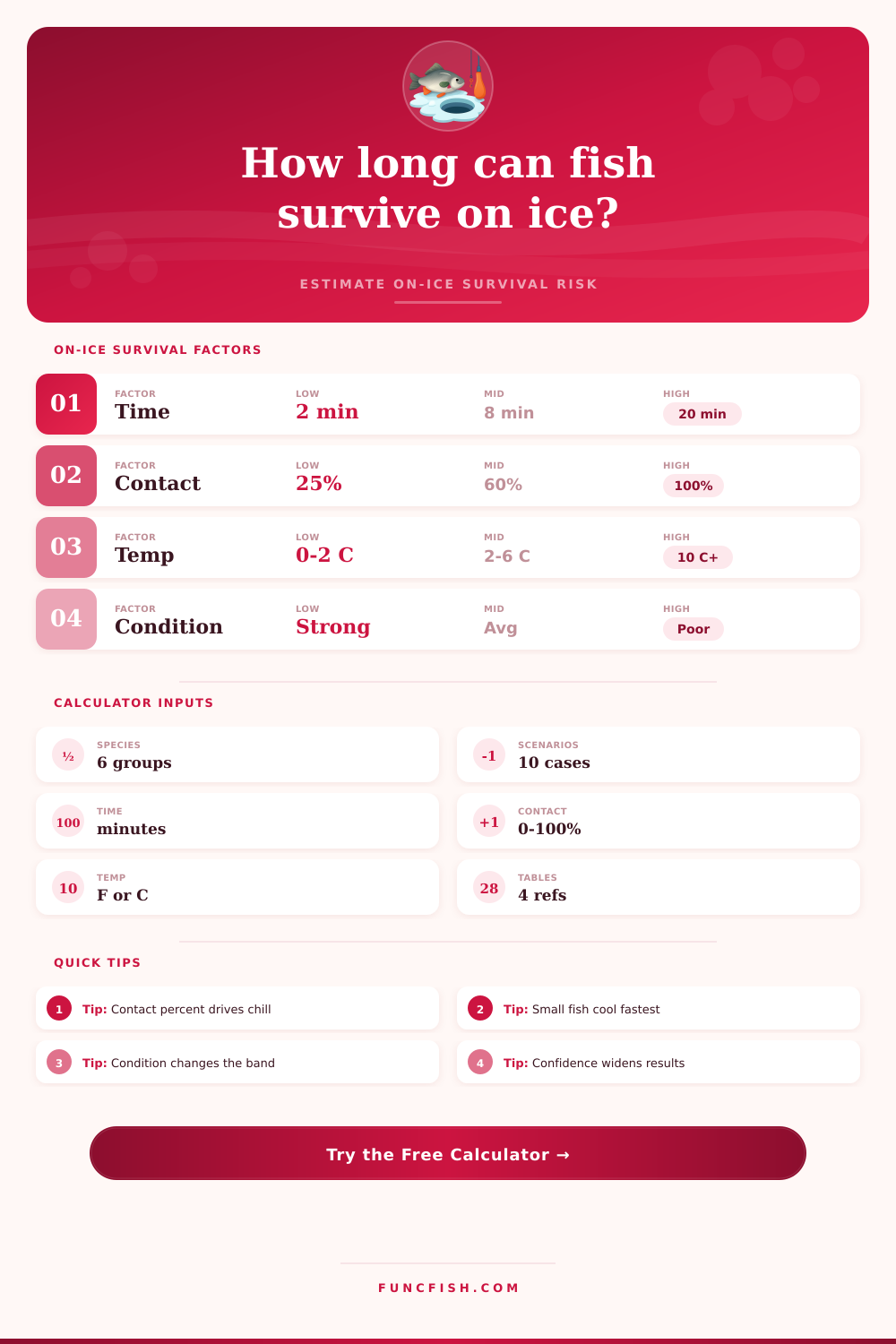
When a person places a fish on ice, the person must consider two thing: for how long will the fish stay fresh on ice, and for how long will the fish survive after the fish leave the water? The survival of a fish can depend on several factor, such as the size of the fish, the species of the fish, and how much contact that the fish have with the ice. Fish that have a high percentage of contact with the ice will lose heat from the fish much more faster than fish that have a low percentage of contact with the ice.
Because fish can lose heat at different rates, a person cannot rely upon the length of time that the fish is on the ice alone to determine how long the fish will survives. To calculate for how long a fish will survive on ice, a person must consider several factor. The species group of the fish is one factor to consider because some fish species has more tolerance to cold water than others.
How Long Fish Can Survive on Ice and What Affects Them
For example, cold water salmonids will react differently to the water temperatures than warm water sunfish. Other factor to consider include the length of the fish, the weight of the fish, and the length of time that the fish is on the ice. Time alone is not a factor that will determine survival, but the length of time that the fish is on the ice can be factored in along with the other variable.
Contact percent is one of the factor that a person must consider in the calculation of how long the fish will survive on ice. Contact percent is a means of measuring how much of the fish is in contact with the ice; fish in contact with bare ice will experience more cold temperatures than fish in contact with snow or ice liners. Ambient temperature is another factor that must be considered; air temperature that are well below freezing will cause the fish to lose heat at a faster rate than air temperatures that are closer to the equilibrium temperature of the fishs body.
The initial condition of the fish is another factor that must be considered; fish with more energy will have a different survival probability than fish with less energy. The other factors to consider include the insulation and drainage settings of the area where the fish is placed on ice; drained ice will behave differently than bare ice, and bare ice will behave differently than snow. Finally, moisture and oxygen level in the air will impact how quickly the fish lose its ability to tolerate the cold temperatures; fish lose their tolerance to the cold faster in dry air than in air with high moisture content.
Based off the observations of fish survival on ice, several output can be provided to help the person understand the data. For instance, the survival probability band will provide information regarding the survival of the fish. Additionally, chill exposure index will provide a number between 0 and 200 that allow for the comparison of the survival of two fish.
Recovery window estimate will provide the person with a time period during which to observe the fish. Risk tier will also provide information for the person regarding the survival of the fish and allow the person to act quick in the case of a high risk to the fish. The reference tables included in the calculator may help a person understand the logic behind the calculator.
For instance, these tables illustrate different species, their sensitivity to cold water, the different factor of temperature, and the factor of insulation. Certain factor will have more of an impact upon the survival of the fish than other factor; the reference tables help to explain this. Finally, the confidence settings allow a person to adjust the width of the survival probability band; if a person has an approximate idea of the survival of the fish, a person can use these settings to adjust for the uncertainty in the survival.
Many people feel that time is the only factor that determines the survival of a fish on ice. However, time is not the only factor. For instance, a fish that remains on snow covered ice for twelve minutes may survive better than a fish that remains on bare ice for six minute.
Small fish will lose heat at a faster rate than large fish; thus, another factor must be considered. Because these factor are predictable, a person must consider each of these factor to understand the risk to the fish. Using the calculator will allow a person to make better decision regarding the fish.
For example, a person can use the calculator to decide whether to keep the fish or to release the fish. The calculator will help the person to make these decisions by removing guesswork. For instance, the calculator use each of the mentioned variable to calculate for the survival of the fish.
Thus, a person can use this calculator to make the same decisions when caring for the fish throughout the season. Additionally, by using this calculator, a person can better understand the factor that will impact the survival of the fish and how to handle the fish more effective.