Roosterfish Weight Calculator
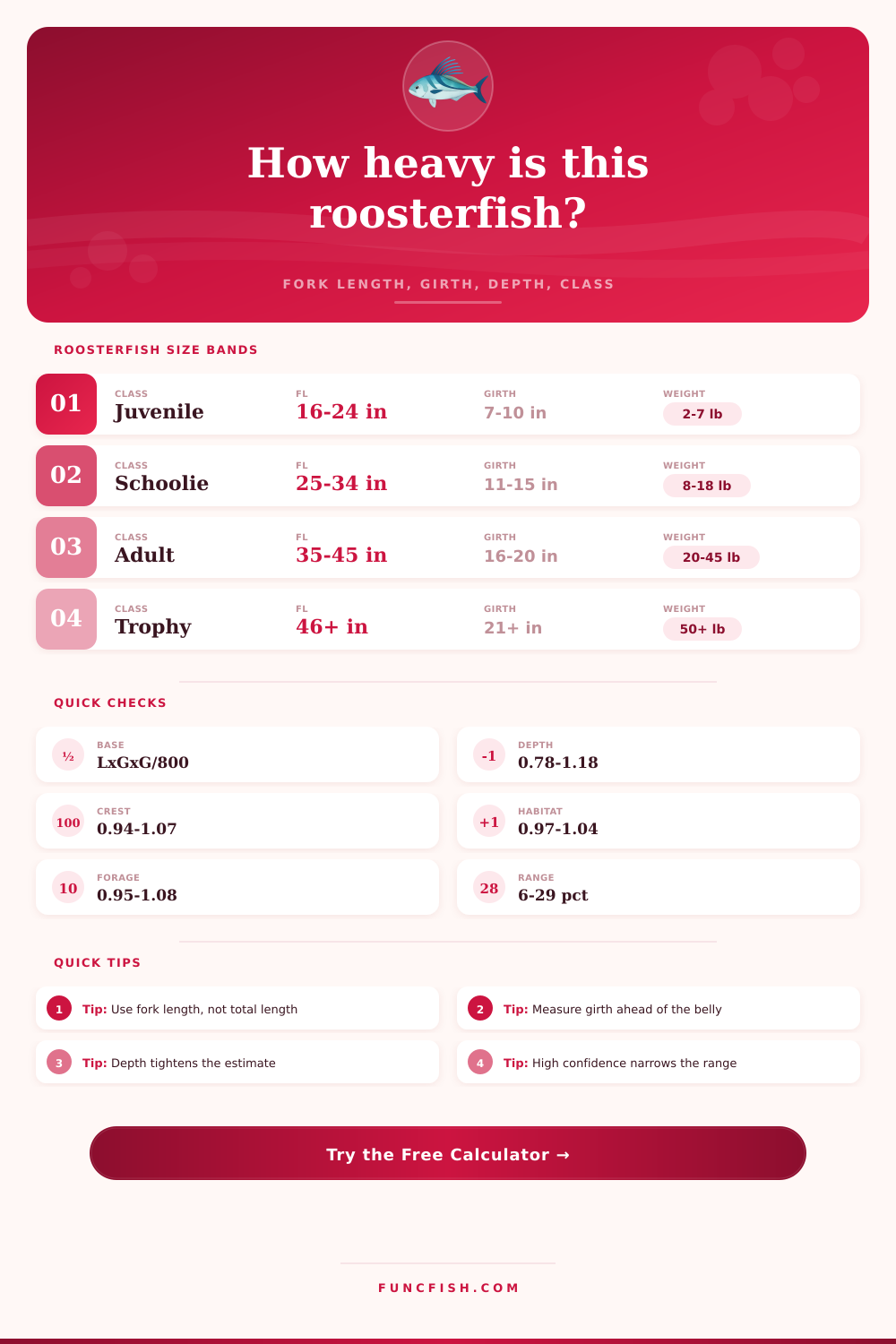
Estimate roosterfish weight from fork length, girth, body depth, crest class, habitat, condition, forage signal, and measurement confidence.
Calculation Breakdown
| Crest class | Typical fork length | Weight factor | Reading note |
|---|---|---|---|
| Juvenile low crest | 14-24 in / 36-61 cm | 0.94 | Slimmer frame; girth dominates the estimate. |
| Schoolie developing crest | 25-34 in / 64-86 cm | 0.98 | Fast growth with moderate shoulder depth. |
| Adult full crest | 35-45 in / 89-114 cm | 1.02 | Best match for the default roosterfish divisor. |
| Tall crest mature bull | 46+ in / 117+ cm | 1.07 | Broader shoulders and thicker caudal base. |
| Setting | Factor range | Why it matters | Use when |
|---|---|---|---|
| Surf and sandy beach | 0.98 | Long-running beach fish often read slightly lean. | The fish was measured after a surf-zone fight. |
| Reef edge or rocky point | 1.02 | Ambush feeding can create a heavier shoulder line. | The fish held tight to rocks or reef edges. |
| Offshore bait school | 1.04 | Open-water bait balls can push high girth values. | The fish was around sardines, mullet, or jacks. |
| Post-spawn or long run | 0.95 | Same length can carry less belly mass. | The fish appears hollow behind the pectoral area. |
| Measurement | Best point | Common miss | Effect on weight |
|---|---|---|---|
| Fork length | Snout to tail fork | Using total length | Can overstate weight by 8-12 percent. |
| Girth | Thickest shoulder-belly loop | Tape too loose or behind belly | Largest impact because girth is squared. |
| Body depth | Behind shoulder, vertical profile | Measuring diagonal flank depth | Refines thick versus lean body shape. |
| Confidence | Stable fish, wet tape, clear marks | Guessing from a photo only | Widens or tightens the final range. |
Roosterfish can be found in specific locations where baitfish are trapped. Additionally, roosterfish tend to displaying activity on the surface before they begin to eat the baitfish. For anglers, the most important part of catching a roosterfish is determining it’s weight.
The weight of the fish is important to determine if the fishing trip was successful or not. Because roosterfish does not have the same body shape as tuna or jack fish, their weight isnt calculated in the same manner. Roosterfish have a body that is long and thin, but compressed from side to side.
How to Tell the Weight of a Roosterfish
Depending upon the feeding habits of the roosterfish, the weight of the fish can change. In addition to the length and girth of the fish, the depth of the roosterfish can also play a role in its weight. A single measurement of the fish is insufficient to determine the weight.
To determine the weight of a roosterfish, both the fork length and girth of the fish must be measured. However, the girth can be misleading without also measuring the body depth of the roosterfish. The area where the roosterfish spend most of its time can also play a role in the weight of the fish.
A roosterfish that lives in areas where it can find mullet will weigh more than a fish that lives in areas with thin waters. To make it easier for anglers to determine the weight of there caught roosterfish, this page has provided a calculator. The calculator use a formula that takes the length of the fish and the square of the girth, and then makes adjustments for the depth of the fish, the crest of the roosterfish, the habitat of the roosterfish, the body condition of the roosterfish, and the forage conditions of the area where the fish was located.
Each of these factor can influence the total mass of the fish. For example, if the roosterfish has tall crests, it will typically have a greater mass than a fish with shorter crests. Additionally, a roosterfish that is caught in the surf may have leaner bodies than a roosterfish that is caught on a reef.
This calculation make sense for a fish because the depth of the roosterfish behind the shoulder is a significant variable in its total weight. If the depth of the roosterfish is twenty percent of the fork length, the fish has a typical body shape for a roosterfish. If the depth of the fish is twenty-five percent of the fork length or greater, then the roosterfish has thick shoulders.
The calculator calculates a range of weights to account for the weight of the fish. A roosterfish that weighs within the range calculated by the calculator can be relied upon to have accurate measurements, as opposed to a measurement that may have been taken from a photograph of the roosterfish. The body condition of the roosterfish may change with the season, and the body condition will have an effect upon the calculation of the weight of the roosterfish.
For example, if the roosterfish has just finished spawning, it may have a thin body behind the pectoral fins. By using the forage setting of the calculator to indicate that the roosterfish has just finished spawning, the calculation of the weight of the roosterfish will not indicate that the weight of the fish is greater then the actual weight of the fish. Similarly, a roosterfish that has been feeding on baitfish for several days will have a greater mass than a roosterfish that has the same length and girth but has not been feeding.
These differences in mass, while small, may be important in determining whether or not the roosterfish should be placed on a leaderboard to compare with other fish that have been caught. People may make several mistakes when they are trying to calculate the weight of a roosterfish. For example, using total length instead of fork length will add to the length of the fish that the calculator cant account for.
Using girth measurements that are too far back on the body of the fish will lead to inaccuracies in the calculation of the weight of the roosterfish. Additionally, ignoring the depth of the fish will also create inaccuracy in the weight calculation. The tables that is located on this page are provided to help people understand the relationship between each of these variables.
The calculator provides a range of the weight of the roosterfish instead of a specific number for the weight. The use of a range accounts for the fact that roosterfish may weigh differently, and that the measurements of the fish are not provided with perfect accuracy. The top of the weight range indicates the weight of a significant fish, while the bottom of the range indicates the weight of a lean roosterfish.
The estimation of the weight of the roosterfish is helpful for anglers who are attempting to determine the weight of the fish without having to use the scale to weigh it. A person will find value in the calculator after using the calculator numerous times to weigh roosterfish. With using the calculator, a person will begin to recognize the depth of the roosterfish when the person lifted up the roosterfish.
A person will also become familiar with the difference in the weight of a roosterfish from the surf as compared to one from a reef point. Additionally, through using the calculator numerous times, a person will understand how the forage conditions of an area can impact the weight of a roosterfish. These understandings of the variables will allow the calculator to become a valuable reference for anglers when measuring their roosterfish.