Striped Marlin Weight Calculator
Estimate striped marlin round weight from lower jaw fork length, maximum girth, body depth, ocean basin profile, sex and maturity, body condition, measurement confidence, and unit system.
📌Striped marlin presets
⚙Basin, maturity, and measurements
Billfish model: this calculator uses lower jaw fork length as the length anchor, blends a striped-marlin length by girth-squared estimate with a depth cross-check, then adjusts for basin body line, sex and maturity, condition, and measurement confidence.
Estimated striped marlin weight
The estimate combines lower jaw fork length, girth, body depth, basin profile, maturity, condition, and measurement confidence.
Calculation breakdown
📊Striped marlin body profile cards
Eastern Pacific
Central Pacific
New Zealand
Confidence band
🐟Billfish comparison grid
Striped Marlin
Slender, high-speed billfish with moderate girth for length and strong regional body-line variation.
Blue Marlin
Much deeper and heavier at the same LJFL, especially in large mature females.
White Marlin
Smaller, light-framed billfish with a lower top-end weight and thinner shoulder line.
Sailfish
Long and blade-like with low body depth, so total appearance can overstate weight.
📘Reference tables
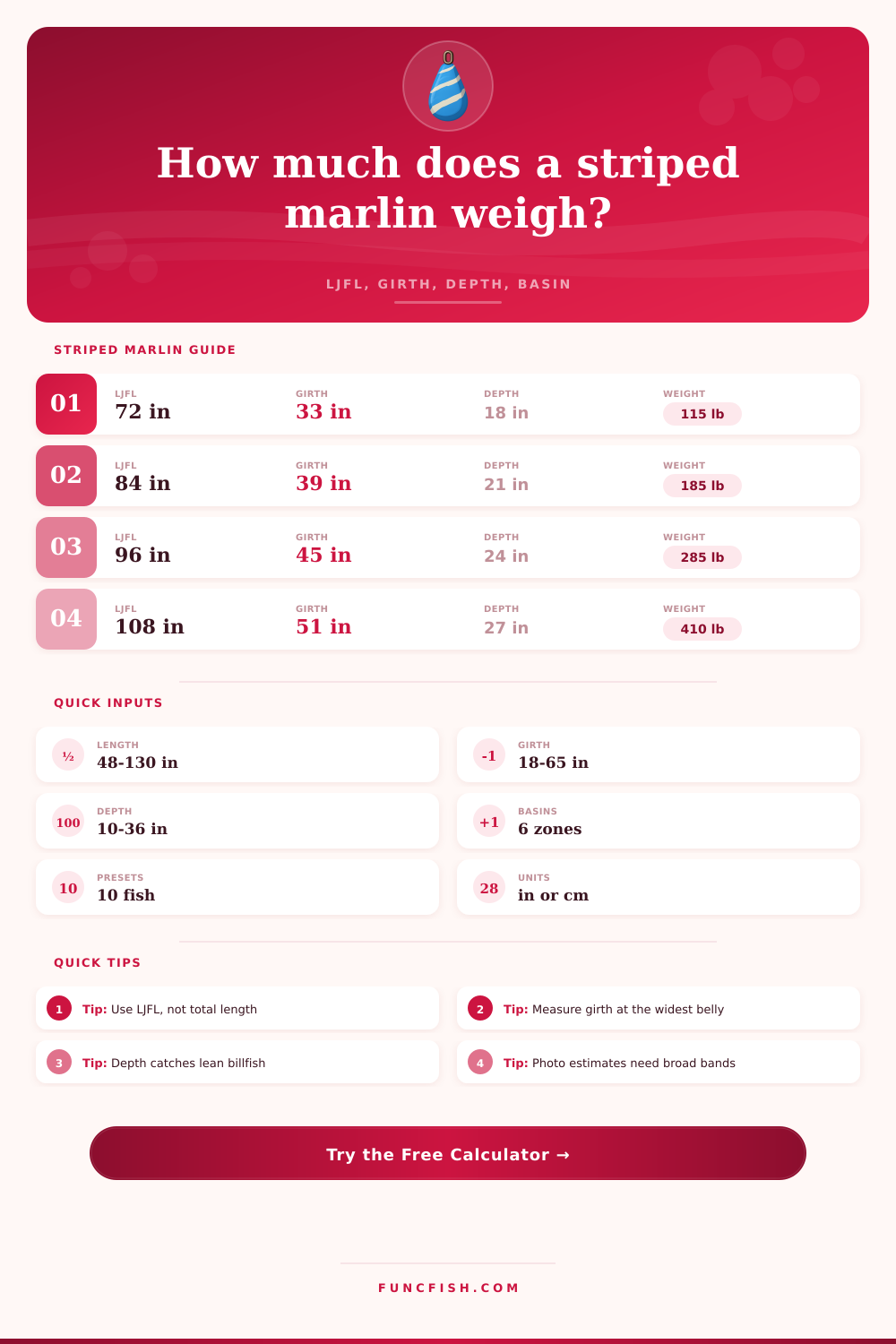
| LJFL checkpoint | Typical girth | Typical depth | Estimated weight band |
|---|---|---|---|
| 60 in / 152 cm | 26-30 in / 66-76 cm | 14-16 in / 36-41 cm | 65-95 lb / 29-43 kg |
| 72 in / 183 cm | 32-36 in / 81-91 cm | 17-19 in / 43-48 cm | 105-145 lb / 48-66 kg |
| 84 in / 213 cm | 37-42 in / 94-107 cm | 20-23 in / 51-58 cm | 165-230 lb / 75-104 kg |
| 96 in / 244 cm | 43-48 in / 109-122 cm | 23-26 in / 58-66 cm | 250-340 lb / 113-154 kg |
| 108 in / 274 cm | 49-55 in / 124-140 cm | 26-30 in / 66-76 cm | 370-510 lb / 168-231 kg |
| Ocean basin profile | Multiplier | Expected shape | Calculator note |
|---|---|---|---|
| Eastern Pacific baitball fish | 1.00 | Balanced striped marlin line | Good baseline for Baja and Mexico fish |
| California Current traveler | 0.98 | Longer, leaner body | Use depth guard when photos look flat |
| Central Pacific lure fish | 0.99 | Lean offshore body | Moderate girth and narrow depth profile |
| South Pacific deep-body fish | 1.02 | Heavier shoulder and belly | Often benefits from measured body depth |
| Tasman or New Zealand fish | 1.03 | Deep mature frame | Large females can outpace LJFL-only math |
| Indian Ocean runner | 0.98 | Long, bright-water runner | Range widens if girth is estimated |
| Sex and maturity | Shape factor | Condition tendency | Best measurement priority |
|---|---|---|---|
| Juvenile or small fish | 0.94 | Narrow young frame | LJFL and girth are enough |
| Subadult unknown sex | 0.98 | Still adding shoulder mass | Girth is most important |
| Adult unknown sex | 1.00 | Neutral mature profile | Use all three measurements |
| Adult male | 0.99 | Often longer and leaner | Depth checks overestimates |
| Adult female | 1.02 | More depth and belly | Depth and girth together |
| Large mature female | 1.04 | Heavy frame potential | Measure depth carefully |
| Billfish comparison | Same 90 in LJFL cue | Body profile | Weight model note |
|---|---|---|---|
| Striped marlin | 190-280 lb / 86-127 kg | Fast, slim, moderate depth | Girth matters more than length alone |
| Blue marlin | 260-430 lb / 118-195 kg | Deep shoulder and belly | Depth can dominate on mature females |
| White marlin | 75-130 lb / 34-59 kg | Light billfish frame | Use a separate species curve |
| Sailfish | 55-110 lb / 25-50 kg | Long, blade-like body | Low depth keeps weight down |
💡Measurement tips
Striped marlin weight charts are usually built around lower jaw fork length. If you only have total length, convert it before comparing fish or using the preset shape ratios.
Two striped marlin can have the same LJFL and girth while carrying different depth. The depth cross-check keeps a long, flat fish from being scored like a deep mature female.
This is a field estimator for round whole striped marlin measurements and photo review. A calibrated scale is the final weight reference.
Estimating the weight of a striped marlin require several different measurement of the striped marlin to obtain an accurate estimate of its total weight. While it may be tempting to guess the weight of a striped marlin based off its length, the length of the striped marlin does not account for the girth or the body depth of the striped marlin. The girth and the body depth of a striped marlin are important measurements because the girth and the body depth of a striped marlin will help to determine the total weight of those fish.
Thus, to estimate the total weight of a striped marlin, you must measure the length, girth, and body depth of that fish to obtain an accurate estimate of its weight. The most common and standard measurement of striped marlin is referred to as the lower jaw fork length of the striped marlin. This measurement are taken from the lower jaw of the fish to the lower jaw of the opposing fish.
How to Estimate the Weight of a Striped Marlin
The reason that this is the standard measurement is that it will remain consistent even if the tail of the striped marlin is damage. However, the lower jaw fork length is not the only measurement that must be obtained. Along with the length measurement, you must also measure the girth and body depth of the striped marlin.
The girth of a striped marlin is the measurement of the distance around the widest part of the body of the striped marlin, while the body depth is the thickness of the striped marlin from the top of its head to its tail. Striped marlin with a larger girth or body depth will weigh more than striped marlin with small girth or body depth. Another factor that must be considered in the estimation of the striped marlins weight is the ocean basin in which that striped marlin was caught.
Striped marlin from different ocean basins may have different body shape and sizes. For instance, striped marlin from the Eastern Pacific Ocean have a balanced ratio of their girth to their length, while striped marlin from areas like New Zealand and the Tasman Sea have deeper bodies. Additionally, striped marlin from the Indian Ocean and the California Current have longer but narrow bodies, which may mean that the striped marlin from those areas may weigh less than striped marlin from other ocean.
By selecting the ocean basin of origin for the striped marlin in the calculator, the calculator will account for the expected girth and depth of striped marlin from that specific ocean basin. The maturity and sex of the striped marlin may also impact the total weight of the fish. Adult male striped marlin often grow to be longer and leaner than female striped marlin of the same age.
Additionally, large mature female striped marlin often have more depth to their belly than male striped marlin of the same age. Thus, when using the calculator, the user must account for the maturity of the striped marlin to reflect the differences in body shape between the two sex. Additionally, the condition of the striped marlin may also play a factor in the total weight of the striped marlin.
For example, striped marlin that contains more mass in its belly will be more heavier than striped marlin that does not contain as much mass in that area. Thus, striped marlin that is full of bait will weigh more than striped marlin that is lean. The calculator can account for the condition of the striped marlin.
Each measurement of striped marlin must be taken accurately for the weight to be accurate. For example, a striped marlin will weigh more if you measure it using a professional board and tape measure than if the measurement are taken from a photograph of the striped marlin. Additionally, using only a rough estimation of the girth or body depth of the striped marlin will result in a wider range of potential weight for that striped marlin.
A wider range of weights indicates that the weights were not measured as precisely as they could of been. Thus, using a wider range of weights is still useful information in that it indicates the striped marlins weight is not certain. Furthermore, the striped marlin may also be compared to other types of billfish to ensure that it is compared to the correct type of fish.
For instance, blue marlin are often heavier and deeper than striped marlin of the same length, while white marlin are lighter than striped marlin, and sailfish have thinner bodies than striped marlin. The comparison grid within the striped marlin weight estimating tool will help ensure that the striped marlin is compared to the other billfish species correct. Thus, the weight of striped marlin can only be as accurate as the measurements and settings used for the calculator; the user must make sure that the length, girth, and body depth are measured as accurately as possible.
Youll recieve a more moddern estimate if you follow these steps.