Repower Horsepower Calculator
Estimate practical fishing boat repower horsepower from length, displacement, hull shape, current horsepower, target speed, fishing load, prop efficiency, fuel and gear, sea state, and unit system.
📌Named repower presets
⚙Repower inputs
Repower horsepower results
Calculation breakdown
📊Repower reference cards
Planing Load
Offshore Load
Prop Factor
Reserve
🛥Fishing boat hull comparison grid
Modified V
Efficient all-around fishing hull with predictable planing speed and moderate load sensitivity.
Deep V
Needs more horsepower for the same speed, but keeps better control in chop and offshore swell.
Flat / Jon
Runs efficiently at lower weights and shallow draft, with less comfort when the surface gets rough.
Catamaran
Often carries fishing load well, planes cleanly, and may need less horsepower per loaded pound.
Pontoon
Wide fishing platform with strong load capacity, but windage and tube drag limit top-end speed.
Semi-Displacement
Best estimated with conservative speed targets because horsepower rises sharply past efficient cruise.
📋Reference tables
| Hull type | Efficient loaded speed | Typical hp / 1000 lb | Repower note |
|---|---|---|---|
| Flat skiff or jon | 18-28 mph / 29-45 km/h | 12-22 hp | Light hulls respond strongly to weight changes. |
| Modified V planing | 24-38 mph / 39-61 km/h | 18-32 hp | Good baseline for bay, bass, and center-console rigs. |
| Deep V offshore | 24-34 mph / 39-55 km/h | 24-42 hp | More deadrise normally needs more horsepower reserve. |
| Fishing catamaran | 24-40 mph / 39-64 km/h | 16-30 hp | Efficient when loaded evenly across both hulls. |
| Pontoon fishing | 16-28 mph / 26-45 km/h | 14-28 hp | Tube drag and windage limit high target speeds. |
| Prop efficiency input | Condition match | What it means | Use in calculator |
|---|---|---|---|
| 0.45-0.52 | Heavy load or poor match | More slip and lower thrust transfer. | Raises recommended horsepower. |
| 0.53-0.61 | Average fishing setup | Common with mixed fuel, bait, and crew loads. | Good conservative starting point. |
| 0.62-0.72 | Well-matched prop | Clean lift and lower slip near cruise. | Often fits tuned planing hulls. |
| 0.73-0.78 | Highly efficient case | Use only when measured speed and rpm support it. | May reduce the calculated hp need. |
| Sea state | Added allowance | Fishing situation | Repower effect |
|---|---|---|---|
| Protected light chop | 4% | River, flats, small lake, sheltered bay. | Small reserve above smooth-water estimate. |
| Open bay steady chop | 10% | Typical inshore run with crew and wells full. | Useful for maintaining cruise without overloading. |
| Offshore wind chop | 18% | Deep V or center-console runs to reefs and ledges. | Raises margin for acceleration and head sea load. |
| Heavy load in rough water | 28% | Long-range fuel, ice, crew, and returning catch. | Conservative repower reserve for demanding use. |
| Trip load item | Typical range | Metric range | Why it matters |
|---|---|---|---|
| Angler and crew load | 350-900 lb | 159-408 kg | Directly increases planing horsepower. |
| Fuel and oil | 120-900 lb | 54-408 kg | Longer trips carry more weight early in the run. |
| Ice, bait, and livewell | 80-500 lb | 36-227 kg | Weight grows during fishing and can sit aft. |
| Tackle and safety gear | 60-350 lb | 27-159 kg | Portable gear often gets underestimated. |
💡Repower calculation tips
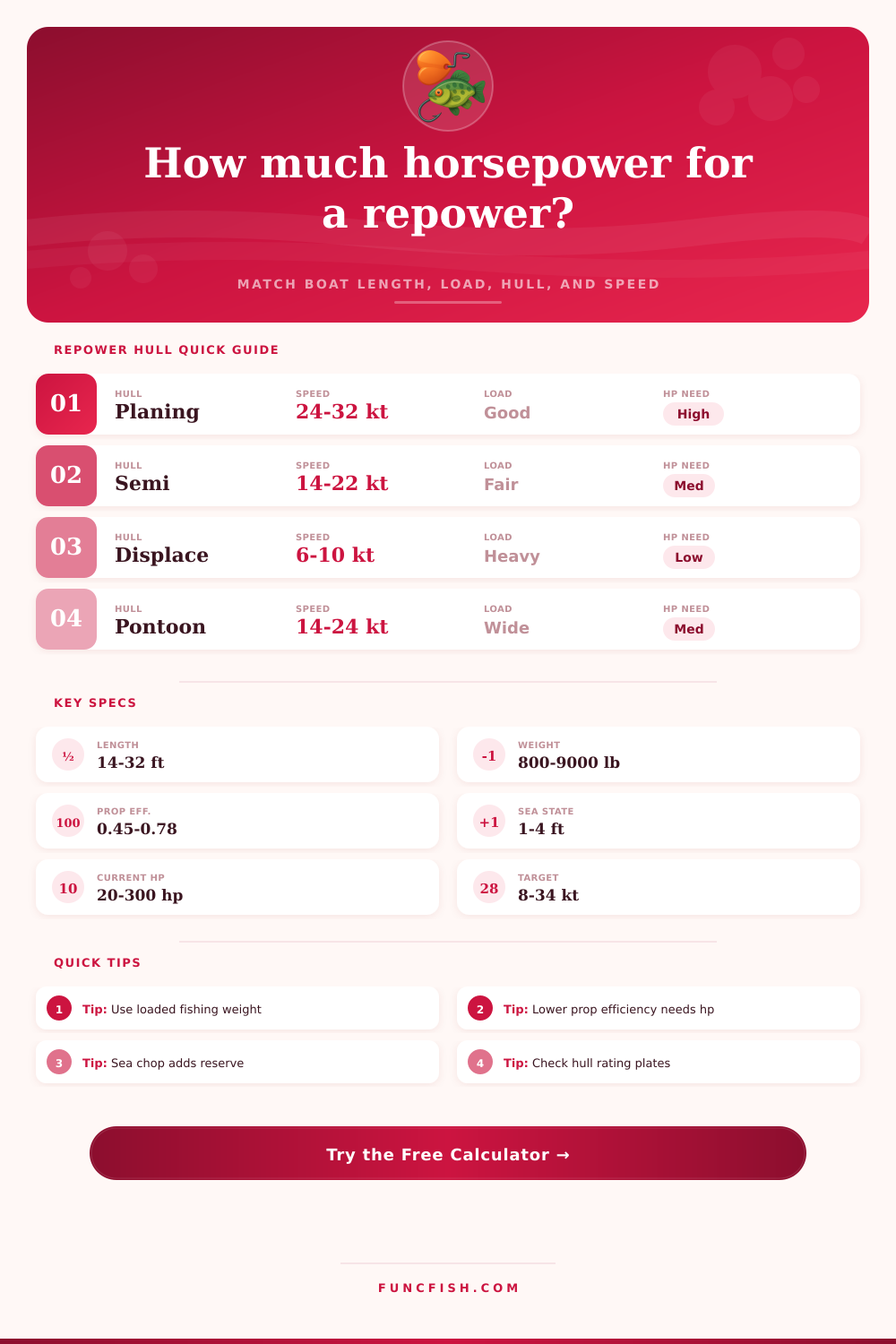
Use loaded fishing weight: Include fuel, batteries, ice, bait, crew, tackle, safety gear, and expected catch. A repower based on empty displacement can feel underpowered once the boat is rigged for a real trip.
Keep rating limits in the decision: Treat this calculator as a performance estimate and compare the result with the boat builder rating plate, transom structure, steering system, and local safety requirements.
When you choose a motor for your boat, you must choose the correct amount of horsepower for your boat. The correct amount of horsepower for your boat is important because the amount of horsepower you need can change based on the weight of the boat and the environmental condition in which the boat will be operating. People who are performing boat repowering often use the horsepower that the boat achieved in previous boating seasons.
However, the amount of horsepower that a boat require may differ based on the weight of the boat or the environmental conditions in which it is operating. If you choose the incorrect amount of horsepower your boat will require, then your boat may struggle to reach the target speed that it should of be able to achieve when it is loaded with all of it equipment. The primary factor that will determine how much horsepower your boat requires is the shape of the boats hull.
Choose the Right Horsepower for Your Boat
For example, boats with hulls that are modified Vs or flat bottom skiffs will generally require less horsepower than boats with deep V hulls or offshore center console hulls. For example, a fishing catamaran will require that the catamaran even distribute the horsepower between each hull. The calculator takes into account these different type of hulls by using coefficients that adjust for each hull type.
Another of the most important variables in determining the amount of horsepower your boat will require is the weight of the boat. The boat manufacturer’s builder’s plate may represent the weight of the boat. However, this weight does not include the weight of the fuel, the ice, the crew, or the gear that will be on the boat.
The weight of this additional equipment will change the ratio of the weight of the boat to the horsepower that it produces. The weight of the crew, the fuel, and the gear will impact the amount of horsepower that the boat will require to function corectly. A third factor that will impact the horsepower that is required for your boat is the efficiency of the propeller that is installed on the boat.
Installing a propeller that does not match your boats hull or the load of the boat will waste the horsepower that the motor produces. Propeller slip will impact how efficient the motor can work. The horsepower calculator incorporates the possibility of slip of the propeller by adjusting the amount of horsepower that is required according to the slip rate of the propeller.
Therefore, you must consider the efficiency of the propeller when calculating the amount of horsepower your motor will require. Another factor in the calculation of the horsepower that is required for your boat is the sea state. The horsepower that is required for a boat to move through protected waters with little chop in the water will be less than the horsepower that is required for a boat to travel through open bay or offshore areas with wind that may impact the movement of the boat.
The selection of the sea state for which your boat will be operating will allow the calculator to provide a margin for the horsepower that will be used to accelerate or maintain the boats cruise speed. This additional horsepower will provide a reserve of horsepower to ensure that the boat can maintain its traveling speed when the weather change. The horsepower that is required for your boat will also depend on the speeds to which you will be traveling on the boat.
Both displacement hulls and planing hulls will require a significant increase in the horsepower produced by the motor if the speed of the boat increases beyond the speed at which the boat is designed to travel efficient. Planing hulls are more forgiving of slightly higher speeds than displacement hulls. However, both type of hulls will struggle to increase the horsepower produced by the motor beyond the amount at which they are designed to operate.
The calculator incorporates these different speed requirements for both hull types so that there is an estimate of the speed at which the boat should travel alongside the amount of horsepower. Some of the most common mistakes in boat repowering is when individuals fail to account for the weight of the boat and the gear that was accumulated throughout the fishing day. Another mistake is using the horsepower specification from the boats builders plate as if it is a guarantee of the performance of the boat.
This specification is a measure of the maximum load that the boat can take. Another common mistake is to use the same motor as the friend who owns the boat. The motor that a friend may use on their boat may not provide the appropriate amount of horsepower for the specific propeller, load, and sea condition that the friend uses for their boat.
After you calculate the amount of horsepower that the boat will require, you must compare that number to your current motor and the transom structure on the boat. Additionally, you will need to consider the steering capacity of the boat and any local requirements of the boat. Depending on the differences between the horses of your current motor and the motor that is calculated to be required, you may only need a small increase in the horsepower of the motor or a much larger increase that would require changing the rigging or hull of the boat.
Your goal during the boat motor repowering process should not be to add the maximum amount of horsepower to your boat. Instead, your goal should be to find the correct amount of horsepower that will allow your boat to perform its function effective with the loads and water conditions that it encounters.