Jig Fall Rate Calculator
Estimate jig sink speed, countdown time, line-belly drift, and target-depth timing from jig weight, trailer drag, line, depth, current, and water density.
📌Scenario presets
⚙Fall rate inputs
Jig fall forecast
Full breakdown
📋Jig drag reference grid
Ball Head
Football
Swim Jig
Flutter
📐Fall rate reference tables
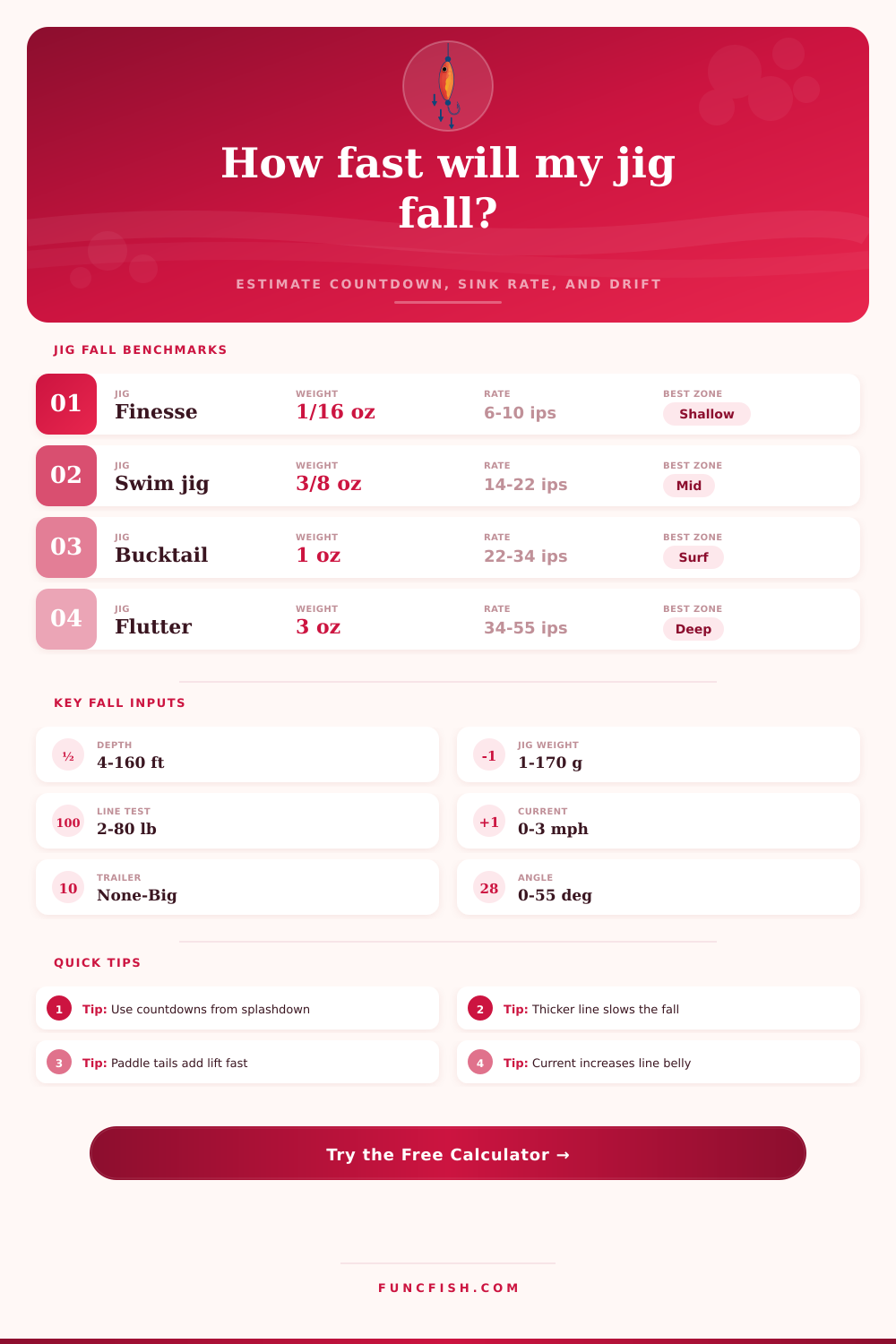
| Jig weight | Bare compact fall | Soft trailer fall | Countdown use |
|---|---|---|---|
| 1/32 oz / 0.9 g | 4-7 in/sec | 3-5 in/sec | Shallow panfish |
| 1/16 oz / 1.8 g | 6-10 in/sec | 4-8 in/sec | Crappie, trout |
| 1/8 oz / 3.5 g | 9-15 in/sec | 7-12 in/sec | Finesse bass |
| 1/4 oz / 7 g | 13-22 in/sec | 10-17 in/sec | Walleye, bass |
| 3/8 oz / 10.5 g | 16-28 in/sec | 12-22 in/sec | Swim jig |
| 1/2 oz / 14 g | 20-34 in/sec | 15-27 in/sec | Deep bass |
| 1 oz / 28 g | 28-44 in/sec | 22-35 in/sec | Surf bucktail |
| 3 oz / 85 g | 42-66 in/sec | 34-55 in/sec | Deep jigging |
| Line material | Sink behavior | Drag behavior | Fall-rate note |
|---|---|---|---|
| Braid | Neutral to slow | Thin for strength | Fastest countdowns |
| Fluorocarbon | Sinks | Moderate diameter | Cleaner vertical fall |
| Monofilament | Floats slightly | Larger diameter | Slower on slack line |
| Copolymer | Near neutral | Medium diameter | Middle-ground timing |
| Wire leader main line | Sinks | High stiffness | Stable but more drag |
| Lead-core trolling line | Sinks fast | Large diameter | Only for special rigs |
| Species target | Typical zone | Useful fall window | Common adjustment |
|---|---|---|---|
| Panfish / crappie | 4-18 ft | 3-10 in/sec | Small tube or hair jig |
| Trout | 3-25 ft | 5-14 in/sec | Thin line, small jig |
| Walleye | 8-45 ft | 10-28 in/sec | Match current first |
| Bass | 2-35 ft | 8-30 in/sec | Trailer controls fall |
| Redfish | 2-12 ft | 8-22 in/sec | Slow fall in skinny water |
| Striped bass | 8-70 ft | 18-45 in/sec | Use heavier bucktails |
| Pike / muskie | 3-25 ft | 12-32 in/sec | Account for wire drag |
| Deep-water predators | 60-250 ft | 30-70 in/sec | Keep line angle tight |
💡Practical calculation checks
Tip: Recheck the countdown whenever you change trailer shape. A paddle tail or hair dressing can slow the fall more than a small jig-weight change.
Tip: In current, watch the line angle. A jig that looks heavy enough on paper may fish much shallower once line belly forms.
When you first drop a jig into the water, the amount of time it takes for the jig to reach the fish is going to be a determining factor of whether or not you are going to successfuly land a fish. Many anglers may believe that the amount of time it takes for a jig to sink is a fixed number, but the time it takes for a jig to reach the fish can change based off changes in the head weights of the jig, changes in the trailer shape of the jig, changes in the line diameters, and changes in the movement of the water in which the jig is being cast. Both the amount of time it takes for the jig to land in the strike zone as well as the amount of time it takes for the jig to sail past the fish can be measured in second, so it is essential for anglers to calculate the amount of seconds it will take for the jig to reach the fish rather than guessing as to how long it will take for the jig to reach the fish.
The same variables affect the jig as those that appear when you are setting up the rod each time you go into the water. The jig head itself will have its own style, but the trailer that is attached to the jig will create resistance for the jig when moving through the water. For instance, if the trailer for the jig has paddle tails, the trailer will act as a parachute for the jig when it enters the water, which will create resistance for the jig.
How Fast Your Jig Sinks and Moves
Additionally, the line that is used for the jig will also affect the rate at which the jig falls. For instance, the current in the water will affect braided lines less than lines made of monofilament. Monofilament lines will have more diameter and will stretch more than braided lines because the monofilament is thicker than the braid.
Lastly, the density of the water will impact the movement of the jig. For instance, saltwater is more buoyant than freshwater, and colder water is more dense than water that is warmed. Additionally, the speed of the current in the water will impact the amount of horizontal movement the jig will make, as will the angle at which the jig is being cast.
These variables will impact the horizontal movement of the jig. While the jig calculator will provide the calculations necessary based upon the information that you provide for each of these variables, you must understand what each of these calculations indicate about your jig. The fall rate calculation will provide the speed at which the jig will fall through the water once all resistance variables have been applied to the jig.
The countdown time will convert that fall rate to the amount of seconds that it will take for the jig to reach the desired depth. The drift distance will calculate how far the jig will travel horizontally while it is falling. Each of these measurements is essential for understanding in what manner the jig will move through the water.
Most anglers tend to focus exclusively upon the weight of the jig that they are using. However, focusing exclusively upon the weight of the jig is a mistake. The calculation of the weight of the jig works for still water and without any additions to the jig, but will not account for either the trailer for the jig or the current in the water.
For instance, a three-eighths ounce football jig with a straight worm will have the proper drop for fishing in a calm body of water, but if you fit the same three-eighths ounce football jig with a paddle tail trailer and use it in a tide, the drop rate will be significantly slower due to the resistance of the paddle tail trailer. Additionally, if the jig is too light, such as a three-eighths ounce jig with a paddle tail trailer, the jig may drop too quicklyly past the fish that are present in the water. Anglers must consider each of these variables and the effect that they will have upon the movement of the jig to properly fish for the target species of fish.
Anglers must also pay attention to the angle at which the line is created between the fish and the jig. The angle is rarely a vertical line, but instead created as the jig is cast and the line is allowed to fall to the fish with slack line. When the jig is dropped with slack line, the angle of the line will cause the line to create belly in the line.
Additionally, the current in the water will push on the belly of the line, which will reduce the vertical movement of the jig but increase the horizontal movement of the jig in the water. The jig calculator will account for this line angle, but anglers must remember that if the fish are not in the same depth at which they are targeted with the calculation, this angle is potentially the cause of the fish not being at the targeted depth for the jig. The species of fish that are targeted in the area also add to the complexity of the jig.
For instance, walleye that are present in areas with current will require a different fall rate for the jig than crappie that are found in areas with brush. Additionally, redfish in shallow waters may flee the area if the jig is dropped too quickly with a too-light jig head, while deep water predators require heavier jig heads and line angles to account for the distance between the angler and the fish. The most common mistakes by anglers is to establish a successful day with a certain type of jig and to believe that this success will continue indefinitely.
The conditions in the water, however, can and do change. These conditions can change based upon the presence of wind, changes in the temperature of the water, or even the specific type of trailer that is being used for the jig. Anglers should re-evaluate the fall rate for the jig each time that one of these variables changes.
Checking the fall rate will help anglers to feel when one of the variables is not properly set up for success with the species of fish in the area. Finally, the calculations are only useful if they match the outcome of the jigs that are being dropped into the water. By dropping the jig into the water, counting the seconds indicated by the calculations, and noting to what depth the jig touches the bottom of the water area, anglers can ensure that the jig is falling at the proper rate.
If the calculations of the jig head match what is occurring in the water area, anglers can have confidence in using those calculations for fishing success. However, if the calculations do not match what occurs when the jig is dropped, it indicates that one of the variables has changed, at which point the angler can adjust those variables to account for the changes in the water.