🎣 Florida Bass Weight Calculator
Estimate largemouth bass weight from length & girth — imperial & metric, multiple formulas
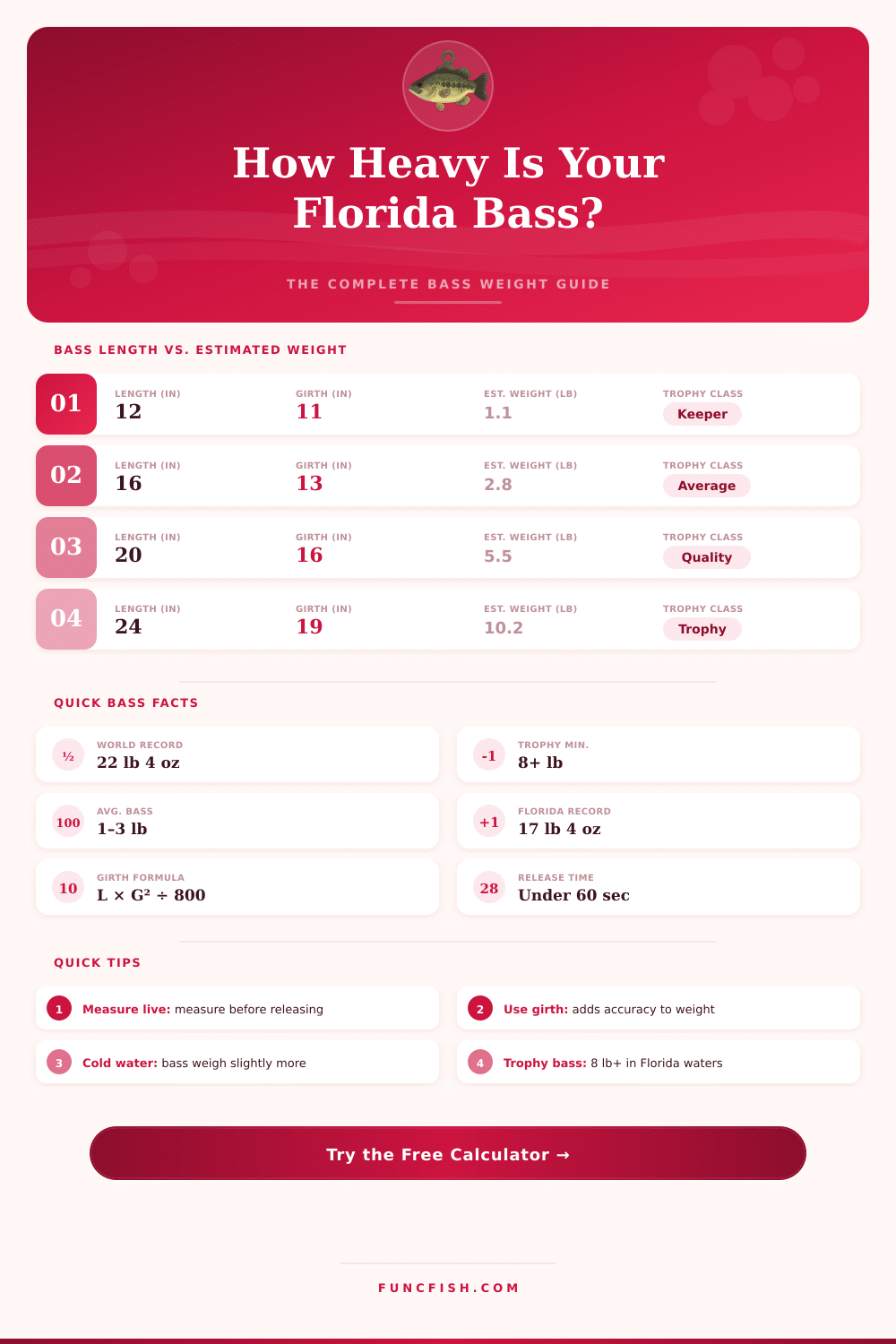
| Length (in) | Length (cm) | Typical Girth (in) | Est. Weight (lb) | Est. Weight (kg) | Class |
|---|---|---|---|---|---|
| 10 | 25.4 | 9.0 | 0.7 | 0.32 | Juvenile |
| 12 | 30.5 | 10.5 | 1.1 | 0.50 | Keeper Min. |
| 14 | 35.6 | 11.5 | 1.8 | 0.82 | Keeper |
| 16 | 40.6 | 12.5 | 2.8 | 1.27 | Average |
| 18 | 45.7 | 14.0 | 3.9 | 1.77 | Average+ |
| 20 | 50.8 | 15.5 | 5.5 | 2.50 | Quality |
| 22 | 55.9 | 17.0 | 7.7 | 3.49 | Quality+ |
| 24 | 60.9 | 18.5 | 9.9 | 4.49 | Trophy |
| 26 | 66.0 | 20.0 | 13.0 | 5.90 | Trophy+ |
| 28 | 71.1 | 21.5 | 16.5 | 7.48 | Record Class |
| Species | Avg. Weight | Trophy Weight | World Record | Formula Adjust |
|---|---|---|---|---|
| Largemouth Bass (Northern) | 1–3 lb | 8+ lb | 22 lb 4 oz | Standard (÷800) |
| Largemouth Bass (Florida Strain) | 2–5 lb | 10+ lb | 22 lb 4 oz | +8% adjustment |
| Smallmouth Bass | 0.5–2 lb | 5+ lb | 11 lb 15 oz | ÷900 divisor |
| Spotted Bass | 0.5–2 lb | 4+ lb | 10 lb 4 oz | ÷850 divisor |
| Striped Bass / Hybrid | 2–15 lb | 20+ lb | 81 lb 14 oz | L x G² ÷ 750 |
| Fish Condition | Girth:Length Ratio | Example (18" bass) | Weight Impact |
|---|---|---|---|
| Very Lean / Post-spawn | 0.60–0.65 | 10.8"–11.7" | −15 to −20% |
| Lean | 0.66–0.70 | 11.9"–12.6" | −8 to −12% |
| Average / Normal | 0.71–0.78 | 12.8"–14.0" | Baseline |
| Above Average | 0.79–0.85 | 14.2"–15.3" | +8 to +15% |
| Fat / Pre-spawn / Florida | 0.86–0.95 | 15.5"–17.1" | +20 to +35% |
Figuring out the Weight of deep fish without use of a scale is a challenge that many fishermen commonly meet. Common methods help that are estimate the length and girth of the fish, then put those values in a special formula. One of the most used recipes works thus: one multiplies the length by itself, then multiplies that by the girth and divides the result by 1 200.
The length and girth one measures in inches, where girth means the circumference of the body at the broadest place, and the final number shows pounds.
How to Estimate Fish Weight Without a Scale
Even so, such formulas only deliver guesses. They rely on average form of bass, hence fish fatter or slimmer than the standard can differ from the results. For instance, female bass that almost will bear, will weigh much mroe than the formula projects, so one should add some units to the rating in a similar situation.
Another way offers the use of tables to convert length to Weight. They show the usual mass for each measured length. Biologists of the B.A.S.S.
Organizations prepared a table for largemouth deep fishes, that is easy and reliable. When one knows the standard Weight for a certain length, fishermen can figure out what one calls relative Weight. For that, one divides the actual mass of the bass by the standard and multiplies by 100.
For instance, a 20.5-inch bass caught at 4.2 pounds could be compared with the standard for that size.
The yearly season seriously affects how much a bass weighs for any length. A fat 20-inch largemouth maybe reach around 7 pounds, even so that could seem a bit little according to the time of the year. According to rates of relative Weight, that use wildlife authorities in several states, a healthy 22-inch bass weighs about 6.21 pounds.
An interesting question is, what most determines the mass of bass. Diet, physical structure and length all matter, and hence too basses of same length can have very different weights.
Different formulas from various sources also can produce a lot of different results. One fisherman measured length and girth of the same fish, and received ratings between 8.88 and 10.5 pounds, according to what recipe one chose.
A picture always stays an imprecise way to estimate Weight, unfortunately. Without a scale, opinion from a photograph is simply opinion. Usually, estimating length helps better estimate the real size of bass.
The mass can adjust upward or down according to circumstances, but length of bass never shrinks. Online there are calculators for fish weights on fishing websites, that are useful for fast guesses, when a scale is not around. Basically, almost all such methods are only guesses, andthe alone safe method is to weigh the fish yourself.