🎣 Fluorocarbon Line Lifespan Calculator
Estimate how long your fluorocarbon line will last based on usage, conditions & storage habits
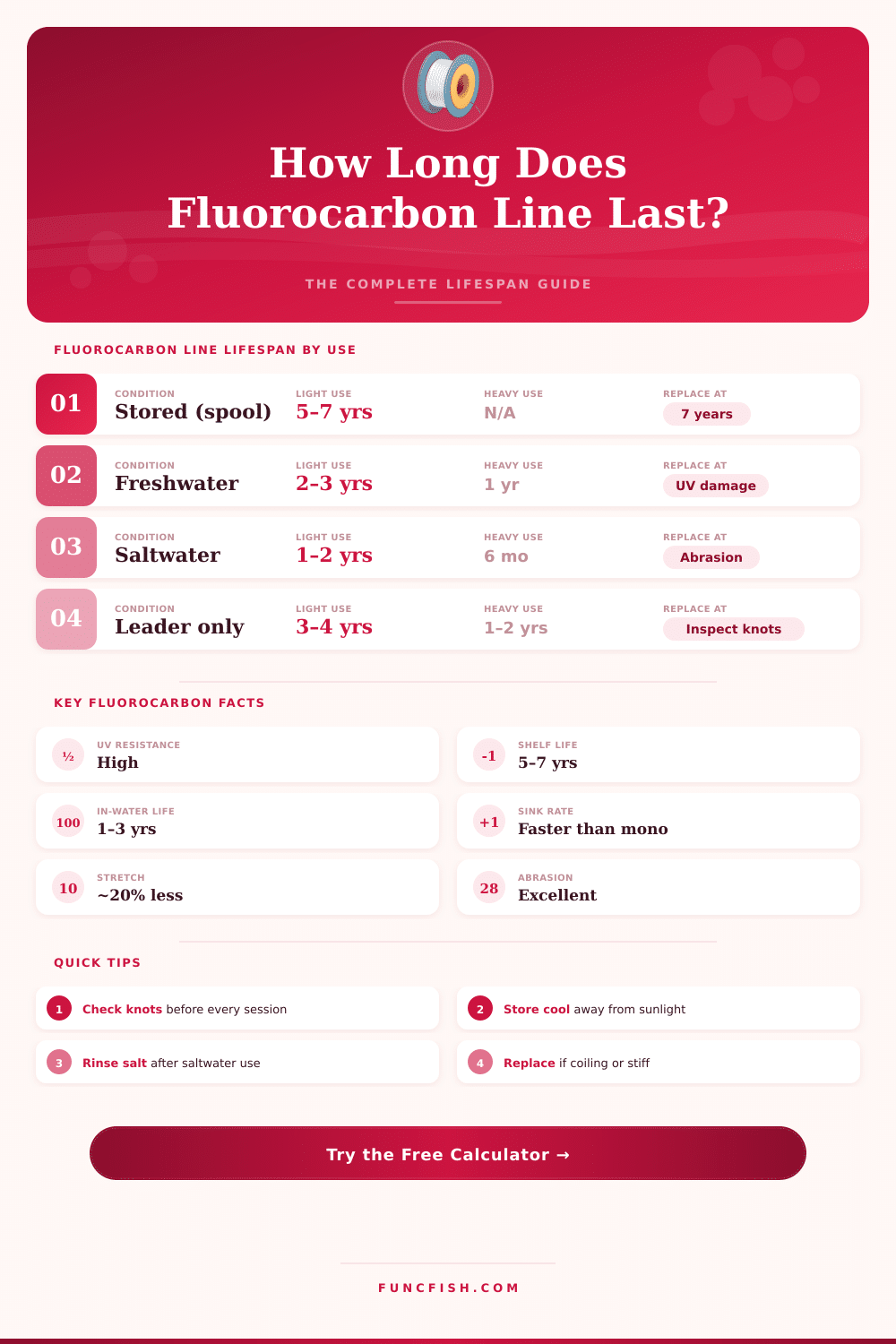
| Scenario | Estimated Life | Key Degradation Factor | Replace When |
|---|---|---|---|
| Stored (unopened spool) | 5–7 years | Humidity & heat | Visible coiling or brittleness |
| Stored (opened, indoor) | 3–5 years | Oxidation, UV exposure | Loss of suppleness |
| Light freshwater use | 2–3 seasons | Knot fatigue, abrasion | Memory coiling |
| Moderate freshwater use | 1–2 seasons | Abrasion, UV, knots | Nicks or rough texture |
| Heavy freshwater use | 6–12 months | Abrasion, repeated knots | Any nick near terminal tackle |
| Light saltwater use | 1–2 seasons | Salt crystallization | After rinsing if still stiff |
| Heavy saltwater use | 3–6 months | Salt, abrasion, UV | Monthly inspection |
| Leader only (freshwater) | 3–4 seasons | Knot stress, UV | After any big fish fight |
| Leader only (saltwater) | 1–2 seasons | Salt, abrasion | Every 5–10 trips |
| Target Species | Typical Weight Range | Recommended Fluoro LB | Expected Seasonal Life |
|---|---|---|---|
| Bluegill / Panfish | 0.1–1 lb (0.05–0.45 kg) | 2–4 lb | 2–3 seasons |
| Trout (stream) | 0.5–5 lb (0.2–2.3 kg) | 4–8 lb | 1–2 seasons |
| Bass (largemouth) | 1–10 lb (0.45–4.5 kg) | 8–15 lb | 1–2 seasons |
| Walleye | 1–8 lb (0.45–3.6 kg) | 6–12 lb | 1–2 seasons |
| Pike / Muskie | 5–40 lb (2.3–18 kg) | 15–30 lb | 1 season |
| Catfish | 2–50 lb (0.9–22.7 kg) | 15–30 lb | 6–12 months |
| Redfish / Inshore | 2–20 lb (0.9–9 kg) | 12–20 lb leader | 3–6 months |
| Snook | 3–30 lb (1.4–13.6 kg) | 20–30 lb leader | 3–6 months |
| Offshore (tuna/mahi) | 5–200+ lb | 40–80 lb leader | Inspect every trip |
| LB Test | Diameter (in / mm) | Knot Strength (%) | Abrasion Rating |
|---|---|---|---|
| 4 lb | 0.007" / 0.18 mm | 75–80% | Low |
| 6 lb | 0.009" / 0.23 mm | 78–83% | Low–Medium |
| 8 lb | 0.010" / 0.25 mm | 80–85% | Medium |
| 10 lb | 0.011" / 0.28 mm | 82–87% | Medium |
| 15 lb | 0.013" / 0.33 mm | 83–88% | Medium–High |
| 20 lb | 0.016" / 0.41 mm | 85–90% | High |
| 30 lb | 0.019" / 0.48 mm | 85–90% | Very High |
| 40 lb | 0.022" / 0.56 mm | 80–88% | Very High |
| 60 lb | 0.026" / 0.66 mm | 80–87% | Excellent |
| 80 lb | 0.030" / 0.76 mm | 78–85% | Excellent |
Cut the first 5–10% of your mainline spool after every 10–15 trips — the section nearest your terminal tackle accumulates the most nicks, abrasion damage, and knot stress. This simple habit can double the effective life of the rest of your spool.
Run your thumbnail along the last 12–18 inches of line above your lure. Any rough spots, flat sections, or nicks are a sign of micro-abrasion. Fluorocarbon feels smooth when new — if it catches your nail at all, retie with fresh line from further up the spool before your next cast.
The Fluorocarbon Line is famous because of its almost invisible look under water. It does not bend the light as much as single strand so it seems more small and less bright. Like this the line well hides itself from the fish.
The bending of light in Fluorocarbon Line is much more like that of water than nylon. It is not entirely invisible, but much more hardly noticed. So it well works for catching species that fear lines, for instance tuna.
Fluorocarbon Line: What It Is and How to Use It
The most many Fluorocarbon Line types are made up of a plastic called PVDF. Traits of Fluorocarbon Line range quite a lot from soft and easily cast until hard and resistant against wear. Flexible wet Fluorocarbon Line types give smooth launches and serve as main line or guide for various fishing methods.
Scratch resistance is one of the main bonuses. Although nylon can wear out because of rubbing, Fluorocarbon Line needs much more rubbing for damage than nylon. Guides from Fluorocarbon Line better protect against rocks, barks, teeth and scrapes.
It has also good feeling, so that fishers can notice what happens at the end of the line. Rather than usual single strand Fluorocarbon Line suffers little because of UV rays, what helps it last long.
Some Fluorocarbon Line types are dense and quickly sink, what helps to reach reactive baits like spinning or lipless lures more deeply. That fast sinking can do that soft toys quickly descend, what depends on the circumstances whether that pleases or not.
Knots are very important for Fluorocarbon Line. It can loose force, if rubbing builds during knot tying. Spit for reducing rubbing is a good idea.
Fluorocarbon Line can create bad tangles on bait casting reels. Bad direct launches with Fluorocarbon Line can quickly ruin the line.
Many fishers choose Fluorocarbon Line as guide combined with braided main line, instead of fill whole roll with it. Braided line gives better feeling and no memory, but it shows more in clear water. Adding a Fluorocarbon Line guide brings invisibility and scratch resistance.
In clear, quiet or shallow water Fluorocarbon Line truly helps to get more bites. In dirty or rough water it probably does not make big difference.
Some well known choices are Seaguar Red Label, that is seen as good value. Seaguar itself started the industry of Fluorocarbon Line fishing lines. Trilene Professional Grade Fluorocarbon is a reliable budget pick, that works quite well for everything.
Seaguar AbrazX works for heavy cover and big fish. There are also lines covered with Fluorocarbon Line material, that mixes plastic with Fluorocarbon Line for almost invisible look at lower price. Filling a whole roll with Fluorocarbon Line costs a lot so using it only for guides keeps costs low, while giving anadvantage in clear water.