🐟 Giant Trevally Weight Calculator
Estimate GT weight from length & girth measurements — imperial & metric supported
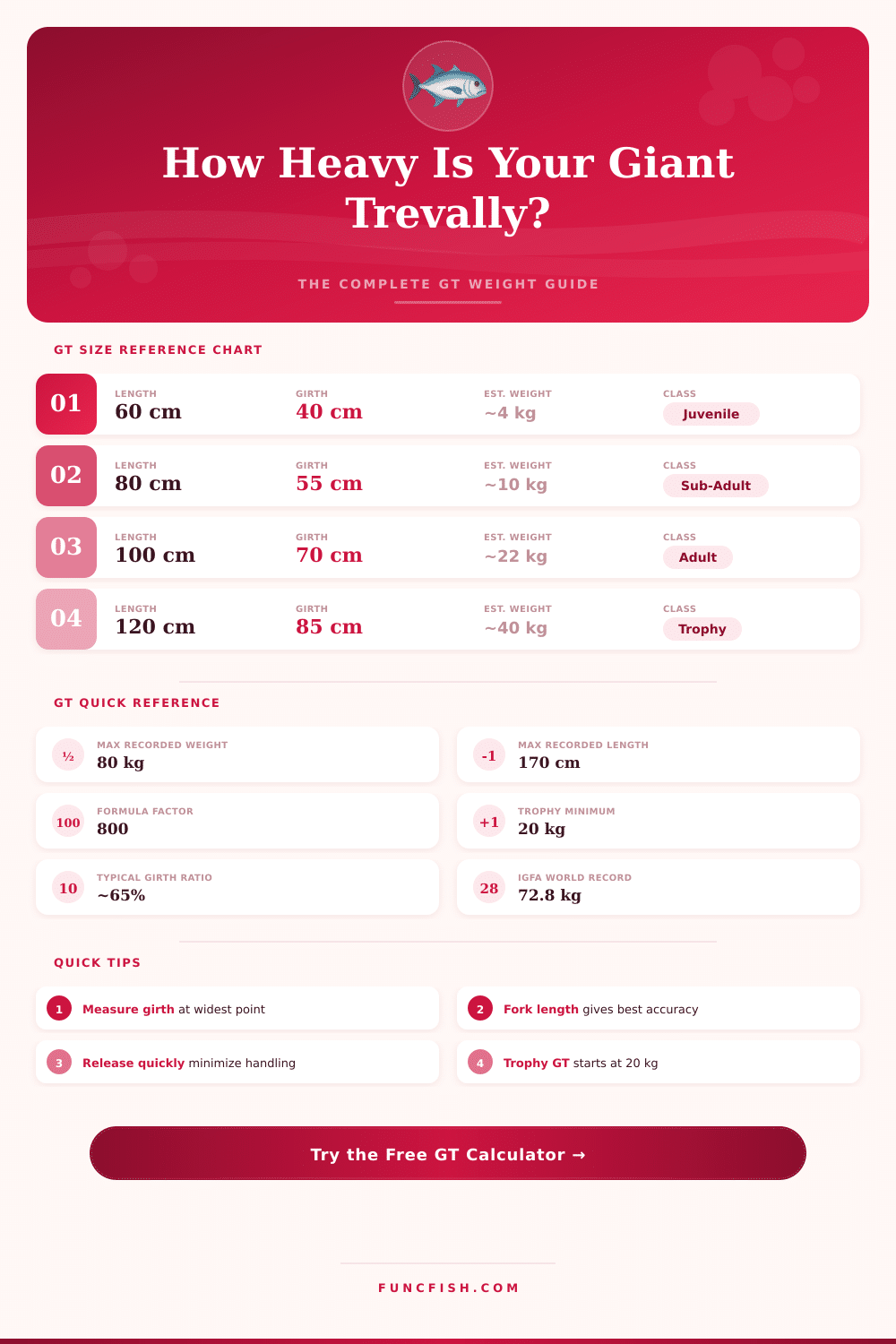
| Fork Length | Typical Girth | Est. Weight (kg) | Est. Weight (lb) | Size Class |
|---|---|---|---|---|
| 50 cm / 20 in | 33 cm / 13 in | ~2.3 kg | ~5 lb | Juvenile |
| 60 cm / 24 in | 40 cm / 16 in | ~4.1 kg | ~9 lb | Juvenile |
| 70 cm / 28 in | 47 cm / 18.5 in | ~6.6 kg | ~14.5 lb | Sub-Adult |
| 80 cm / 31.5 in | 54 cm / 21 in | ~10.1 kg | ~22 lb | Sub-Adult |
| 90 cm / 35 in | 61 cm / 24 in | ~15.1 kg | ~33 lb | Adult |
| 100 cm / 39 in | 68 cm / 27 in | ~21.4 kg | ~47 lb | Adult |
| 110 cm / 43 in | 75 cm / 29.5 in | ~28.9 kg | ~64 lb | Adult |
| 120 cm / 47 in | 82 cm / 32 in | ~38.2 kg | ~84 lb | Trophy |
| 130 cm / 51 in | 89 cm / 35 in | ~49.5 kg | ~109 lb | Trophy |
| 140 cm / 55 in | 96 cm / 38 in | ~62.5 kg | ~138 lb | Record Class |
| Size Class | Est. Weight | Rod Rating | Line (PE/Braid) | Technique | Leader |
|---|---|---|---|---|---|
| Juvenile | <8 kg / <18 lb | 20–40 lb | PE 2–4 | Casting / Fly | 60–80 lb mono |
| Sub-Adult | 8–18 kg / 18–40 lb | 40–60 lb | PE 4–6 | Popping / Jigging | 80–100 lb mono |
| Adult | 18–35 kg / 40–77 lb | 60–80 lb | PE 6–8 | Popping / Jigging | 100–130 lb mono |
| Trophy | 35–60 kg / 77–132 lb | 80–120 lb | PE 8–10 | Heavy Popping | 130–200 lb mono |
| Record Class | 60+ kg / 132+ lb | 120–200 lb | PE 10–12 | Heavy Popping | 200–300 lb mono |
| GT Weight | Popper Size | Stickbait Size | Jig Weight | Hook Size |
|---|---|---|---|---|
| <8 kg / <18 lb | 60–100g | 50–80g | 80–150g | 3/0–5/0 |
| 8–18 kg / 18–40 lb | 100–160g | 80–130g | 150–250g | 5/0–7/0 |
| 18–35 kg / 40–77 lb | 160–220g | 130–200g | 250–350g | 7/0–9/0 |
| 35–60 kg / 77–132 lb | 220–280g | 200–280g | 300–450g | 9/0–11/0 |
| 60+ kg / 132+ lb | 260–350g | 250–350g | 400–600g | 11/0–14/0 |
When talking about the biggest fish from the genus Caranx, the Giant Trevally gets the prize. Those creatures reach around 170 centimetres in length… About five and a half to six feet if you use imperial measures.
The heaviest officially recorded Weight is about 80 kilos, which matches to 176 to 180 pounds depending on the source that you check. Truly, it is an impressive heavy fish.
Size and Weight of the Giant Trevally
But here comes the truth. Fish of such huge size are not commonly found. Only rarely you find Giant Trevally that pass the 80-centimetre limit.
Usually, you meet them at around three feet in length, weighing maybe 50 pounds or so. Catching one in the 20-pound rnage? That happens quite commonly, and honest, fish that size is still a typical Giant Trevally, whatever the place of your fishing.
The Giant Trevally ranks in the fifth place among the biggest members of the family Carangidae. Four species beat it: the yellowtail amberjack, the greater amberjack, the leerfish and the rainbow runner, all reach bigger size. There is also the crevalle jack, another relative, that tops out at around 120 centimetres and weighs maybe 30 kilos, far from reaching the huge size of the Giant Trevally.
In normal conditions, that fish weighs between 33 and 132 pounds according to various cases. After maturity, many adults find themselves in the zone of 40 to 60 pounds. Fully grown ones commonly pass 150 centimetres and can reach 80 kilos.
Their sharp brow, together with thick tail and compact body, make them explosive hunters, ideal for fast attack on prey.
Other species of trevally can reach around 50 kilos, but most of them stay in the range of 5 to 10 kilos. The Giant Trevally leaves those figures behind. For serious fishermen, catching something above 100 pounds is the dream, although such fish become more rare today, when pressure grows in popular places.
Giant Trevally passing 50 kilos appear regularly for expert skilled fishermen, that know what they do. The record Weight reached a massive 176 pounds. Small ones, called papio in Hawaii, are edible at 1 to 3 pounds.
That fish reaches sexual maturity at around 60 centimetres, with typical adult length around 100 centimetres. They live usually between 10 and 25 years. Males can turn dark in colour during maturity, while the species widely have silver tone with scattered black marks.
Seeing adults is easy, but youngsters weighing three or fourkilos commonly confuse, because many trevally species live in same waters.