🎣 Largemouth Bass Relative Weight Calculator
Calculate your bass Wr score and see how it compares to standard population benchmarks
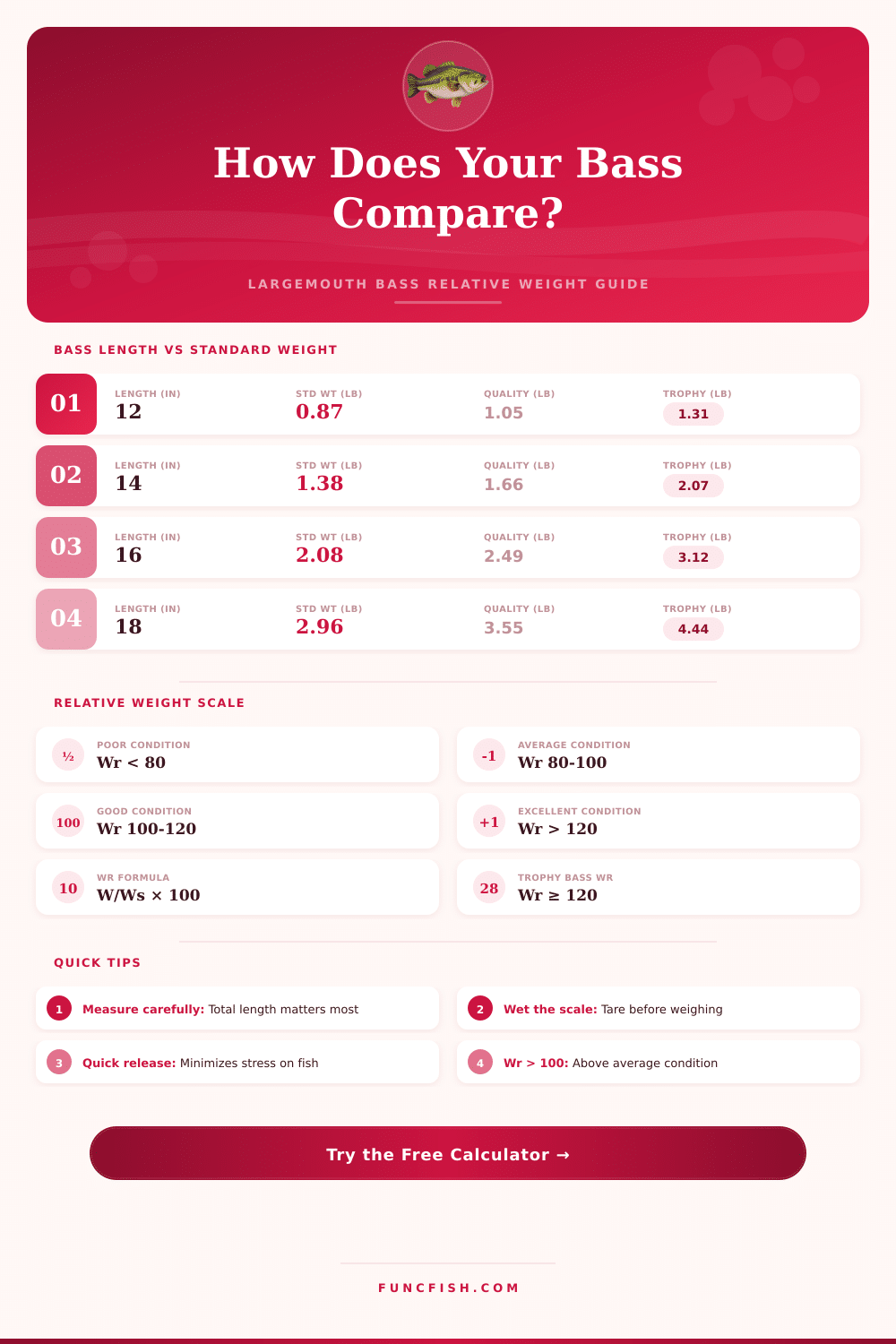
| Length (in) | Length (cm) | Std Weight Ws (lb) | Std Weight Ws (kg) | Quality (Wr=100) lb | Memorable (Wr=120) lb |
|---|---|---|---|---|---|
| 10 | 25.4 | 0.55 | 0.25 | 0.55 | 0.66 |
| 12 | 30.5 | 0.87 | 0.39 | 0.87 | 1.04 |
| 13 | 33.0 | 1.11 | 0.50 | 1.11 | 1.33 |
| 14 | 35.6 | 1.38 | 0.63 | 1.38 | 1.66 |
| 15 | 38.1 | 1.71 | 0.78 | 1.71 | 2.05 |
| 16 | 40.6 | 2.08 | 0.94 | 2.08 | 2.50 |
| 17 | 43.2 | 2.50 | 1.13 | 2.50 | 3.00 |
| 18 | 45.7 | 2.96 | 1.34 | 2.96 | 3.55 |
| 19 | 48.3 | 3.47 | 1.57 | 3.47 | 4.16 |
| 20 | 50.8 | 4.03 | 1.83 | 4.03 | 4.84 |
| 22 | 55.9 | 5.35 | 2.43 | 5.35 | 6.42 |
| 24 | 61.0 | 6.94 | 3.15 | 6.94 | 8.33 |
| Wr Range | Condition | Population Interpretation | Management Note |
|---|---|---|---|
| <80 | Poor | Overcrowded or food-limited | May need harvest pressure |
| 80–89 | Below Average | Slightly stunted or stressed | Monitor forage base |
| 90–99 | Slightly Below Avg | Adequate but not thriving | Observe forage availability |
| 100–109 | Average | Healthy, balanced population | Standard management OK |
| 110–119 | Above Average | Excellent forage / habitat | Protect quality fish |
| 120–134 | Excellent | Outstanding body condition | Trophy potential present |
| 135+ | Exceptional | Peak condition / exceptional forage | Preserve genetics |
| Species | Typical Length (in) | Avg Weight (lb) | Wr Formula Base (log a) | World Record (lb) |
|---|---|---|---|---|
| Largemouth Bass | 10–24 | 1–6 | –5.316 | 22.25 |
| Smallmouth Bass | 8–20 | 0.5–4 | –5.329 | 11.94 |
| Spotted Bass | 8–18 | 0.5–3 | –5.374 | 10.56 |
| Florida Largemouth | 12–28 | 2–12 | –5.316 | 25.11 (CA) |
| Redeye Bass | 6–14 | 0.25–1.5 | –5.374 | 8.3 |
| Guadalupe Bass | 6–12 | 0.2–1 | –5.40 | 3.71 |
The relative weight of largemouth bass is a simple tool for guessing whether a fish has good health or not. It compares the current weight of the fish with what it should weigh based on its length. The idea behind it is simple: you take the real weight, divide it by the standard weight for that length then multiply by 100 to get the percentage.
There is your relative weight, clear and easy.
How to Use Weight and Length to Check Bass Health
Let me walk you through some cases to explain this. Assume you caught a largemouth bass of 16 inches, that weighs 2 pounds on the scale. This gives 89 percent of relative weight, which sits well in the normal range.
Here is another situation, using metric values. When your bass has 454 grams, while the average for that size is about 401 grams, you divide the two numbers and multiply by 100, to reach 113. This fish is doing wlel.
Higher than the usual, actually.
About what counts as healthy, relative weights between 0.8 and 1.0 sit easily in what one finds among living bass in a population. A 15-inch largemouth bass of 1.5 pounds wood not reach the perfect target, but it stays in a well accepted range for healthy fish.
To learn the average weights at different lengths, those values show in charts. A 10-inch bass normally weighs around 10 ounces. Go up to 16 inches, and you find about 36 ounces, say 2 pounds and 4 ounces.
A 20-inch fish has around 72 ounces, or almost 4 pounds and 8 ounces. At 22 inches, the standard weight climbs to around 99 ounces, which is about 6 pounds and 3 ounces (healthy 22-inch bass usually reach 6.21 pounds). The biggest case here: a 24-inch bass should have 131 ounces, so around 8 pounds and 3 ounces.
In other words, the condition matters… A good 24-inch bass can weigh between 6 and 8 pounds, depending on how well it fed itself.
You can guess the weight of fish for many species, if you know the length and sometimes the girth. For largemouth bass, there are charts, online calculators and rules, that help to guess weight from measurements. One commonly used rule takes the girth, squares it, multiplies by the length, then divides the total by 800 to get pounds.
This is quite handy, if you do not have a scale with you.
Actually, the length is a more steady measure than the weight in some ways. The weight changes with seasons and with food, but bass do not get shorter with time. The time of year makes a big difference for the weight of fish.
Also, measuring length puts less strain on the fish than weighing, it goes faster and with less stress. Getting the catch back in the water soon and in good shape truly matters. If you are interested, the calculators for relative weight work for largemouth bass, smallmouth bass and hybridstriped bass also.