🐟 Largemouth Bass Weight Calculator
Estimate bass weight from length & girth using the official fish weight formula — imperial & metric supported
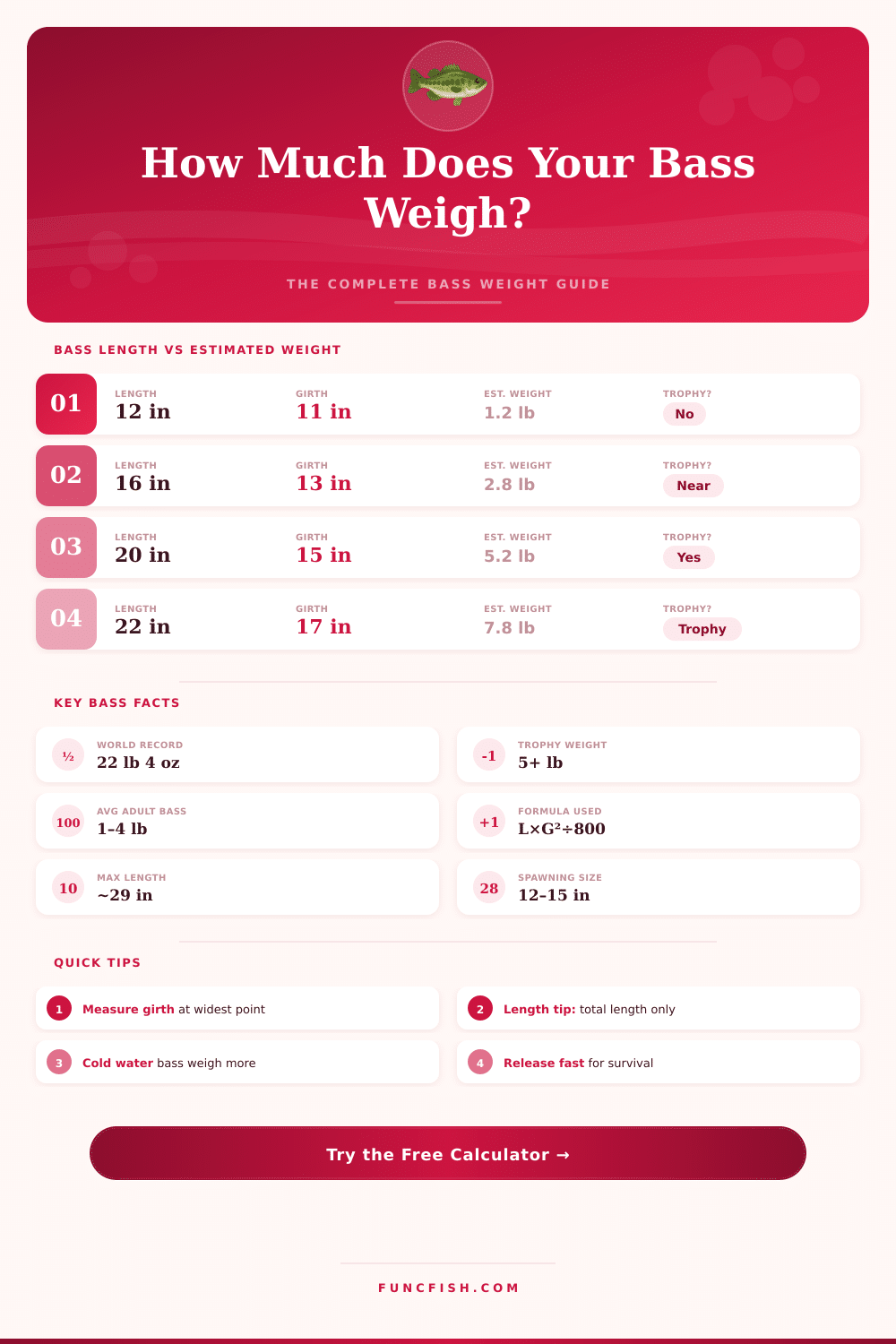
| Length (in) | Length (cm) | Typical Girth (in) | Est. Weight (lb) | Est. Weight (kg) | Classification |
|---|---|---|---|---|---|
| 10 | 25.4 | 9.0 | 1.0 | 0.45 | Sub-legal / Juvenile |
| 12 | 30.5 | 10.0 | 1.5 | 0.68 | Legal Minimum (many states) |
| 14 | 35.6 | 11.0 | 2.1 | 0.95 | Keeper Bass |
| 15 | 38.1 | 11.5 | 2.5 | 1.13 | Keeper Bass |
| 16 | 40.6 | 12.5 | 3.1 | 1.41 | Quality Bass |
| 18 | 45.7 | 13.5 | 4.1 | 1.86 | Quality Bass |
| 20 | 50.8 | 15.0 | 5.6 | 2.54 | Trophy Bass 🏆 |
| 22 | 55.9 | 16.0 | 7.0 | 3.18 | Trophy Bass 🏆 |
| 24 | 61.0 | 17.5 | 9.2 | 4.17 | Elite Trophy ⭐ |
| 26 | 66.0 | 18.5 | 11.1 | 5.03 | State Record Class ⭐ |
| Bass Weight | Technique | Recommended Line | Rod Power | Hook Size |
|---|---|---|---|---|
| Under 2 lb | Finesse / Drop Shot | 6–10 lb mono / 10 lb braid | Light–Med Light | #1 – 1/0 |
| 2–4 lb | Spinning / Crankbait | 10–14 lb mono / 20 lb braid | Medium | 2/0 – 3/0 |
| 4–6 lb | Baitcasting / Jig | 14–17 lb mono / 30 lb braid | Medium Heavy | 3/0 – 4/0 |
| 6–8 lb | Flipping / Frog | 17–20 lb mono / 50 lb braid | Heavy | 4/0 – 5/0 |
| 8+ lb | Heavy Cover / Punching | 20+ lb mono / 65 lb braid | Heavy–XHeavy | 5/0 – 7/0 |
| Species | Avg Weight | Trophy Weight | World Record | Formula Divisor |
|---|---|---|---|---|
| Largemouth Bass | 1–4 lb | 5+ lb | 22 lb 4 oz | 800 |
| Smallmouth Bass | 0.5–2 lb | 3+ lb | 11 lb 15 oz | 900 |
| Spotted Bass | 0.5–2 lb | 3+ lb | 10 lb 4 oz | 850 |
| Striped Bass | 5–15 lb | 20+ lb | 81 lb 14 oz | 800 |
| White Bass | 0.5–1.5 lb | 2+ lb | 6 lb 13 oz | 900 |
Always measure total length from tip of mouth to end of tail (pinched closed). Measure girth at the widest point of the body, typically just behind the pectoral fins. Use a flexible measuring tape for girth. The formula Weight = (Length × Girth²) ÷ 800 gives weight in pounds when measurements are in inches.
Fish weight varies by up to 15–20% seasonally. Pre-spawn females (spring) are at peak weight carrying eggs. Post-spawn fish can weigh 10–15% less. Summer bass actively feeding in warm water can exceed formula estimates. Winter bass in cold water often weigh slightly more per unit length due to denser, less active muscle tissue.
Cook fish skin until it crisps well in the pan are more difficult than many folks imagine. When the fish touch the warm oil, it commonly curls and jumps what stops the cook and result in soft loose skin. Using a fish press, you can print the bend against the bottom of the pan during the cook, what allows the skin become crisp and golden during the heat spreads equally.
That pressure spreads above the whole surface and ease the lift for you. Honestly, from afar it looks like a burger press. There exist good stainless steel versions, that ship quickly in United States or Canada.
How to Make Fish Skin Crispy and Weigh a Fish
Some like to search little cast iron presses in thrift shops as a practical solution. The stuff weighs a bit more than one would mind and washes easily without fuss.
Getting the Weight of fish without removing the scales happen more commonly than one would assume. For this exists a simple way that relies on length and girth. Here is how it works: square the girth, multiply the result by the length, later divide everything by 800.
Assume you caught a fish with girth of 15 inches and length of 29 inches. Simply enter those in the calculation. The number can slide upward or down according to the species, because local fishes occasionally weigh more or less than average.
If you can not measure the girth, use 0.58 times the length as an estimate.
Even so, those calculations are not always precise. Thin or fattening fishes of same length can have entirely different weights. Length-based tools are especially not reliable four species like stingrays.
Not always the longest fish is the heaviest.
For truly precise Weight, use a digital hanging scale with a built-in lip grip. Simply hook it to the center of the bottom jaw and read the value. If your scale has only hooks, clip a extra lip grip and cancel its Weight by means of the tare button.
One model fits until 110 pounds, has a lit screen for good reading and operates on two AAA-batteries.
The Weight of fish shrinks quickly after one pulls it from the water. Blood, vomiting and waste all contribute. But water loss?
It usually is the main cause. Fishes always manage their internal water by means of osmoregulation, so what weighs at the catch moment does not match the final Weight on the scale.
Length occasionally beats Weight as a rating. Weight changes, but the length stays permanent. Quickly replace the fish in the water after catching matters a lot, keep it from the water no longer than you can hold your breath, as a good rule.
In one study about more than 144 individuals, the averageloss outside was around 2.38 units for fish, what matches roughly 6.75 for pounds.