🐟 Mahi Mahi Weight Calculator
Estimate dorado weight from length & girth — imperial & metric results instantly
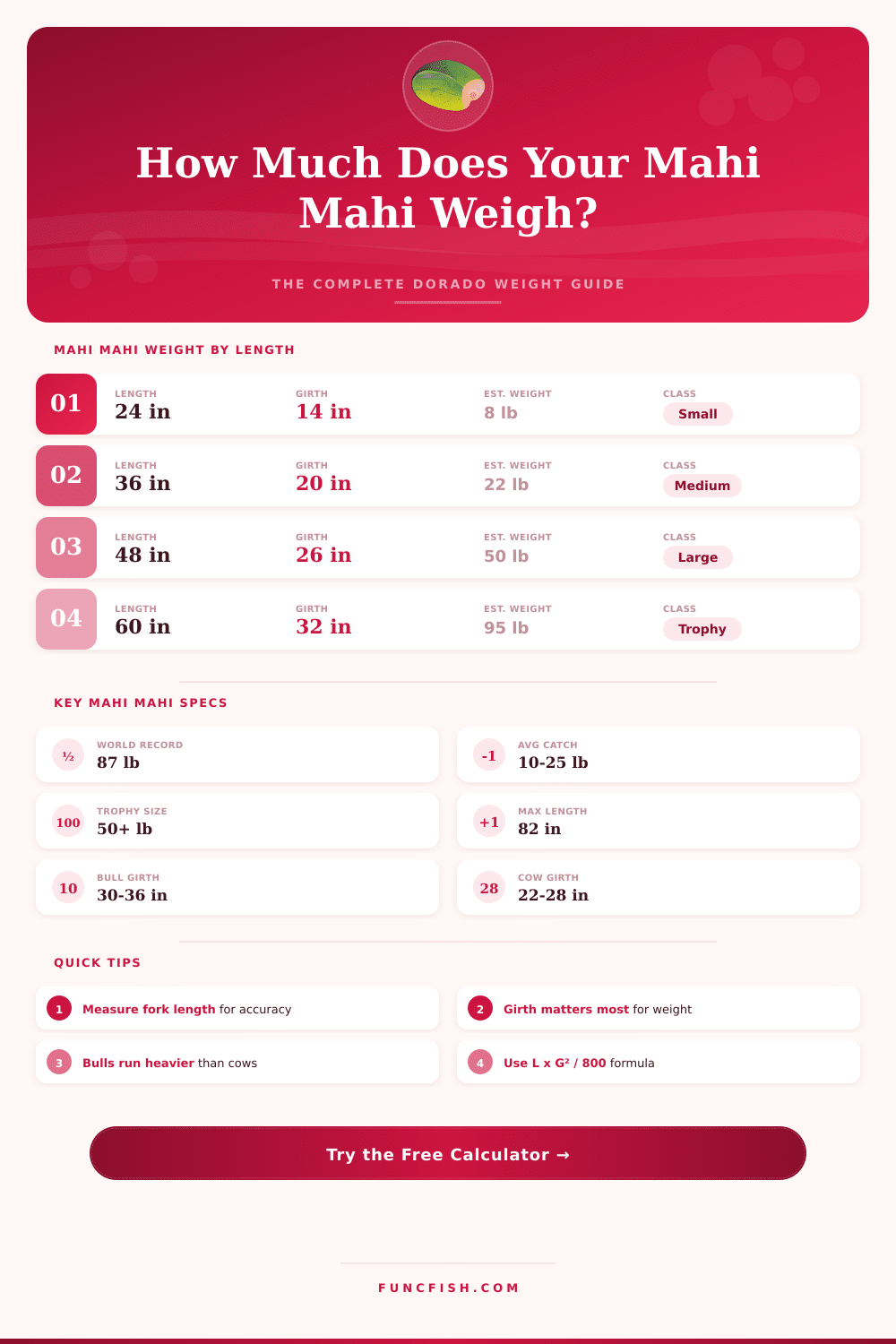
| Fork Length (in) | Fork Length (cm) | Est. Girth (in) | Est. Weight (lb) | Est. Weight (kg) | Class |
|---|---|---|---|---|---|
| 18 | 45.7 | 11 | 4.5 | 2.0 | Juvenile |
| 24 | 61.0 | 14 | 9.9 | 4.5 | Small |
| 30 | 76.2 | 17 | 18.5 | 8.4 | Medium |
| 36 | 91.4 | 20 | 32.4 | 14.7 | Good |
| 42 | 106.7 | 23 | 49.8 | 22.6 | Large |
| 48 | 121.9 | 26 | 74.9 | 34.0 | Trophy |
| 54 | 137.2 | 29 | 105.0 | 47.6 | Big Trophy |
| 60 | 152.4 | 32 | 143.4 | 65.0 | Slam |
| Species | Avg Weight | Trophy Weight | Formula | Girth / Length Ratio |
|---|---|---|---|---|
| Mahi Mahi (Bull) | 15–30 lb | 50+ lb | L x G² / 800 | 60–65% |
| Mahi Mahi (Cow) | 10–20 lb | 35+ lb | L x G² / 800 | 55–60% |
| Wahoo | 20–40 lb | 80+ lb | L x G² / 800 | 40–48% |
| Yellowfin Tuna | 40–100 lb | 200+ lb | L x G² / 800 | 70–80% |
| Sailfish | 50–90 lb | 140+ lb | L x G² / 800 | 35–45% |
| Measurement Type | Description | Conversion to Fork Length | Accuracy |
|---|---|---|---|
| Fork Length | Tip of jaw to fork of tail | 1.00x (baseline) | Highest |
| Total Length | Tip of jaw to end of tail | Multiply by 0.92 | Good |
| Lower Jaw Fork | Lower jaw to fork of tail | Multiply by 0.98 | High |
Get crisp skin on fish is more difficult than it seems. When the bit touches the warm oil, it immediately curls. That curving ruins your cook, you end with uneven warming and floppy skin that none enjoys.
Fish pressure helps to settle every problem. It is a kind of press that keeps the fish flat against the pan, ensuring permanent contact of the skin with the heat. That pressing allows the skin to cook well and crisp, while the meat inside cooks equally.
Make Fish Skin Crispy, Weigh Fish, and Choose the Right Sinkers
If you ever used a press for hamburgers, you will right away know the idea. Josh Niland created one famous version from stainless steel, that became very known in the cooking world. It is a professional tool that gives results almost from a restaurant, without need of years of practice.
The object weighs around 4 pounds (about 1.8 kilos) and costs around 165 dollars. There is even a version in rainbow colours, if you want something more colorful and both versions ship quickly to United States and Canada.
Here where things become interesting, counting the weight of fish, when you stand here without a scale, is an entirely other thing. There is a simple formula that is based on length and girth. You square the girth, later multiply it by the length and then divide the result by 800.
Both measures must be in inches, and the answer will come out in pounds. That number 800 is not exact. You can raise or lower it based on the species of fish, whether it weighs more than avreage or less.
Here the key: only the length does not work. One fish can be short but thick, while another is long and slim. You truly need both measures to reach something close to accuracy.
The real body shape affects a lot. Does the fish have a full belly, recently born or migrating, everything affects its wait compared to only the length.
Because of that, to truly weigh fish, a digital scale with a built-in lip grip works best. The grip keeps flat the center of the bottom jaw. If you have only a hook, you can add a separate lip grip and later subtract its weight.
One good digital model comes with a big handle plus built-in tape, maxes out at 110 pounds or 50 kilos, and includes three AAA batteries right from the box.
When dealing with sinkers for fishing, those weights that you use in the water… The choice depends fully on the conditions. More lightweight split sinkers work for sliding along the bottom in calm water.
Heavier casting sinkers stay better fixed in one place. Pyramid weights work well in strong flows, like at the coast. Slim weights that are smooth and sleek slip through flows more easily.
From my experience, fishers commonly choose 4 to 6 ounce pyramid sinkers to anchor the lines against the flow. Others prefer 3 to 4 ounce slim weights forsmoother launching and pulling back.