🐟 Sailfish Weight Calculator
Estimate sailfish weight from length & girth measurements — imperial & metric supported
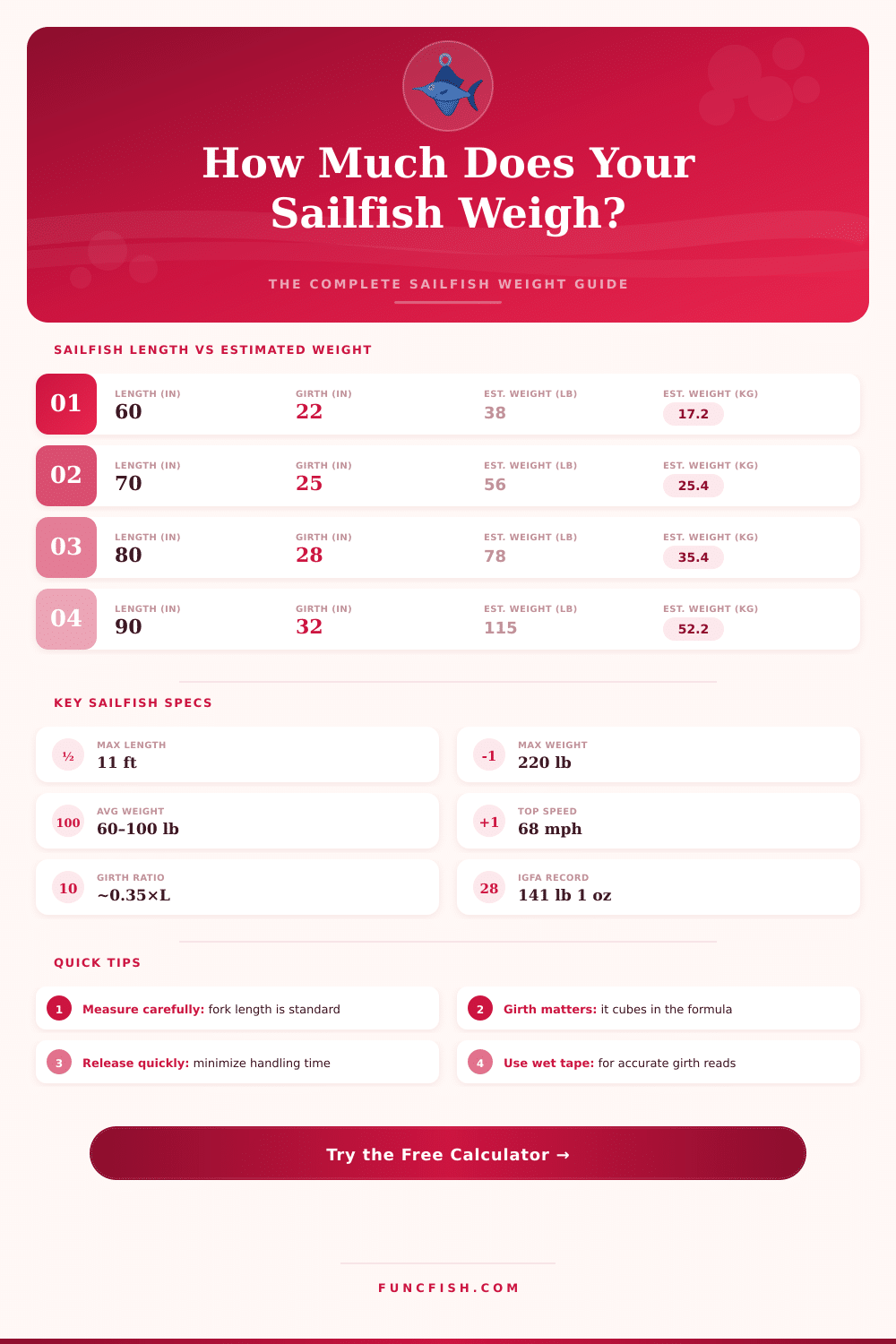
| Fork Length (in) | Fork Length (cm) | Typical Girth (in) | Est. Weight (lb) | Est. Weight (kg) | Species |
|---|---|---|---|---|---|
| 55 | 140 | 20 | 28 | 12.7 | Atlantic |
| 60 | 152 | 22 | 36 | 16.3 | Atlantic |
| 66 | 168 | 24 | 48 | 21.8 | Atlantic |
| 72 | 183 | 26 | 61 | 27.7 | Atlantic |
| 78 | 198 | 28 | 76 | 34.5 | Atlantic/Pacific |
| 84 | 213 | 30 | 95 | 43.1 | Pacific |
| 90 | 229 | 32 | 115 | 52.2 | Pacific |
| 96 | 244 | 34 | 138 | 62.6 | Pacific |
| 102 | 259 | 36 | 165 | 74.8 | Pacific |
| 108 | 274 | 38 | 194 | 88.0 | Pacific |
| Species | Avg Weight (lb) | Avg Length (in) | Formula Divisor | IGFA Record (lb) |
|---|---|---|---|---|
| Atlantic Sailfish | 40–100 | 60–84 | 800 | 141.1 |
| Pacific Sailfish | 60–180 | 72–108 | 800 | 221.0 |
| Blue Marlin | 200–800 | 96–180 | 800 | 1402.2 |
| White Marlin | 40–80 | 60–90 | 800 | 181.1 |
| Striped Marlin | 80–200 | 78–120 | 800 | 494.0 |
| Spearfish | 30–60 | 54–72 | 800 | 90.4 |
| Swordfish | 100–400 | 84–160 | 800 | 1182.0 |
| Est. Weight (lb) | Rod Class | Line Class (lb) | Reel Size | Leader (lb) |
|---|---|---|---|---|
| 20–40 | Light 20 lb | 12–20 | Medium spinning | 40–60 |
| 40–70 | Medium 30 lb | 20–30 | 4000–6000 | 60–80 |
| 70–100 | Medium-Heavy 50 lb | 30–50 | 6000–8000 | 80–100 |
| 100–150 | Heavy 80 lb | 50–80 | 8000–10000 | 100–130 |
| 150–220 | Extra Heavy 130 lb | 80–130 | Heavy conventional | 130–200 |
Crisping the skin of fish is between those tasks that seems easy, but commonly result hardly. When the bit of fish touches the hot check, it curls upward. That curling causes uneven cook and soft skin.
Maybe none wants that experience.
How to Get Crispy Fish Skin and Weigh Fish Without a Scale
Here comes the fish press. This tool presses the fish pieces so that it crisps and cooks evenly. The press delivers strong pressure on the whole surface of the fish, what keeps it down during the skin becomes crispy.
At first sight, it reminds you of the press for hamburgers.
A well known model is the stainless steel press for fish, created by Josh Niland. One describes it as a professional tool, that helps to reach skin of restaurant quality, crispy and perfect, without big effort. According to reports, it weighs about 1.8 kg, what matches around 4 pounds.
The cost is 165 dollars. One can receive it quickly in United States and Canada.
Here is a totally different topic: how to estimate the weight of fish, when there is no scale. A common method works for trout and many other species. You take the length of the fish, multiply it by the square of the girth, then divide by 800.
The formula looks like this: girth times girth times length, then divided by 800, what gives the weight in pounds. The girth and length one measures in inches. The number 800 it is possible to adjust higher or lower, according to the species…
Whether it tends to be heavier or more lightweight than average.
But here is the trouble. Fish can be short and thick, or long and thin. To reach almost precise rating of the weight, you need to measure the length and the girth.
Only the length commonly cheats. A skinny pike of 31 inches will knot weigh the same as a thick copy of same length.
To truly weigh fish, a digital scale for fish with a built-in lip grip works well. The grip sets flat in the center of the bottom jaw. When the scale has only a hook, one can add a separate pair of lip grips and subtract their weight with the tare function.
A popular option is an electronic hanging scale for fish, that lasts until 110 pounds or 50 kilos, and includes a big hook, a measuring tape and three AAA-batteries.
Fish also is known for being rich in proteins, low in fat and low in calories. Most species have only one to five percentages of fat. Eating only fish to lose weight technically works, if you have a calorie gap, but that does not work forlong.
Diets with little fat can cause dry skin, hormone problems, trouble focusing, headaches and constant hunger.