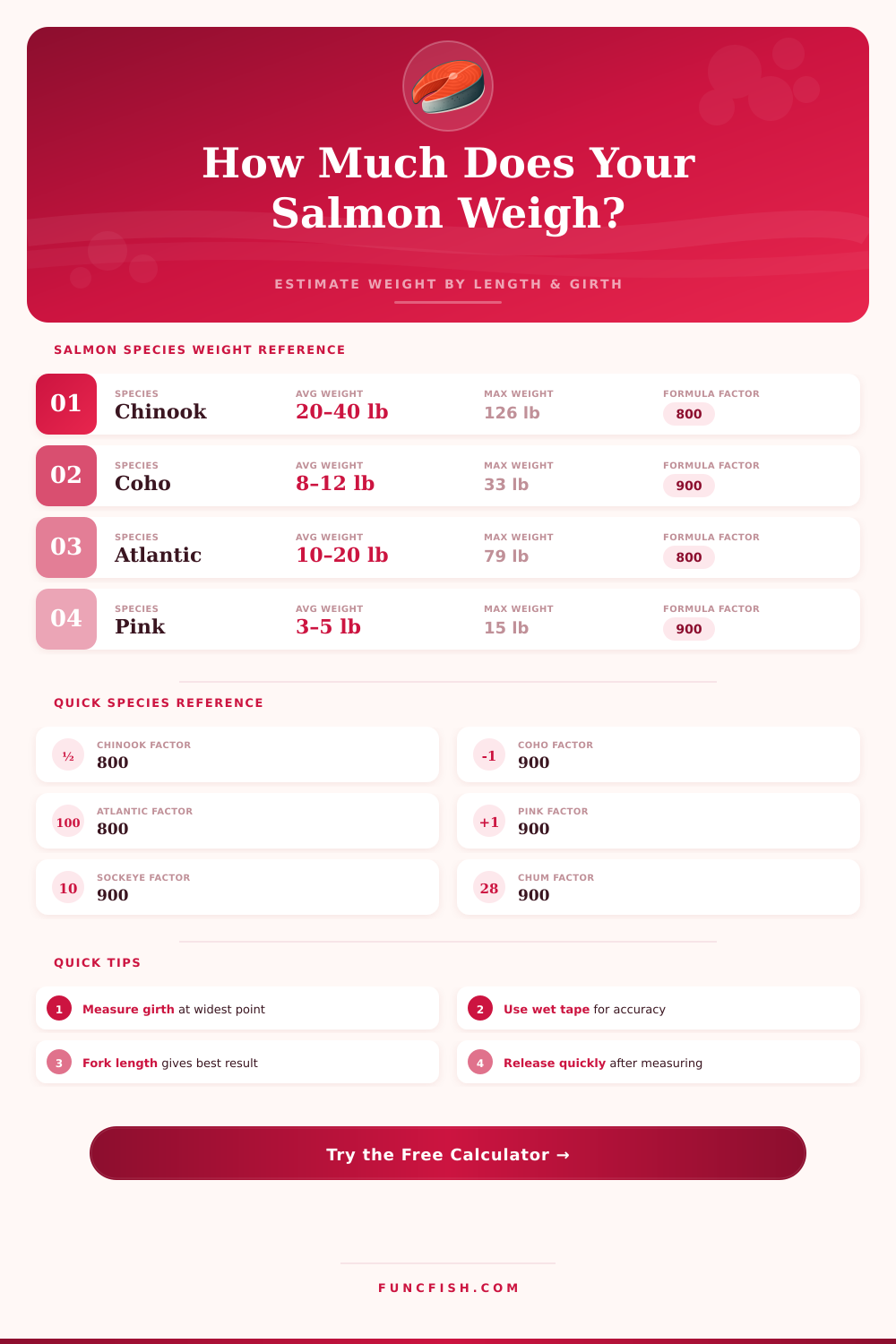
🐟 Salmon Weight Calculator
Estimate salmon weight by length & girth — all species, imperial & metric
| Species | Avg Weight (lb) | Avg Weight (kg) | World Record (lb) | Typical Length (in) | Formula Factor |
|---|---|---|---|---|---|
| Chinook (King) | 20–40 lb | 9–18 kg | 126 lb | 30–50 in | 800 |
| Coho (Silver) | 8–12 lb | 3.6–5.4 kg | 33 lb | 22–30 in | 900 |
| Atlantic Salmon | 10–20 lb | 4.5–9 kg | 79 lb | 28–40 in | 800 |
| Pink (Humpy) | 3–5 lb | 1.4–2.3 kg | 15 lb | 18–24 in | 900 |
| Sockeye (Red) | 5–8 lb | 2.3–3.6 kg | 16 lb | 20–28 in | 900 |
| Chum (Dog) | 10–15 lb | 4.5–6.8 kg | 35 lb | 24–36 in | 900 |
| Fork Length (in) | Fork Length (cm) | Est. Girth (in) | Est. Weight (lb) | Est. Weight (kg) |
|---|---|---|---|---|
| 24 in | 61 cm | 14 in | ~7 lb | ~3.2 kg |
| 28 in | 71 cm | 16 in | ~10 lb | ~4.5 kg |
| 32 in | 81 cm | 18 in | ~15 lb | ~6.8 kg |
| 36 in | 91 cm | 20 in | ~20 lb | ~9.1 kg |
| 40 in | 102 cm | 22 in | ~27 lb | ~12.2 kg |
| 44 in | 112 cm | 24 in | ~35 lb | ~15.9 kg |
| 48 in | 122 cm | 26 in | ~45 lb | ~20.4 kg |
| 52 in | 132 cm | 28 in | ~57 lb | ~25.9 kg |
| Girth (in) | Girth (cm) | Est. Weight (lb) | Est. Weight (kg) | Typical Class |
|---|---|---|---|---|
| 12 in | 30 cm | ~5 lb | ~2.3 kg | Juvenile / Small |
| 15 in | 38 cm | ~9 lb | ~4.1 kg | Average |
| 18 in | 46 cm | ~15 lb | ~6.8 kg | Good |
| 21 in | 53 cm | ~23 lb | ~10.4 kg | Large |
| 24 in | 61 cm | ~35 lb | ~15.9 kg | Trophy |
| 27 in | 69 cm | ~49 lb | ~22.2 kg | Trophy+ |
Get crisp skin on Salmon filet result more hard than one can imagine. When the filet touch the hot pan, it curls upward. That causes uneven cook and soft skin.
Using a fish press, one settles that, because it presses the filet down, so the skin becomes crisp while the flesh cook equally. At first sight, a fish press looks like a press for hamburgers. Between popular choices is the stainless steel fish press of Josh Niland, that delivers quickly to United States and Canada.
Make Salmon Skin Crispy and Weigh Fish
Some folks like it to a little old iron for cake, that kind with only solid metal Weight and handle. It weighs a lot for its size and cleans easily.
Now, guessing the real Weight of fish is entirely other cause. There is a practical formula, that counts for trout and other species. One multiplies the girth by itself and by the length, later divide by 800.
The girth and legnth measure in inches, and the result gives pounds. For instance, if fish has 15-inch girth and measures 29 inches, simply enter those values. The number 800 it is possible to change higher or below, if the fish is heavier or lightweight compared to average.
When no girth measure is ready, one can use default of 0.58 times the length. This method works also for sea fish as tarpon.
Here comes the tricky part however. Formulas, that only uses length, commonly err. A rough 31-inch pike could way much less, than length-based guess points.
The longest fish, that one catches, not always are the most heavy from them either.
Fish can lose Weight after capture. Bloody bleeding, throwing up and waste all add. But loss of water matters most a lot.
Because fish live in water, they always work to keep the right water balance in their bodies by means of process called osmoregulation.
Because of that, one weighs fish in the place, hanging scales work well. One popular model lasts until 110 pounds, works by means of two AAA-batteries and has a lit LCD-screen. Scales with built-in lip grip are perfect.
Simply clip the grip to the center of the bottom jaw. When the scales have only hooks, separate pair of lip grips answer. Simply takethe Weight of the grips from the whole.
Some anglers reckon, that guessing length are more reliable than weighing, because Weight changes up or below, but length never shrinks. Quickly turning the fish in water should always be the main issue.