🐟 Striped Bass Weight Calculator
Estimate your striper's weight from length & girth measurements — imperial & metric
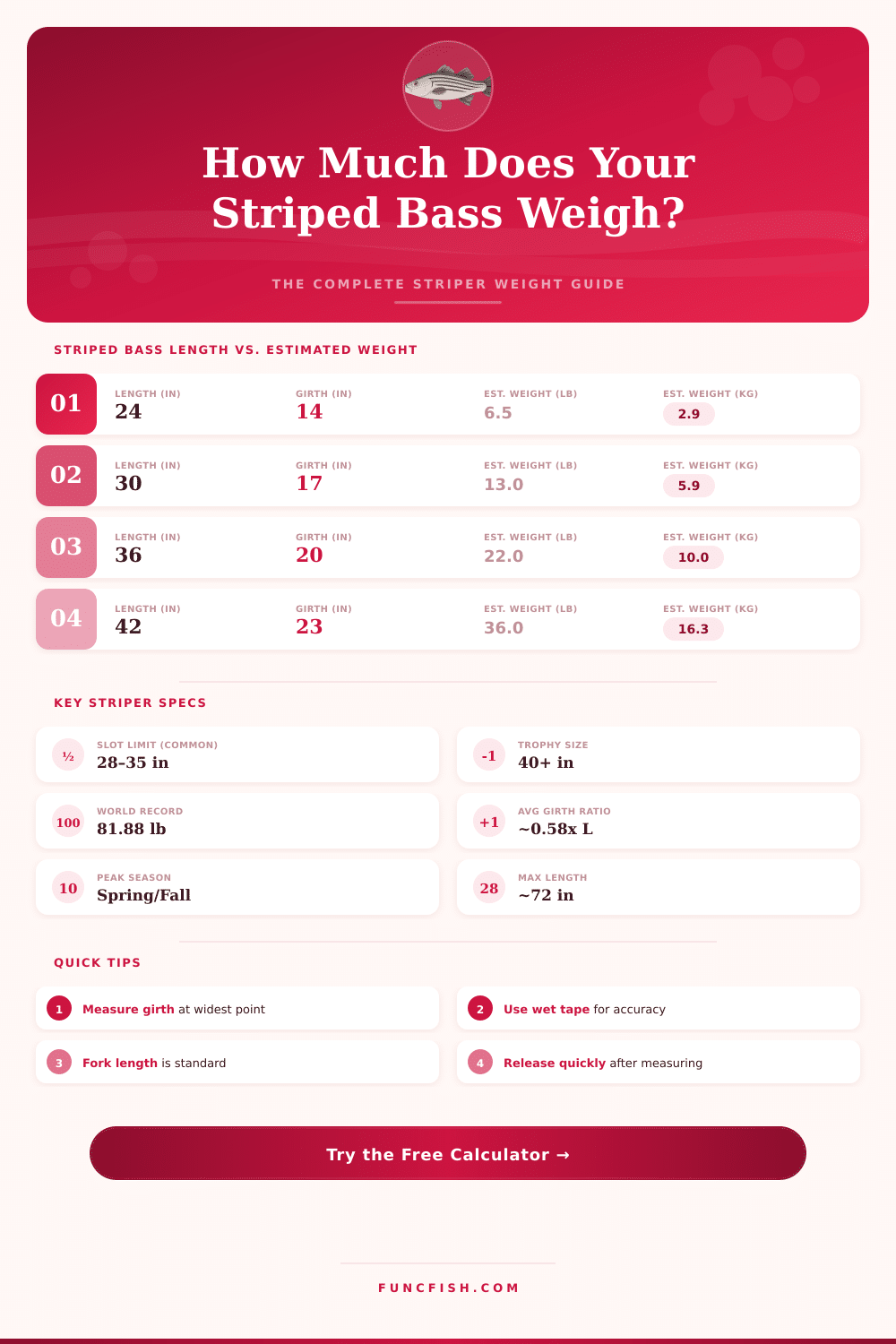
| Length (in) | Length (cm) | Avg Girth (in) | Est. Weight (lb) | Est. Weight (kg) | Gear Class |
|---|---|---|---|---|---|
| 18 | 45.7 | 10.4 | 2.4 | 1.1 | Ultralight |
| 20 | 50.8 | 11.6 | 3.4 | 1.5 | Light |
| 24 | 61.0 | 13.9 | 5.8 | 2.6 | Light |
| 28 | 71.1 | 16.2 | 9.2 | 4.2 | Light/Med |
| 30 | 76.2 | 17.4 | 11.4 | 5.2 | Medium |
| 34 | 86.4 | 19.7 | 16.5 | 7.5 | Medium |
| 36 | 91.4 | 20.9 | 19.7 | 8.9 | Medium |
| 40 | 101.6 | 23.2 | 26.9 | 12.2 | Heavy |
| 44 | 111.8 | 25.5 | 35.7 | 16.2 | Heavy |
| 48 | 121.9 | 27.8 | 46.3 | 21.0 | X-Heavy |
| 52 | 132.1 | 30.2 | 58.9 | 26.7 | X-Heavy |
| Fish Weight | Rod Power | Line (lb test) | Reel Size | Hook Size |
|---|---|---|---|---|
| Under 5 lb | Light | 8–12 lb | 2500–3000 | 1/0–2/0 |
| 5–15 lb | Med-Light | 12–20 lb | 3000–4000 | 2/0–4/0 |
| 15–30 lb | Medium | 20–30 lb | 4000–6000 | 4/0–6/0 |
| 30–50 lb | Med-Heavy | 30–50 lb | 6000–8000 | 6/0–8/0 |
| 50+ lb | Heavy | 50–80 lb | 8000+ | 8/0–10/0 |
| Species | Typical Weight | Max Length | Formula Divisor |
|---|---|---|---|
| Striped Bass | 5–40 lb | 72 in / 183 cm | 800 |
| Hybrid Striped Bass | 3–20 lb | 36 in / 91 cm | 800 |
| Largemouth Bass | 1–10 lb | 29 in / 74 cm | 1200 |
| Smallmouth Bass | 0.5–6 lb | 27 in / 69 cm | 1250 |
| White Bass | 0.5–3 lb | 18 in / 46 cm | 900 |
Lead to crisp skin on fish fillets needs attention. When the fillet touches the hot surface, it curls upward. That causes uneven cooking and soft skin.
Using a fish press one flattens the fillet and presses it down. Like this the skin becomes crisp, while the flesh cooks equally. The Weight spreads the pressure over the whole fillet.
How to Get Crispy Fish Skin and Weigh Fish
At first sight, a fish press looks like a burger press. There is a famous model from stainless steel, created by Josh Niland, that ships quickly in United States and Canada. A practical replacement is searching in thrift shops for small vest weights, a solid metal piece with a handle.
That fish press weighs a lot for its size and washes well.
Guessing Weight of fish without a scale happens commonly. For Striped Bass one uses this usual method: one multiplies the length by the girth and again by the girth, then divides by 800. Both measures, girth and lenght, use inches, and the result one gets in pounds.
For instance, if a fish has a girth of 15 inches and a length of 29 inches, the calculation gives surrounding Weight. One can adjust the number 800 higher or down, freely, depending on whether the caught fish is fatter or slimmer than usual. If a girth reading is missing, one applies a default value for the girth, that matches 0.58 times the length.
But those methods are not always accurate. Slim fish and fat fish with the same length have very different weights. Only the length does not work four a good estimate of the Weight, especially for species like pike.
For truly weighing fish, a digital portable hanging scale works well. One model lasts until 110 pounds, has a lit LCD screen, hooks and a sliding handle. Scales with a built-in jaw grip are even more practical.
The setup keeps flat the center of the bottom jaw. When the scale has only a hook, one can hang a separate jaw grip, and subtract its Weight by means of the tare function.
After capture fish commonly lose Weight. Blood loss, vomiting and waste all contribute. Even so water loss usually most seriously matters.
Because fish live in water, they constantly manage their water balance in the body through regulation. Hence oneshould weigh them right away.
Sometimes one prefers to measure length instead of Weight. Weight goes up or down, but length of fish never shrinks. Keeping the fish in water should always be the main concern.