🐟 Walleye Weight Calculator
Estimate walleye weight from length & girth using the standard fish weight formula
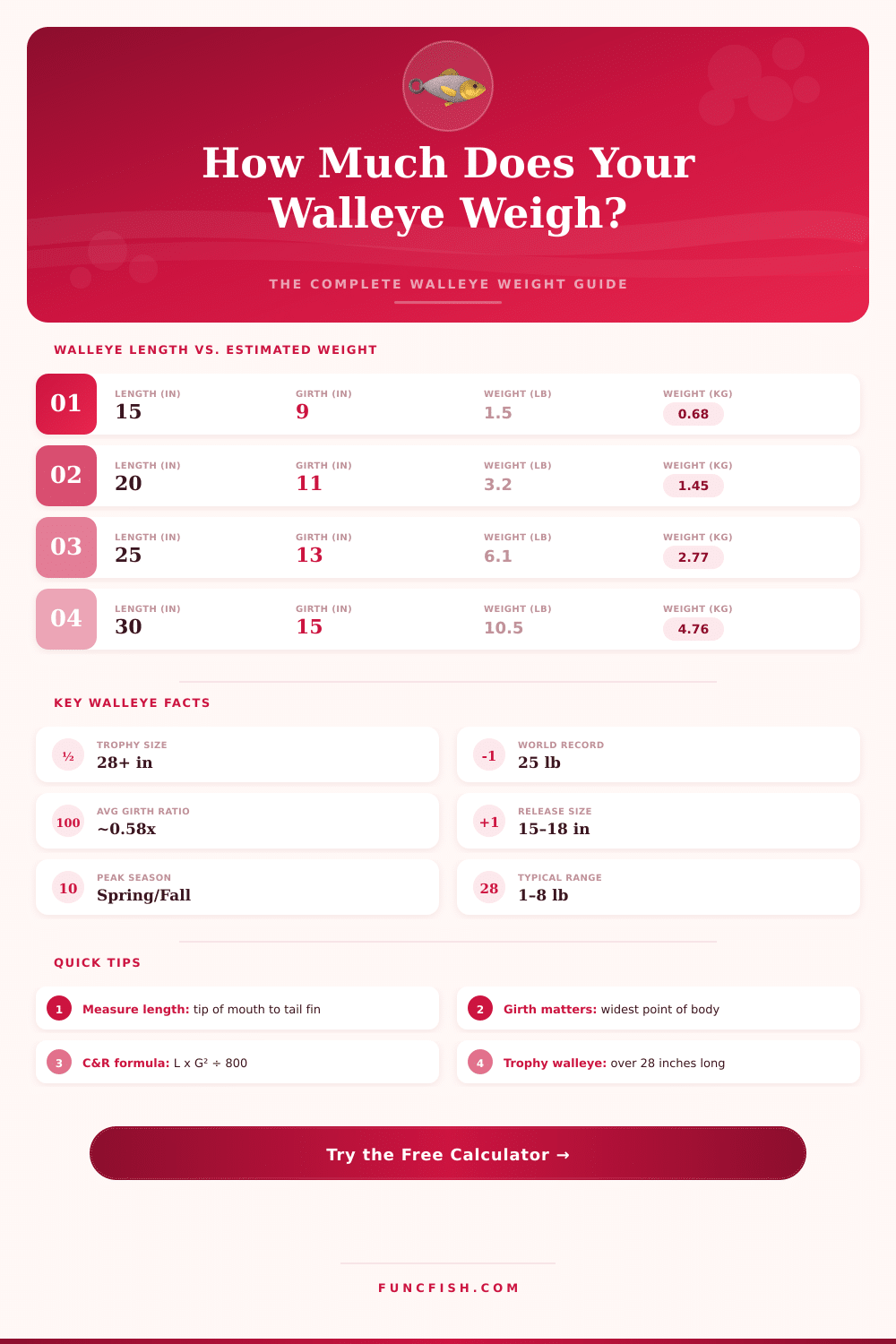
| Length (in) | Length (cm) | Avg Girth (in) | Est. Weight (lb) | Est. Weight (kg) | Classification |
|---|---|---|---|---|---|
| 10 | 25.4 | 6.0 | 0.45 | 0.20 | Juvenile |
| 12 | 30.5 | 7.0 | 0.74 | 0.34 | Small |
| 14 | 35.6 | 8.0 | 1.12 | 0.51 | Small |
| 15 | 38.1 | 9.0 | 1.52 | 0.69 | Keeper |
| 17 | 43.2 | 10.0 | 2.13 | 0.97 | Keeper |
| 19 | 48.3 | 10.5 | 2.61 | 1.18 | Average |
| 20 | 50.8 | 11.0 | 3.03 | 1.37 | Average |
| 22 | 55.9 | 12.0 | 3.96 | 1.80 | Good |
| 24 | 61.0 | 13.0 | 5.07 | 2.30 | Good |
| 26 | 66.0 | 14.0 | 6.37 | 2.89 | Trophy |
| 28 | 71.1 | 15.0 | 7.88 | 3.57 | Trophy |
| 30 | 76.2 | 16.0 | 9.60 | 4.35 | Master Angler |
| 32 | 81.3 | 17.0 | 11.56 | 5.24 | Master Angler |
| Species | Typical Length | Typical Weight | Divisor (Formula) | Rec. Line Wt. |
|---|---|---|---|---|
| Walleye | 15–30 in | 1–10 lb | 800 | 8–14 lb |
| Sauger | 12–22 in | 0.5–4 lb | 820 | 6–10 lb |
| Saugeye (hybrid) | 13–25 in | 0.75–6 lb | 810 | 8–12 lb |
| Yellow Perch | 8–15 in | 0.25–2 lb | 900 | 4–8 lb |
| Northern Pike | 24–48 in | 3–25 lb | 690 | 14–30 lb |
| Muskellunge | 36–54 in | 10–40 lb | 700 | 20–50 lb |
| Formula | Equation | Best For | Accuracy |
|---|---|---|---|
| Standard C&R | L x G² ÷ 800 | All walleye | ±5% |
| Anderson Method | L x G² ÷ 850 | Slim fish | ±6% |
| Length-Only | 0.000228 x L³ | Quick field est. | ±12% |
| Pope & Young | L x G² ÷ 775 | Heavy pre-spawn | ±7% |
Get perfectly crisp skin on fish fillets is more complex than one thinks. If you lay the fillet on hot metal it usually curls up. That results in uneven cook and soft skin.
The fish press helps flatten the fillet and keep it on the pan. Thanks to that, the skin can crisp well up, while the flesh cooks evenly. The pressure delivers steady force over the whole surface.
How to get crispy fish skin and guess a fish’s weight
At first sight, fish press looks like a hamburger press. There are versions with holes, made from stainless steel. It weighs a lot for its size and is easy to wash.
If you want something similar at low cost, a little old cast iron could serve as replacement, mainly because it is simply a metal Weight with handle.
Rating the Weight of caught fish without a scale is a common problem. One favourite method for trout is based on length and girth. The calculation works like this: you multiply the girth by itself, then multiply that by the length and divide by 800.
The girth and length are measured in inches, and the result gives pounds. For instance, a fish with 15-inch girth and 29-inch length can be counted by that metohd. The number 800 can be adjusted higher or lower depending on whether the caught fish tends to be fatter or slimmer than average.
If you do not have girth, you can use a standard value, where the girth equals 0.58 times the length. Other length-based ratings are common for fish. Slim fish and fat fish with the same length have very different weights.
Only the length does not show the whole picture.
To truly weigh fish, digital hanging scales with a built-in lip grip work well. The grip attaches right to the centre of the bottom jaw. If the scale has only hooks, you can add separate lip grips and then subtract there Weight using the tare function.
One popular portable fish scale fits up to 110 pounds, has a lit LCD screen and a padded handle.
Fish can lose Weight after capture. Bloody flow, throwing up and waste all contribute. Even so, in most cases, water loss is the main cause.
Fish always work to keep the right water balance in their bodies through a process called osmoregulation. So fish weighed several hours after capture could weigh less than you expect.
Measuring length sometimes seems better than weighing, especially for fish that you will release. The Weight can shift up or down depending on conditions, but the length of a fish nevershortens. Quickly returning the fish to the water should always be the main concern.