Ice Fishing Rod Length Calculator
Match an ice rod to shelter space, hole position, jig style, target species, fish power, depth, line stretch, and hookset clearance.
🎣Quick Ice Rod Presets
⚙Rod Length Inputs
Ice Rod Length Match
Enter your setup and calculate to see the recommended rod length.
Calculation Breakdown
📏Rod Length Data Grid
📊Reference Tables
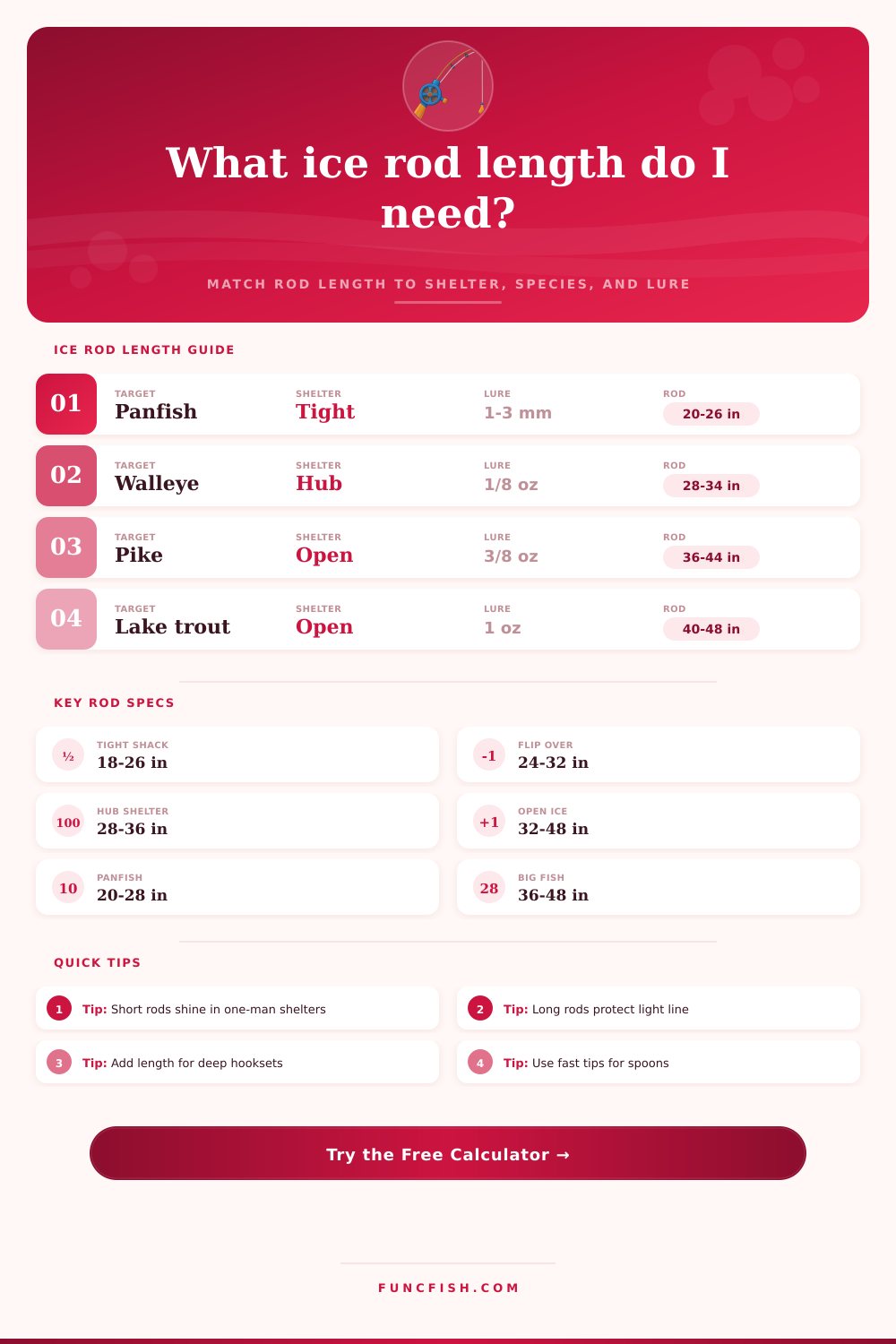
| Fishing space | Useful rod range | Metric range | Best use |
|---|---|---|---|
| Tight one-person shack | 18-26 in | 46-66 cm | Sight fishing, shallow panfish, minimal sweep |
| Flip-over shelter | 24-32 in | 61-81 cm | Panfish, perch, walleye spoons, mobile fishing |
| Hub or wheelhouse | 28-38 in | 71-97 cm | Seated jigging, dead sticks, set lines, larger holes |
| Open ice outside | 32-48 in | 81-122 cm | Hole hopping, lake trout, pike, long sweep sets |
| Target species | Typical rod length | Power range | Length reason |
|---|---|---|---|
| Bluegill / sunfish | 20-28 in | UL to light | Shorter rods show light bites and control micro jigs. |
| Crappie / perch | 24-32 in | UL to ML | Moderate length cushions paper mouths and light line. |
| Walleye | 28-36 in | ML to medium | Extra sweep helps set hooks through depth and lure weight. |
| Pike / lake trout | 36-48 in | Medium to heavy | Long rods protect line and steer fish at the bottom of the ice. |
| Presentation | Length bias | Action match | Notes |
|---|---|---|---|
| Micro jig / spring bobber | Short to mid | UL noodle or light fast | Rod should load from tiny jigs without stealing feel. |
| Jigging spoon | Mid | ML fast | Enough tip recovery to snap spoons without overworking them. |
| Rattle bait / lipless | Mid to long | Medium fast | More length smooths aggressive cadence and hooksets. |
| Tube / heavy jig | Long | Medium-heavy | Length and backbone help drive hooks in deep water. |
💡Rod Length Notes
Clearance check: If you fish seated in fabric, the longest usable rod is often limited by the backcast and hookset arc, not the fish.
Depth check: Deep water, monofilament stretch, and a delayed hookset all reward extra rod length because the tip moves more line.
I rent this one guy’s shack for the day. My new twenty eight inch rod won’t fit in there, and I drilled a hole through three feet of ice. So now tip is banging against the roof and the handle is tapping heater and those fish aren’t buying it anyways.
This scenario illustrates what happens when we just guess at ice rods based off their lengths. It’s not really about the length of the blank in a vacuum. It’s about relationship between the length, the power of the fish you’re after and sensitivity needed to get the bite from whatever lure you’re throwing. Enter your desired species and roof height, and the calculator does math for you. This way, you won’t have to wonder if your thirty-two inch rod will clear your headrest during a hard hookset.
How to Choose the Right Ice Fishing Rod
The first thing that trips people up is shelter clearance. Whether or not you’re going after crappie or something else doesn’t matter; a short rod are necessary when dealing with a tight fabric hut. Eight square feet isn’t enough room to swing a forty inch rod around without transforming the inside into a pinball machine. Now if you ice from an open ice or flip-over, the ceiling limit goes out the window, but now you’re dealing with wind. Cold air cause long rods to flex more, which sends your lure off to one side rather than hovering right over the hole. It’s a balancing act between shelter comfort and staying steady in the wind.
The second main thing to think about is a matter of sensitivity versus power. Crappie and bluegill is best fished on ultralight blanks that will telegraph even the most subtle bit of pressure in your hand. Often they barely pull before taking the bait, and a heavy-handed approach won’t let you know they are biting.
On the other end of the spectrum, walleye and lake trout can uses enough force to part company with light line unless you have sufficient rod length to absorb the shock. Longer rods offers more cushion because they bend all the way up the blank instead of only at the tip. This gives you some protection for your leader during the initial fish run. The table below (on the page) shows this concept well and moves you from panfish to predatory species in terms of rod length.
But even more important then the fish is how you present it. When fishing jigs spoons, you need a rod with a quick tip to really pop it back up fast after it falls down. If you use a noodly rod, the spoon will fall too far and never quite get back into the right spot, throwing off its action. On the other hand, if you’re trying to dead stick live bait, you want a long softer blank to keep your line in place and not moving constantly in tiny movements. The calculator consider these things. It also looks at your retrieve type to find the ideal length. This helps you match the action of the fish with how you set the hook.
Another variable to consider is depth. The same reel and rod combo can feel different when fished at four feet compared to forty feet. Cold water temperatures also increase mono stretch. This reduces the bite’s feel because it takes some of the sensation away from your fingers. Using a longer rod gives you greater leverage over your line and helps counteract loss of feeling. You get a cleaner hookset that goes deeper into the water column. When fishing shallow with braided line, you still want enough control without excessive swing weight, so a shorter rod are all you need.
One common error is purchasing the longest rod because people think longer is always better. Using a rod that is too long in a small area will cause fatigue and lost fish due to poor tip control in tight spaces. This calculator incorporates your seat-to-hole separation into the equation so you can see how much length is necessary and when it’s too much. Sitting farther back require more length to reach while not putting yourself at risk of falling onto thin ice. Closer in means you can go shorter and precise.
So in conclusion, it’s all very much about the angles or geometry of an ice rod too as opposed to just catching fish. What works is finding a rod that fits your space within the shelter. It needs to reach down to the bait and bend enough to pull the fish up without bending so hard that it breaks. Whatever that is, it will feel like nothing. Just like it melts away from your hand to the hole, the best ice rods would of go away as well and leave you with the bite.
Clear out some room, make your selection and listen to the ice talk.