
It’s frustrating to pull in what you think is a big one only for it to weigh surprisingly light after feeling like such a heavyweight. You hook up with a nice fish and it takes off running. For 20 minutes you battle what you’re sure is a barn burner of a fish. Eventually you boat side her and measure her and she doesn’t look like much in your mind. The difference between how much you thought it should weigh versus how much it actualy weighed proves the importance of being able to estimate weight based off length. Because now you have hard facts where before you had vague excitement. Now you know about fish you caught.
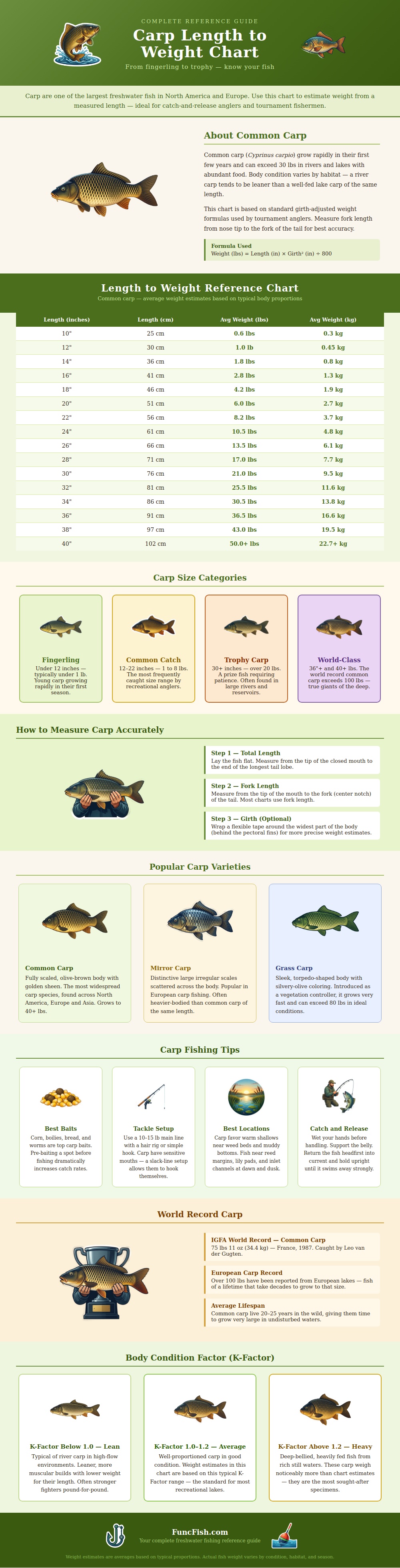
As you can see in the chart above, these are simple estimates. But it’s a clear breakdown of what you should expect for a ten-inch fingerling all the way up to a forty-inch trophy specimen. You’ll also see that weight doesn’t increase at the same rate then length. For example, a 12-inch carp could be a single pound while a 20-inch carp are six pounds. That’s because as carp grow, their girth increases very quickly. And they don’t grow in length alone. To handle this three-dimensional bulk, we used a standard formula which multiply length by its girth squared. This will give you a good baseline for many recreational lakes where conditions is stable and there’s plenty of food available.
How to Estimate Fish Weight by Length
But wait, that’s where habitat comes into play. Is that carp you catch in a slow-moving pond going to look the same as the one you catch in a swift flowing river? No matter their respective ages, no. Muscles is more prominent on river fish, which will typically weigh less but put up more of a fight for their given size. Because they’re storing energy as fat, pond fish will get rounder and bulkier. All these factors can add up to bigger or smaller fish depending off conditions in your home body of water. The infographic assumes an average condition factor, a measure of relative plumpness in relation to body length.
Depending on what kind of insect and baitfish base exists on your home waters, your fish may well be heavier than this chart predicts. Conversely, if you live in a nutrient-poor water environment, your fish may well come in lighter. Knowing the conditions and adjusting your expectations accordingly will help you avoid a letdown when things don’t match up.
The most difficult step is the measuring. Measuring incorrectly will skew your weight estimate upward. First, measure from the tip of the nose to the middle of the notch at the end of its tail, which is called the fork length. Don’t stretch the tail fins out. Doing so will add some extra inches to your measurement, throwing off your weight estimate. For an accurate calculation, you’ll want to use both measurements. The girth measurement is the distance around the widest point behind the gills. Wrap a flexible tape measure around this area. For an accurate fork length measurement, don’t extend the tail fins. They can add extra inches, skewing your weight estimate up.
Before you touch the fish, wet your hands. This protects the fish’s slime coat, which serves as an important barrier between parasites and diseases. If you are practicing catch-and-release fishing, keep the fish in the water as long as possible. This will reduce stress on the fish and improve their chance of surviving.
Different types of carp mature differently as well. Mirror carp tend to get wider and have scales scattered all over them. mirror carp tend to be fatter and get thicker bodies. So if you know what kind of fish you’re likely catching, it helps you read chart better. This infographic is centered around average common carp growth rates. Consider the biological differences between grass carp, mirror carp, etc. Use this chart to judge your fish against numbers given.
Now these charts don’t serve just as a means to score points on the water, or brag about a big bag at a tournament. But instead they show what’s happening on the water you’re fishing. Are the fish you’re catching far smaller than the chart suggests? Maybe there isn’t much food available in that lake, or maybe it’s overpopulated. Big fish is a sign of a healthy ecosystem where the fish have ample resources to grow to their full potential. Whether you know it or not, each fish you catch will provide some sort of biological information.
Next time you hook a carp, take an additional half-minute to accurately measure it before letting go. How long is it? What do you think its girth might be? Check the measuring stick and compare its size to that reference guide. You’ve just turned what would of been a normal catch into a lesson in local population changes. And guess what. The fish is none-the-wiser. It swam off unharmed while each data point increased your knowledge of the lake. That’s the silent satisfaction of paying attention on the water.