🪱 Fishing Worm Fridge Life Calculator
Estimate how long your bait worms will stay alive & fresh in the refrigerator
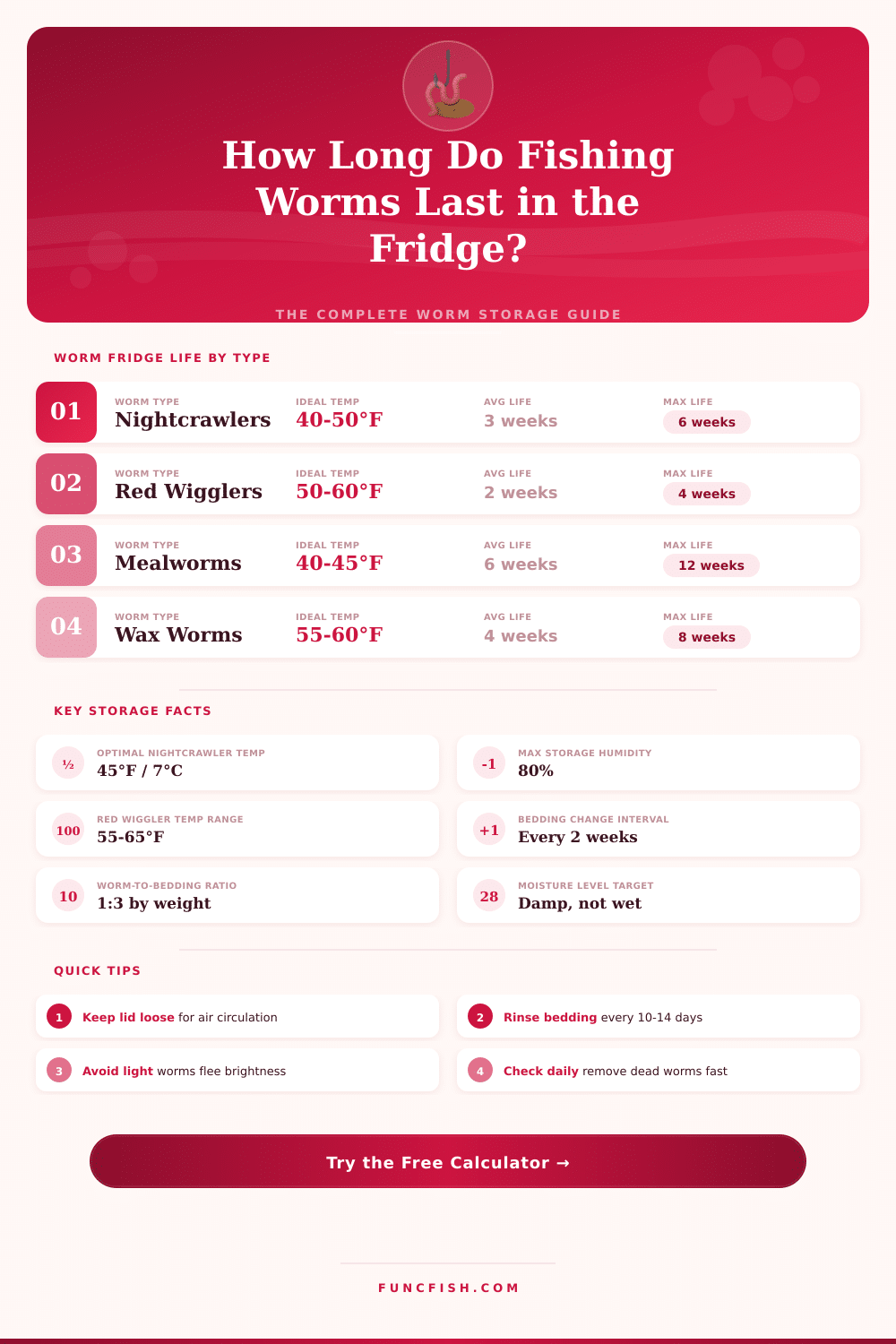
| Worm Type | Ideal Temp (°F) | Ideal Temp (°C) | Avg Fridge Life | Max Fridge Life | Best Bedding | Target Fish |
|---|---|---|---|---|---|---|
| Nightcrawler | 40°–50°F | 4°–10°C | 3 weeks | 6 weeks | Peat / Newspaper | Bass, Catfish, Trout |
| Red Wiggler | 50°–65°F | 10°–18°C | 2 weeks | 4 weeks | Peat / Coconut Coir | Trout, Panfish, Perch |
| Mealworm | 40°–45°F | 4°–7°C | 6 weeks | 12 weeks | Wheat Bran / Sawdust | Panfish, Bluegill, Perch |
| Wax Worm | 55°–60°F | 13°–16°C | 4 weeks | 8 weeks | Wheat Bran | Crappie, Bluegill, Ice Fish |
| Blood Worm | 33°–40°F | 1°–4°C | 5 days | 10 days | Seaweed / Damp Paper | Striped Bass, Flounder |
| Super Worm | 50°–60°F | 10°–16°C | 5 weeks | 8 weeks | Sawdust / Bran | Walleye, Catfish, Bass |
| Bedding Type | Moisture Retention | Freshness Boost | Change Interval | Notes |
|---|---|---|---|---|
| Shredded Newspaper | Moderate | +10% | Every 14 days | Affordable; avoid glossy ink |
| Peat Moss | High | +20% | Every 21 days | Best for nightcrawlers |
| Coconut Coir | Very High | +25% | Every 21 days | Excellent moisture control |
| Fine Sawdust | Low | +5% | Every 10 days | Good for mealworms / super worms |
| Wheat Bran | Low | +15% | Every 14 days | Best for wax worms; also food |
| Species | Typical Weight | Recommended Worm | Hook Size | Presentation |
|---|---|---|---|---|
| Largemouth Bass | 1°–8 lb / 0.5°–3.6 kg | Nightcrawler | #2 – #1/0 | Whole worm, Texas rig |
| Rainbow Trout | 0.5°–4 lb / 0.2°–1.8 kg | Red Wiggler / Nightcrawler | #8 – #12 | Piece or whole on drift |
| Bluegill / Panfish | 0.25°–1 lb / 0.1°–0.45 kg | Mealworm / Wax Worm | #10 – #14 | Small piece under bobber |
| Channel Catfish | 2°–15 lb / 0.9°–6.8 kg | Nightcrawler (big) | #2/0 – #4/0 | Bottom rig, 3–4 worms |
| Walleye | 1°–10 lb / 0.45°–4.5 kg | Nightcrawler / Super Worm | #4 – #8 | Harness rig or jig tip |
| Yellow Perch | 0.25°–1.5 lb / 0.1°–0.7 kg | Mealworm / Red Wiggler | #8 – #12 | Small piece, drop shot |
| Striped Bass | 2°–30 lb / 0.9°–13.6 kg | Blood Worm / Nightcrawler | #1/0 – #3/0 | Surf bottom rig |
Fishing with worms is probably the most popular way to attract fish worldwide. Nightcrawlers, red wigglers and earthworms always work as live bait. Mealworms and wax worms help too, when anglers want to expand their options.
There really is something fit for every kind of fishing.
How to Use Worms for Fishing
Live worms work well for children, because they almost always bring success and the children enjoy the process. One uses worms also for drop-shot rigs, and that results in steady catches. For sunfish worms are the best choice.
Here the thing about worms, they attract catfish, sheepshead and northern pike. Switching to minnows can be useful, if you want to catch more different species.
When the water cools to the 30s and low 40s in degrees, the metabolism of fish slows down. The fish only nibble the ends of worms, instead of swallowing the whole thing. A smaller bit works better in cool water.
For perch, crappie and sunifsh while ice fishing, half of a garden worm is a good idea. Even bullheads like a smaller bite in cold conditions.
Mealworms seem popular for fishing on ice. One puts them on small hooks and lets them fall through the ice four perch, crappie and walleye.
Soft plastic worms are a whole other thing. They copy the natural motion and attract bass and other fish well. Methods like Texas rigging and drop shooting are common for using them.
Plastic worms come in many sizes and colors, great for freshwater and saltwater fishing. Some anglers consider plastic worms the most reliable bait, even above spinners, crankbaits or jigs. Ed Rooms indeed started to make his own plastic worms, when he did not find the wanted models.
The seller of arcade machines in Georgia used a trolling motor in a 55-gallon barrel to mix the plastic and mold his own baits.
Bass and panfish usually eat under the surface. They follow the motion of live worms down below, unlike perch, that feed near the surface. An interesting trick is to cast above plants and let the worm slowly crawl over the weeds.
Largemouth bass rises off the bottom, chases it and jumps in the air.
Taking care of live worms so that they stay alive needs only a little attention. The soil should stay fairly damp, but not muddy. Keep them away from direct sunshine.
A bag full of worms can stay cool in a fridge, if it does not sit in water anddrown them.
The life of a worm on the hook depends on a mix of casting style, hook shape and the natural toughness of the worm itself. A simple setup works well, push the hook into the worm, add two small feathers for balance and place a bobber on it. Cast out and wait.
Dendrobaena worms work well, when one hooks them at the head, for best movement in water. Live worms are useful also outside fishing. Worm composting uses worms to break down organic material and make rich compost for gardening.