🐟 Fish Length to Weight Calculator
Estimate fish weight from length & girth measurements using species-specific formulas
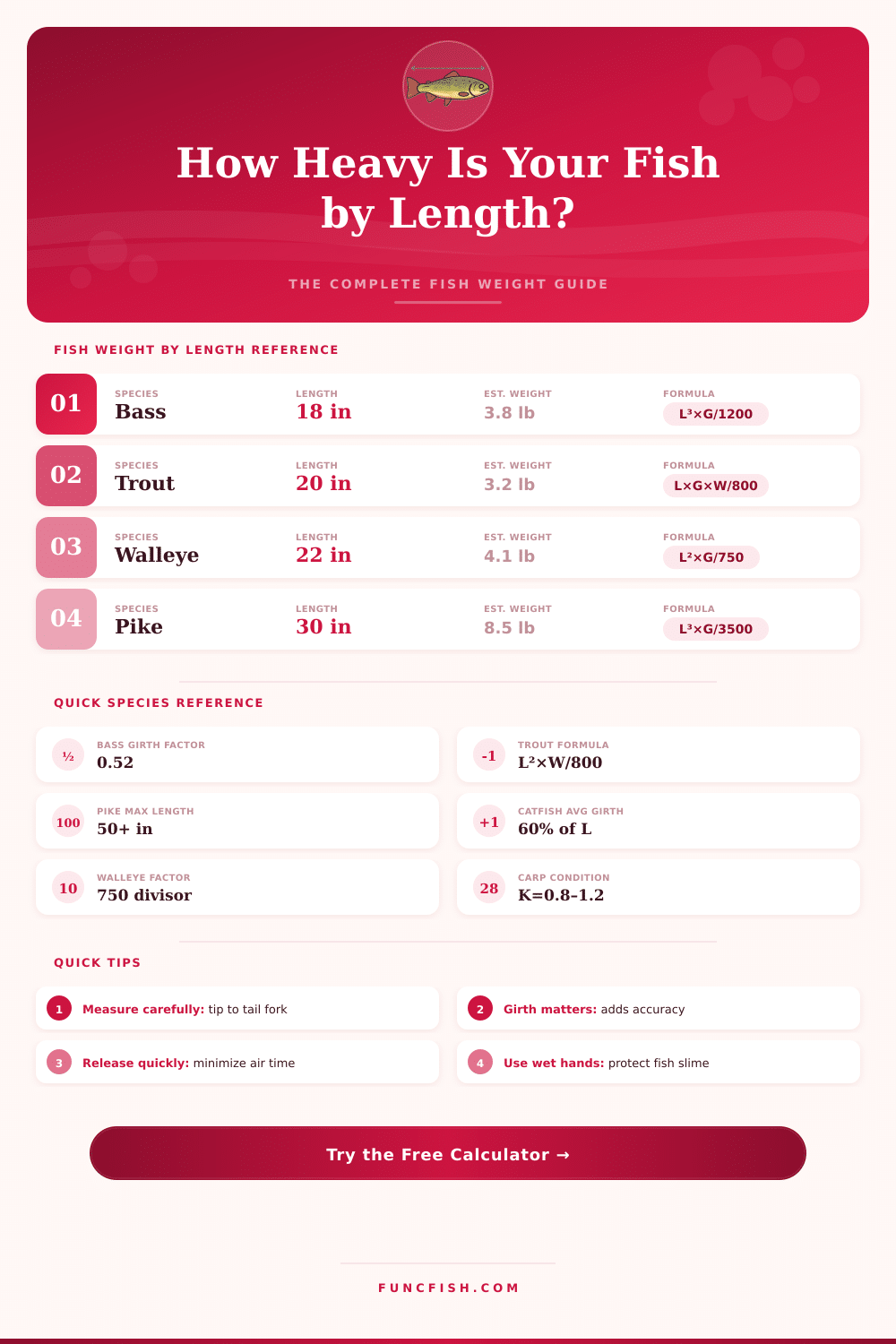
| Species | Length (in) | Length (cm) | Est. Weight (lb) | Est. Weight (kg) | Formula Used |
|---|---|---|---|---|---|
| Largemouth Bass | 15 | 38.1 | 1.88 | 0.85 | L² x G / 1200 |
| Largemouth Bass | 18 | 45.7 | 3.38 | 1.53 | L² x G / 1200 |
| Largemouth Bass | 22 | 55.9 | 6.21 | 2.82 | L² x G / 1200 |
| Rainbow Trout | 16 | 40.6 | 1.76 | 0.80 | L² x G / 800 |
| Rainbow Trout | 20 | 50.8 | 3.20 | 1.45 | L² x G / 800 |
| Walleye | 18 | 45.7 | 2.23 | 1.01 | L³ / 2700 |
| Walleye | 24 | 61.0 | 5.12 | 2.32 | L³ / 2700 |
| Northern Pike | 28 | 71.1 | 6.24 | 2.83 | L³ / 3500 |
| Northern Pike | 36 | 91.4 | 13.32 | 6.04 | L³ / 3500 |
| Channel Catfish | 24 | 61.0 | 4.27 | 1.94 | L² x G / 900 |
| Common Carp | 24 | 61.0 | 6.24 | 2.83 | L² x G / 690 |
| Chinook Salmon | 30 | 76.2 | 9.93 | 4.50 | L² x G / 725 |
| Species | Avg Length | Trophy Length | Avg Weight | Trophy Weight | World Record |
|---|---|---|---|---|---|
| Largemouth Bass | 12–18 in | 22+ in | 1–4 lb | 8+ lb | 22 lb 4 oz |
| Smallmouth Bass | 10–16 in | 20+ in | 0.5–3 lb | 5+ lb | 11 lb 15 oz |
| Striped Bass | 18–30 in | 40+ in | 3–15 lb | 30+ lb | 81 lb 14 oz |
| Rainbow Trout | 10–20 in | 24+ in | 0.5–3 lb | 8+ lb | 48 lb |
| Brown Trout | 12–22 in | 28+ in | 1–5 lb | 12+ lb | 44 lb 5 oz |
| Walleye | 14–22 in | 26+ in | 1–4 lb | 9+ lb | 25 lb |
| Northern Pike | 20–36 in | 40+ in | 2–10 lb | 20+ lb | 55 lb 1 oz |
| Muskie | 30–48 in | 50+ in | 5–20 lb | 40+ lb | 67 lb 8 oz |
| Channel Catfish | 12–24 in | 30+ in | 1–8 lb | 20+ lb | 58 lb |
| Common Carp | 16–28 in | 35+ in | 3–15 lb | 30+ lb | 105 lb 14 oz |
| Chinook Salmon | 24–36 in | 42+ in | 5–20 lb | 40+ lb | 97 lb 4 oz |
| Bluegill / Panfish | 5–9 in | 10+ in | 0.25–0.75 lb | 1.5+ lb | 4 lb 12 oz |
| Method | Formula | Accuracy | Best For | Data Needed |
|---|---|---|---|---|
| Standard (Length Only) | L³ / Divisor | ±15–20% | Quick estimate | Length only |
| Girth Method | (L x G²) / Divisor | ±5–10% | All species | Length + Girth |
| Linear Regression | a x L^b coefficient | ±10–18% | Scientific use | Length only |
| Fulton K Factor | (W / L³) x 100000 | Relative only | Condition assessment | Weight + Length |
Measuring Fish is not this easy, as one could believe. There are several different ways to do that, and the choice depends on the species that you handle, and on the goal of the measurement.
Total Length is the most commonly used method. It takes the distance from the tip of the nose to the end of the tail half. For it, one must press the tail part so that it lies fully flat during the measurement.
How to Measure Fish
Like this one gets the maximum Length of the whole body. In fishing contests and in rules about hunting almost always one uses this total Length as base. Even so there is one warning: the result can range according to that, if the tail is strained or if the end is already damaged or broken.
Here a note about that: if the bottom jaw sticks past the upper, start the measurement from the most distant spot of that bottom jaw. Later close the muzzle and measure directly to the tip of the nose.
Standard Length brings other access. One measures from the nose directly to the place, where the tail truly starts, fully ignoring the tail end. This is the usual standard in scientific settings, unless one points otherwise.
In aquarium hobbies on the other hand, the majority of folks simply use the total Length.
Fork Length brings again a different variant. It goes from the tip of the jaw or nose (with closed muzzle) to the centre of the split tail part. That method works well for Fish with clear forked form.
One commonly applies it to tuna, sharks and other species with that particular tail structure.
Head Length belongs to its own category. It measures from the nose too the back edge of the gill cover or to the place, where the gill cover meets the skull.
Here useful advice, when you are in nature without good tools. Before measure parts of your own body, so that it helps later, for instance distance from fingertip to finger joint, to wrist or to elbow. Those rough marks allow you estimate sizes without needing to carry a measuring tape.
Only the Length does not suffice, if you want to estimate the weight of Fish. Two Fish of same Length can have very different weights according to their thickness or body shape. Bigger Fish naturally weigh more, but between species there is big variety.
Fishing authorities estimate total Length as the distance from the nose to the end of the longest parts on extended tail. Measuring base Length commonly gives more reliable notion about the size than weight, because weight adjusts, but Length stays permanent. Some species have legal minimal Lengths before one can keep them, while others donot have limits.
For instance about trout in Arkansas: no minimal Length for all. But rainbow under ten inches is truly too little to give anything useful.