🐟 Trout Weight Calculator
Estimate trout weight from length & girth measurements — all species, imperial & metric
| Length (in) | Length (cm) | Typical Girth (in) | Est. Weight (lb) | Est. Weight (kg) | Category |
|---|---|---|---|---|---|
| 8" | 20 cm | 5" | 0.25 lb | 0.11 kg | Fingerling |
| 10" | 25 cm | 6.5" | 0.53 lb | 0.24 kg | Small |
| 12" | 30 cm | 7.5" | 0.84 lb | 0.38 kg | Small |
| 14" | 36 cm | 9" | 1.42 lb | 0.64 kg | Keeper |
| 16" | 41 cm | 10" | 2.00 lb | 0.91 kg | Good |
| 18" | 46 cm | 11" | 2.72 lb | 1.23 kg | Good |
| 20" | 51 cm | 12" | 3.60 lb | 1.63 kg | Great |
| 22" | 56 cm | 13" | 4.64 lb | 2.10 kg | Great |
| 24" | 61 cm | 14" | 5.88 lb | 2.67 kg | Trophy |
| 26" | 66 cm | 15" | 7.31 lb | 3.32 kg | Trophy |
| 28" | 71 cm | 16" | 8.96 lb | 4.06 kg | Trophy |
| 30" | 76 cm | 17.5" | 11.48 lb | 5.21 kg | Monster |
| 36" | 91 cm | 20" | 18.00 lb | 8.16 kg | Monster |
| Species | Avg Weight Range | World Record | Formula Divisor | Body Shape | Typical Habitat |
|---|---|---|---|---|---|
| Rainbow Trout | 0.5 – 8 lb | 48 lb (Alaska) | 800 | Average | Cold rivers & lakes |
| Brown Trout | 0.5 – 10 lb | 44.3 lb (NZ) | 800 | Average | Rivers & lakes |
| Brook Trout | 0.2 – 4 lb | 14.5 lb (Canada) | 820 | Slim | Cold streams |
| Lake Trout | 2 – 20 lb | 102 lb (Canada) | 780 | Deep-bodied | Deep lakes |
| Cutthroat | 0.5 – 12 lb | 41 lb (Nevada) | 800 | Average | Mountain streams |
| Steelhead | 3 – 20 lb | 42.2 lb (Alaska) | 800 | Athletic | Rivers (sea-run) |
| Tiger Trout | 0.5 – 6 lb | 20.1 lb (UT) | 800 | Average | Lakes & rivers |
| Bull Trout | 1 – 10 lb | 32 lb (Idaho) | 790 | Slightly deep | Cold rivers & lakes |
| Fish Condition | Girth / Length Ratio | Description | Typical Season |
|---|---|---|---|
| Excellent | 0.60 – 0.65 | Deep body, very plump | Pre-spawn / Fall |
| Good | 0.55 – 0.60 | Well-fed, average depth | Summer |
| Average | 0.50 – 0.55 | Normal stream fish | Year-round |
| Below Average | 0.45 – 0.50 | Lean, stressed fish | Post-spawn |
| Poor | Below 0.45 | Slim, recovering | Winter |
Whether one can reach crisp skin of fish in the pan? Honestly, that is more easily said than done. When the piece touches the warm metal, it immediately crisps, but if that happens wrong you stay with badly cooked and wet, easy skin.
Here comes the fish press: it is a tool that presses the piece flat against the pan, so that the skin genuinely crisps while the meat cooks evenly. The pressure spreads over the whole surface of the piece. First one could believe that it only is a fancy press for hamburgers, but it has its own purpose.
Make fish skin crispy and guess its weight
Josh Niland made a popular version from stainless steel, that ships quickly to United States and Canada, if you want something specifically built. If you are on a tight budget? Search for a small old iron block from a thrift store or antique shop, that is simply a metal block with a handle, and it does the task well.
The Weight itself surprises by means of its density for its size, and the cleanup is easy too.
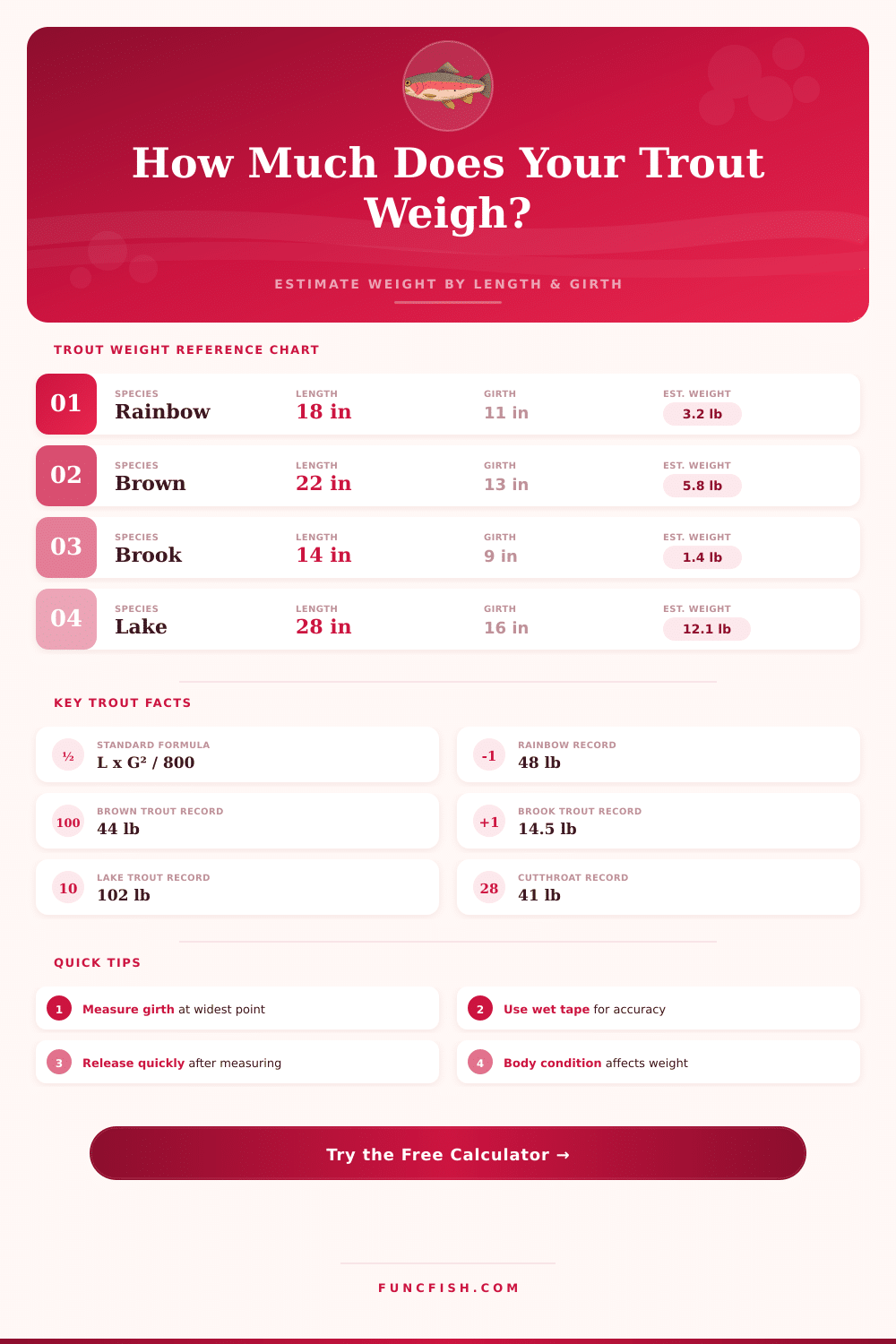
Currently, guessing the Weight of fish genuinely is an entirely other case. Here is a formula that works well for Trout and similar species: multiply the length by the girth, then again by the girth, and divide everything by 800. Assume you caught a fish long 29 inches with 15-inch girth; plug thsoe values in, and you get a reliable guess.
The divider can shift a bit upward or down, depending on whether the fishes in your region are heavy or light compared to the average. When you can not measure the girth easily, use this default calculation: take girth equal to 0.58 times the length. This math counts also for sea species like tarpon, which deserves too mention.
Charts based only on length? They are only rough at best. A pike long 31 inches, but thin as a stick, could weigh much less than the chart says.
The longest pike officially not always is the heaviest. They not necessarily are the same fish, thatrecalls well.
If you genuinely need to weigh fish, take a digital hanging scale with a built-in lip grip. Simply hook the grip to the center of the bottom jaw, and done. If you have only hooks, clip a separate lip grip on and use the tare function to remove its Weight.
One good portable scale lasts up to 110 pounds, has a lit screen and runs on two AAA batteries.
But here is the secret about the Weight of fish: it changes after the capture. Blood loss, vomiting, emptying… All those things matter, but drying out is the main cause.
Fishes always care about the balance of their inner water through body regulation. The more long they stay outside water, the more they dry. So measuring length can give a more reliable idea about the size, Weight changes, but the length of fish stays stable.