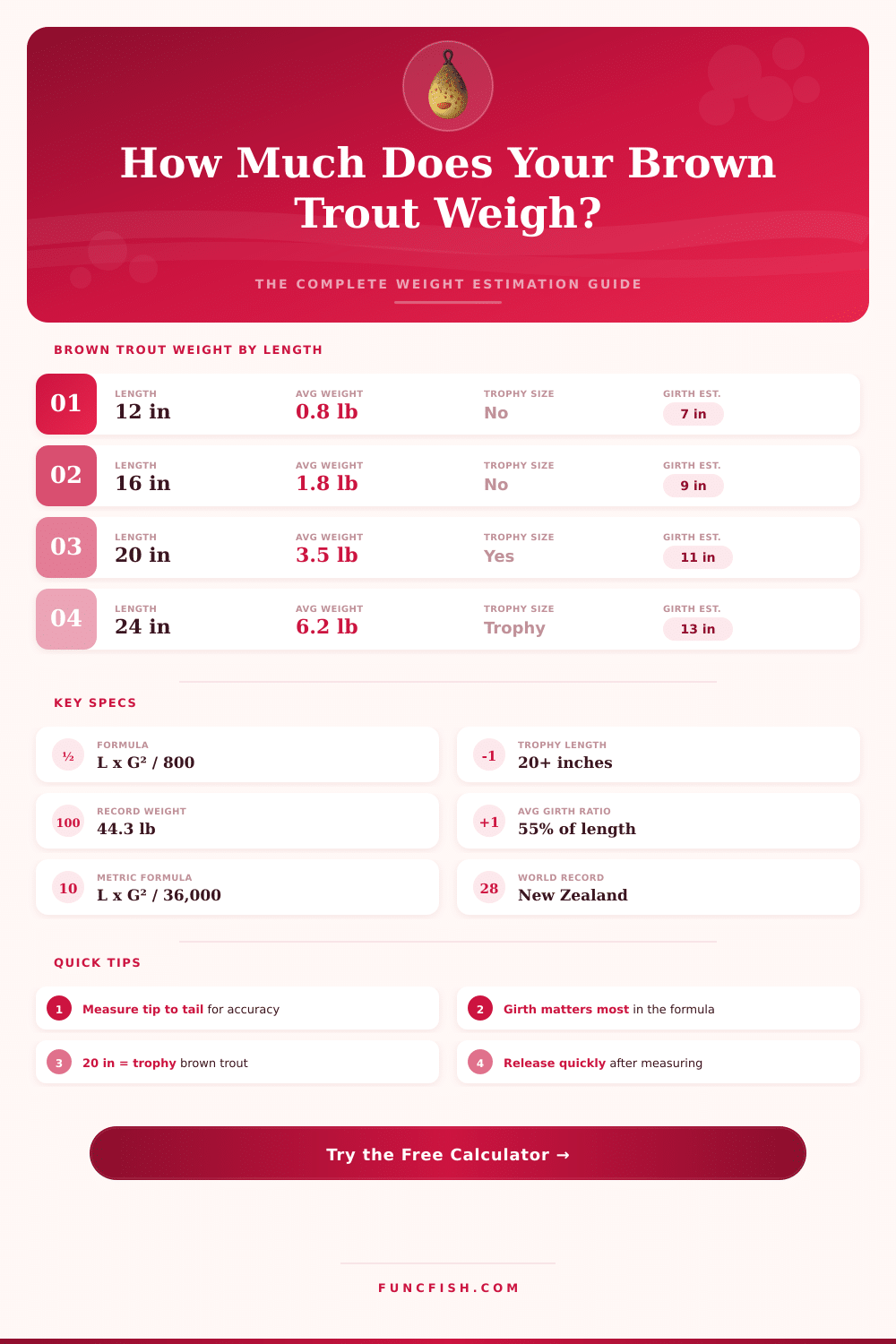
🐟 Brown Trout Weight Calculator
Estimate brown trout weight from length & girth measurements — imperial & metric supported
| Length (in) | Est. Girth (in) | Est. Weight (lb) | Weight (kg) | Classification |
|---|---|---|---|---|
| 8 | 5.0 | 0.25 | 0.11 | Fingerling |
| 10 | 6.0 | 0.45 | 0.20 | Sub-adult |
| 12 | 7.0 | 0.74 | 0.34 | Small |
| 14 | 8.0 | 1.12 | 0.51 | Average |
| 16 | 9.0 | 1.62 | 0.73 | Average |
| 18 | 10.0 | 2.25 | 1.02 | Good |
| 20 | 11.0 | 3.03 | 1.37 | Trophy |
| 22 | 12.0 | 3.96 | 1.80 | Trophy |
| 24 | 13.0 | 5.07 | 2.30 | Trophy |
| 26 | 14.0 | 6.37 | 2.89 | Specimen |
| 28 | 15.0 | 7.88 | 3.57 | Specimen |
| 30 | 16.0 | 9.60 | 4.35 | Specimen |
| 32 | 17.0 | 11.56 | 5.24 | Record Class |
| Species | Avg Weight | Max Weight | Formula Divisor |
|---|---|---|---|
| Brown Trout | 1–5 lb | 44.3 lb | 800 |
| Rainbow Trout | 1–4 lb | 42.7 lb | 900 |
| Brook Trout | 0.5–2 lb | 14.5 lb | 850 |
| Lake Trout | 3–10 lb | 102 lb | 750 |
| Cutthroat Trout | 1–3 lb | 41 lb | 820 |
| Tiger Trout | 1–4 lb | 20 lb | 800 |
| Condition | Multiplier | Fulton K Range | Description |
|---|---|---|---|
| Slim (post-spawn) | 0.88x | K < 0.8 | Lean, recently spawned |
| Standard | 1.00x | K 0.9–1.1 | Typical healthy fish |
| Well-fed / Chunky | 1.10x | K 1.1–1.3 | Above average condition |
| Trophy Condition | 1.20x | K > 1.3 | Peak weight, deep body |
Here you lay fish in the heated pan, and it right away starts curling upward. Here the main problem: the cook happens unevenly, so instead of getting nice golden and crispy surface, you end with soft, rubbery skin. Weight for fish fully changes the result.
It presses the piece flat against the pan, so that the skin truly can crisp during the whole cook equally below. The Weight spreads the pressure through the whole piece, stopping it from shrinking.
How to Press Fish for Crispy Skin and How to Weigh Fish
At first sight, this tool looks like a press for hamburgers. Nothing special. The stainless steel version from Josh Niland became really liked, and one delivers it soon to United States and Canada.
Some noticed that it looks like a little old clothes iron, simply a heavy metal block with a handle. What is nice about it is the balance between Weight and size, and cleaning it after takes only a moment.
Finding the real Weight of fish forms a whole ohter topic. For this there is a formula that one uses sometimes. Here is how it works: one takes the length, multiplies it by the girth, then again by the girth and divides everything by 800 to get pounds (using inches for the measures).
Say you caught a 29-inch trout with 15-inch girth. Plug those values directly in. The number 800 is not fixed, of course.
Depending on whether your fish are slim or fat, that figure can slide up or down. If you do not have a measure of girth handy, here is a simple way: just use 0.58 times the length as a guess.
But here is the catch: those formulas are not perfect. For instance, long pike can give foolish results. A skinny 31-inch pike maybe weighs much less then the chart promises.
The longest fish in the group is not always the heaviest, which commonly surprises the fishermen.
Fish lose Weight after one pulls them from the water. The blood spills, they vomit (everything that happens). But the loss of water is the main cause.
Because fish are full of water, they always control the water levels in their bodies through regulation, and after a change the toll starts quickly.
Because of that, to weigh fish right, a hanging scale helps a lot. The tough models last around 110 pounds, with lit screens, hooks and clips that do not slip. Scales with built-in lip grip are perfect, just clip it to the bottom jaw of the fish.
If yours has only a hook, take a separate pair of lip grips and use the tare function to remove theirWeight.
Long measures sometimes beat the Weight, especially with basses. The Weight changes, but the length of fish? That one can not deny.