🐟 Lake Trout Age Calculator
Estimate lake trout age from length or weight using validated biological growth models
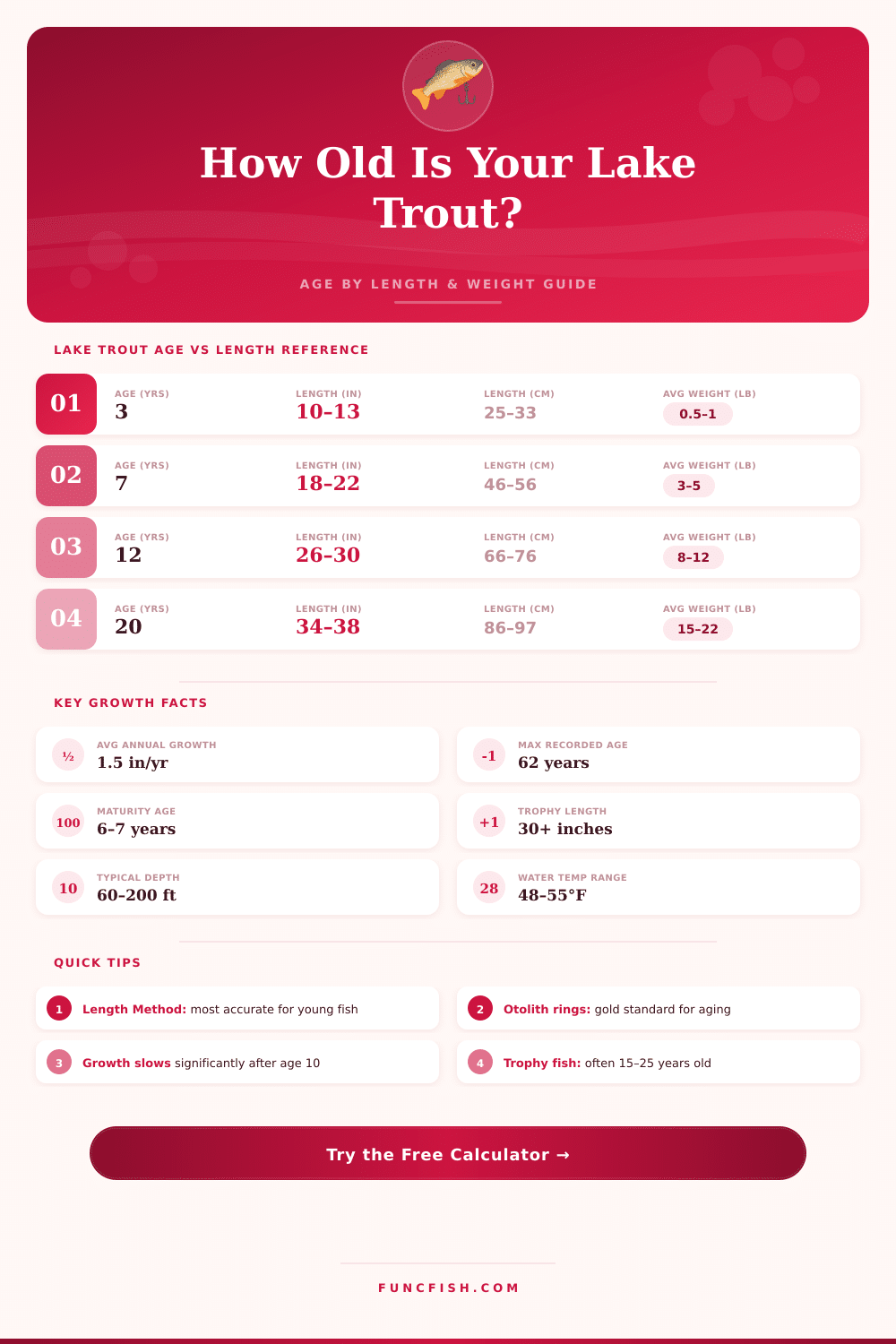
| Age (Years) | Length Range (in) | Length Range (cm) | Avg Weight (lb) | Avg Weight (kg) | Notes |
|---|---|---|---|---|---|
| 1 | 4–6 | 10–15 | 0.1–0.2 | 0.05–0.09 | Stocking size |
| 2 | 7–9 | 18–23 | 0.2–0.4 | 0.09–0.18 | Sub-legal size |
| 3 | 10–13 | 25–33 | 0.5–1.0 | 0.23–0.45 | Fast growth phase |
| 5 | 15–18 | 38–46 | 2–3 | 0.9–1.4 | Near legal size |
| 7 | 18–22 | 46–56 | 3–5 | 1.4–2.3 | Sexually mature |
| 10 | 22–26 | 56–66 | 6–9 | 2.7–4.1 | Growth slows |
| 15 | 27–31 | 69–79 | 10–16 | 4.5–7.3 | Trophy potential |
| 20 | 31–36 | 79–91 | 16–24 | 7.3–10.9 | Notable trophy |
| 30 | 36–42 | 91–107 | 24–40 | 10.9–18.1 | Very old specimen |
| 40+ | 40–50+ | 102–127+ | 35–60+ | 15.9–27.2+ | Rare patriarch |
| Lake / Region | Growth Rate | Avg Annual Growth | Notes |
|---|---|---|---|
| Lake Superior | Moderate–Slow | 1.2–1.6 in/yr | Cold, oligotrophic; slow metabolism |
| Lake Michigan | Moderate | 1.4–1.8 in/yr | Good forage base post-restoration |
| Lake Huron | Moderate | 1.3–1.7 in/yr | Variable by depth zone |
| Lake Ontario | Moderate–Fast | 1.5–2.0 in/yr | Warmer, richer; faster early growth |
| Lake Erie / Small Lakes | Slow–Moderate | 1.0–1.4 in/yr | Limited range, often stunted |
| Canadian Shield Lakes | Slow | 0.8–1.3 in/yr | Nutrient-poor, cold; long-lived fish |
| Alaskan / Northern Lakes | Very Slow | 0.6–1.1 in/yr | Extreme cold; very old specimens common |
| High-Altitude Deep Lakes | Slow | 0.7–1.2 in/yr | Cold, limited forage |
| Age Class | Typical Length | Recommended Line | Hook Size / Lure Weight |
|---|---|---|---|
| Juvenile (1–3 yrs) | 4–13 in | 4–8 lb mono | Size 6–8 hook, 1/8–1/4 oz |
| Sub-adult (4–6 yrs) | 14–18 in | 8–12 lb mono/fluoro | Size 2–4 hook, 1/4–1/2 oz |
| Adult (7–12 yrs) | 19–26 in | 12–20 lb mono or 20 lb braid | Size 1/0–3/0 hook, 1/2–1 oz |
| Large Adult (13–20 yrs) | 27–34 in | 20–30 lb mono or 30 lb braid | Size 3/0–5/0 hook, 1–2 oz |
| Trophy (20+ yrs) | 34+ in | 30+ lb braid with fluoro leader | Size 5/0–7/0 hook, 2–4 oz |
| Method | Accuracy | Requires Harvest? | Best For |
|---|---|---|---|
| Otolith Ring Count | ★★★★★ Highest | Yes | Scientific research, precise aging |
| Scale Ring Count | ★★★★ High | No (scale removal) | Field aging by biologists |
| Length-at-Age Model (von Bertalanffy) | ★★★ Good | No | Catch-and-release estimate |
| Weight-at-Age Regression | ★★ Moderate | No | Quick field estimate |
| Length + Weight Combined | ★★★ Good | No | Best non-invasive method |
The von Bertalanffy growth model using total length gives the best non-invasive age estimate for lake trout. Measure from tip of mouth to end of tail (pinched) for accuracy. Length alone accounts for ~85% of age variance in most lake systems.
A 20-inch lake trout in Lake Superior could be 12–14 years old, while the same fish in Lake Ontario might be only 8–10 years old. Always apply the correct lake system correction factor for the most accurate age estimate.
lake trout are not really part of the trout. They are the biggest species among the freshwater fish. One knows them under several names, as mackinaw, namaycush, lake chars, touladi, togue and gray trout.
The word namaycush comes from a term used in some native communities of the South-East Cree, that describes this fish. In the Ojibwe language, namegos means lake trout while namegoshens refers to rainbow trout, what literally says little lake trout.
Lake Trout Life and Growth
Among the most notable traits of lake trout stands its long life. In northern regions, they manage to reach even 50 years. For them, living 15 to 25 years is not rare.
Commonly they pass the 25-year limit, and some samples reached up to 60 years, according to recorded data. In Alaska, it is possible to live more than 50 years, however the usual maximum sits around 20 years. Depending on the population, they can last even up to 40 years.
lake trout grow very slowly. Their very slow growth rates do not stop them from reaching big sizes. Trout of 30 inches can appear almost usual, depending on the northern area wear the fish live.
Because of their slow growth and long life, their groups easily can be overfished.
Other parts are the long time to reach full maturity. Both sexes, males and females, usually mature in six to eight years. In some groups, that happens only in eight to ten years.
Young lake trout are born in rocky places and later care for themselves. They form a late-maturing species with naturally low breeding skill.
An interesting fact is that during decades of aging, lake trout experience only minor rises in death rate. They keep their breeding chances in full state. Old adult males match in skill to young ones.
During breeding, males get dark strokes on the chest, pelvic and anal fins.
How do scientists determine the age of lake trout? The otolith, or ear stone, shows as the safest method. It sits in the inner ear, and people own one too.
As the fish grows, the otolith grows together with it. The gap between the rings on it is bigger in the early years and shrinks when the fish ages. The record lake trout in Michigan state probably reached 35 to 50 years, according to length-age calculations from Canadian Shield lakes.
In the Great Lakes, stocked lake trout receive year-specific marks by means of a cut of fin, which helps their dating.
For rough guessing about smaller copies, trout of one to one-and-half pounds probably have two to three years. The growthrate slows when the fish ages, so big fish are harder to estimate.