🐟 Snook Table Calculator
Estimate snook weight from length & girth, match gear specs, and get instant imperial/metric conversions
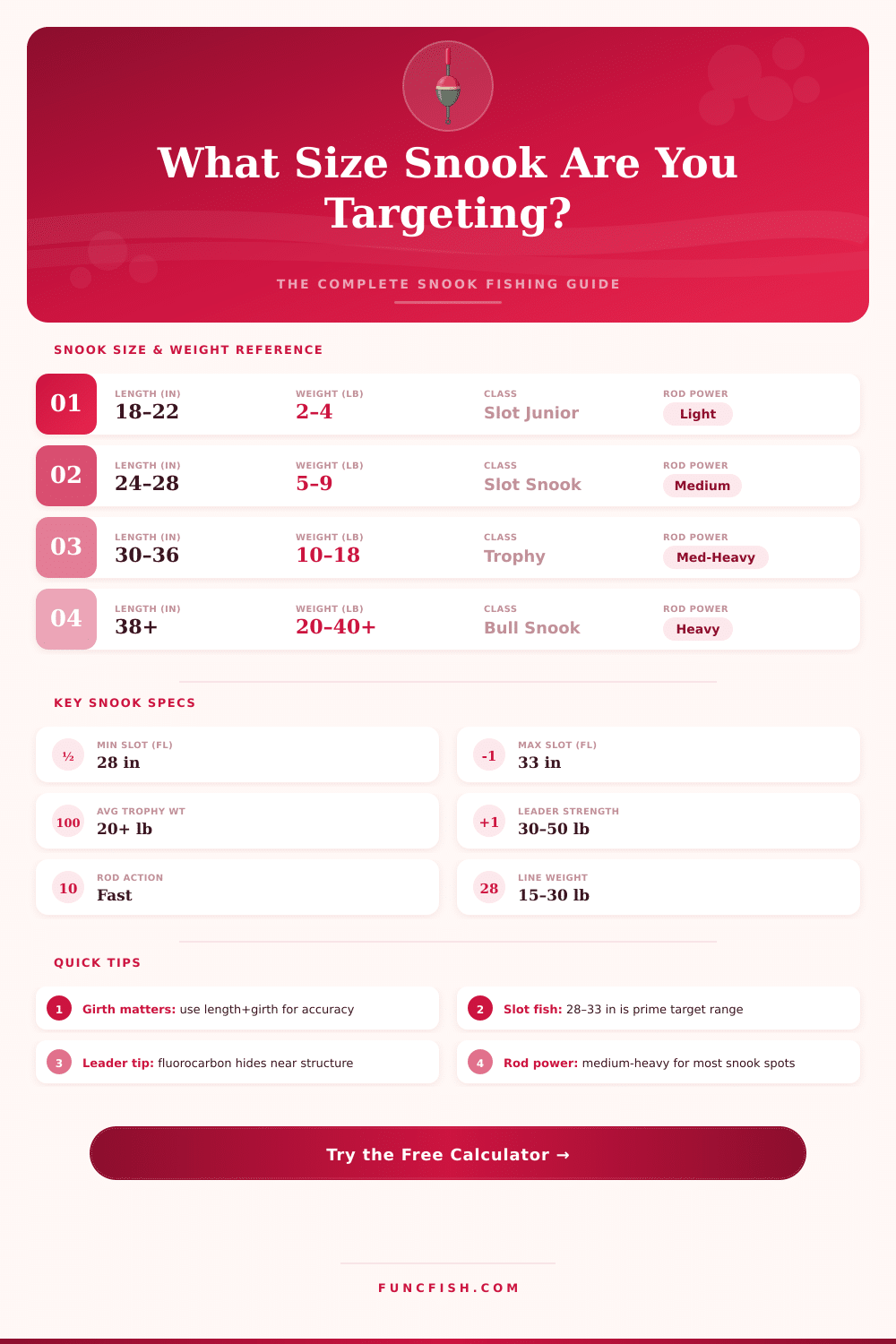
| Length (in) | Length (cm) | Est. Weight (lb) | Est. Weight (kg) | Class | Girth (avg in) |
|---|---|---|---|---|---|
| 14 | 35.6 | 0.8 | 0.36 | Sub-Slot | 7.5 |
| 16 | 40.6 | 1.2 | 0.54 | Sub-Slot | 8.5 |
| 18 | 45.7 | 1.8 | 0.82 | Sub-Slot | 9.5 |
| 20 | 50.8 | 2.6 | 1.18 | Sub-Slot | 10.5 |
| 22 | 55.9 | 3.5 | 1.59 | Near-Slot | 11.5 |
| 24 | 61.0 | 4.8 | 2.18 | Near-Slot | 12.5 |
| 26 | 66.0 | 6.2 | 2.81 | Near-Slot | 13.5 |
| 28 | 71.1 | 7.9 | 3.58 | Slot Snook | 14.5 |
| 30 | 76.2 | 9.8 | 4.45 | Slot Snook | 15.5 |
| 32 | 81.3 | 12.0 | 5.44 | Slot Snook | 16.5 |
| 34 | 86.4 | 14.5 | 6.58 | Trophy | 17.5 |
| 36 | 91.4 | 17.3 | 7.85 | Trophy | 18.5 |
| 38 | 96.5 | 20.5 | 9.30 | Trophy | 19.5 |
| 40 | 101.6 | 24.0 | 10.89 | Bull Snook | 20.5 |
| 42 | 106.7 | 27.8 | 12.61 | Bull Snook | 21.5 |
| 44 | 111.8 | 32.0 | 14.51 | Bull Snook | 22.5 |
| Line Type | Stretch | Visibility | Abrasion Res. | Best For | Typical lb Test |
|---|---|---|---|---|---|
| Monofilament | High (25%) | Medium | Good | Beginners, dock | 12–20lb |
| Fluorocarbon | Low (8%) | Very Low | Excellent | Clear water, leader | 15–30lb |
| Braided Line | None | High | Fair | Structure, feel | 20–50lb |
| Braid + Fluoro Leader | Minimal | Low (leader) | Excellent | All-around best | 20lb / 30lb leader |
| Wire Leader | None | High | Max | Jetty/rocks | 40–60lb |
| Heavy Nylon | Medium | Medium | Good | Budget, surf | 15–25lb |
| Dacron | Low | High | Fair | Backing, trolling | 20–50lb |
| Lead Core | Minimal | High | Fair | Depth trolling | 18–36lb |
| Habitat | Typical Size | Rod Power | Line Weight | Leader |
|---|---|---|---|---|
| Mangrove Edge | 18–28 in | Medium | 15–20lb | 30lb fluoro |
| Dock / Structure | 20–32 in | Med-Heavy | 20–30lb | 40lb fluoro |
| Beach / Surf | 24–40 in | Heavy | 20–40lb | 40–50lb |
| Inlet / Jetty | 28–44 in | Heavy | 30–50lb | 50lb wire/fluoro |
| Bridge | 24–38 in | Med-Heavy | 25–40lb | 40lb fluoro |
| Backwater / Flat | 16–28 in | Medium-Light | 12–20lb | 20–30lb |
| Tidal Pass | 28–42 in | Heavy | 30–50lb | 50lb fluoro |
| River / Canal | 16–30 in | Medium | 15–25lb | 30lb fluoro |
| Rod Power | Snook Size (lb) | Lure Wt (oz) | Line Range (lb) | Best Technique |
|---|---|---|---|---|
| Medium Light | 1–5 lb | 1/8–3/8 | 8–15 | Backwater / fly |
| Medium | 5–12 lb | 1/4–5/8 | 12–20 | General inshore |
| Medium Heavy | 10–22 lb | 3/8–1.5 | 17–30 | Structure / bridge |
| Heavy | 18–40+ lb | 1–3+ | 25–50 | Inlet / beach trophy |
snook are really wonderful fish and their size changes a lot based on the species and the place. The usual snook rules the fishing in Florida and in ports, as if it would be the main star of the game. Usually one sees them weighing around 3 to 15 pounds, but the truly wonderful ones beat that a lot.
When talking about normal catches outside, snook weigh around five pounds. Fish from the gulfs commonly reaches 20 to 30 inches. Even so trophy snook is another cause, it stretches from 36 to 48 inches and weigh between 16 and almost 40 pounds.
How Big Are Snook?
One commonly tlaks about catches passing 50 inches and 50 pounds, although such happen rarely.
There is a good rule that counts quite well: every extra inch above 20 inches matches to around one pound. For instance, a 29-inch snook would weigh average about 8.8 pounds. Every fish passing 40 inches deserves the label of trophy.
After that 40-inch limit even so, the wait grows quickly. Every extra inch adds at least 5 pounds more. That is a big change.
Scientists think that the usual snook can reach 48 inches and pass 60 pounds. The world record of IGFA is 53 pounds and 10 ounces, caught in Parismina Ranch, Costa Rica. There is also another on the list at 59 pounds and 8 ounces, stretching 47.6 inches with a girth of 31.3 inches, what makes it the heaviest snook ever logged.
The state record of Florida sits between 44 and 45 pounds. There was also a catch off the coast in 1937 in the Gulf of Mexico, that weighed 57.50 pounds.
Not all species of snook grow this big, even so. The fat snook averages between 6 and 10 pounds, stretching around 12 inches, although some reaches 28 inches. The eight smaller species of snook usually stay under 6 pounds.
Through the whole group, the lengths range from around 20 to 140 centimetres, give or take. The top weight goes from almost one kilo in the smallest species to more than 20 kilos in the biggest.
Weights for snook are figured using the average weight of each seen fish in a half-inch range. So, if a chart points to a 33-inch snook, that truly is the average of all snook between 32.5 and 33.5 inches. Any effort is a guess between the numbers.
snook truly struggle in water cooler than 60 degrees. Harsh Florida winter years once almost erased them. Gentler winters allowed them to move more north than usually.
In summer of 1989, a 16-pound usual snook appeared at the mouth of the Mississippi River, after a series of twelve gentle winters. Interestingly, such trophy snook above 40 inches does not give a lot offight after capture. Pulling it feels more like dragging a stone.