🐟 Snapper Weight Calculator
Estimate snapper weight from length & girth — red, yellowtail, mangrove & more
K Factor
K Factor
K Factor
K Factor
K Factor
K Factor
K Factor
K Factor
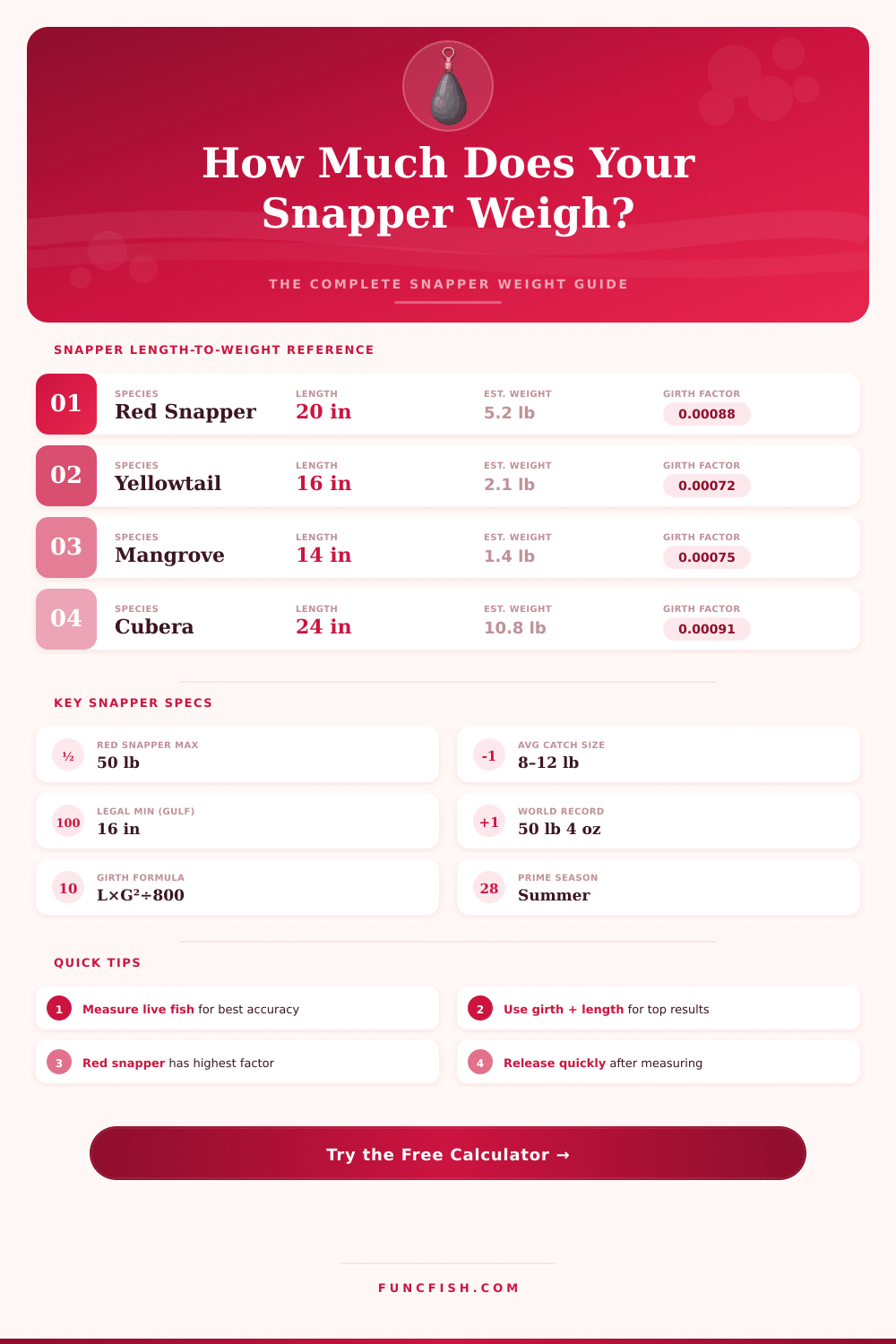
| Length (in) | Length (cm) | Est. Weight (lb) | Est. Weight (kg) | Typical Girth (in) |
|---|---|---|---|---|
| 12 | 30.5 | 1.2 | 0.54 | 8 |
| 14 | 35.6 | 1.9 | 0.86 | 9 |
| 16 | 40.6 | 2.9 | 1.32 | 10 |
| 18 | 45.7 | 4.1 | 1.86 | 11 |
| 20 | 50.8 | 5.6 | 2.54 | 13 |
| 22 | 55.9 | 7.5 | 3.40 | 14 |
| 24 | 61.0 | 9.7 | 4.40 | 15 |
| 26 | 66.0 | 12.4 | 5.63 | 17 |
| 28 | 71.1 | 15.5 | 7.03 | 18 |
| 30 | 76.2 | 19.2 | 8.71 | 19 |
| 32 | 81.3 | 23.4 | 10.61 | 21 |
| 36 | 91.4 | 33.3 | 15.10 | 23 |
| Species | Avg Weight | Max Weight | Common Length | Habitat |
|---|---|---|---|---|
| Red Snapper | 4–15 lb | 50 lb | 16–28 in | Offshore structure |
| Yellowtail | 1–4 lb | 8 lb | 12–18 in | Shallow reef |
| Mangrove (Gray) | 1–5 lb | 14 lb | 10–18 in | Inshore / mangroves |
| Cubera | 10–30 lb | 124 lb | 20–36 in | Deep rocky reef |
| Mutton | 3–12 lb | 30 lb | 14–24 in | Nearshore reef |
| Lane | 0.5–2 lb | 7 lb | 8–14 in | Shallow reef |
| Silk | 1–4 lb | 18 lb | 10–16 in | Deep water |
| Dog Snapper | 2–10 lb | 28 lb | 14–22 in | Rocky shore / reef |
| Vermilion | 0.5–2 lb | 7 lb | 8–14 in | Deep soft bottom |
| Est. Weight | Rod Power | Line (lb test) | Hook Size | Leader (lb) |
|---|---|---|---|---|
| Under 2 lb | Ultralight | 6–10 lb | #4–#1 | 10–15 lb |
| 2–5 lb | Light | 10–15 lb | 1/0–2/0 | 15–20 lb |
| 5–10 lb | Medium | 15–30 lb | 2/0–3/0 | 25–40 lb |
| 10–20 lb | Medium-Heavy | 30–50 lb | 3/0–5/0 | 40–60 lb |
| 20–40 lb | Heavy | 50–80 lb | 5/0–7/0 | 60–80 lb |
| 40 lb + | Extra Heavy | 80–130 lb | 7/0–9/0 | 80–100 lb |
Whether you want to reach nice crisp skin on fish? It seems an easy task, even so it is much more difficult than one thinks. When the fish bit touches the hot pan it immediately starts curling upward.
That curling causes the whole cook to happen uneven, and in the end you receive soft, nasty skin. None wants that.
Make Fish Skin Crispy and Weigh a Fish
Fish pressure helps to settle this problem. It simply is a tool that presses the fish flat against the pan, during the skin crisps in the wanted mode. Advantage: the meat cooks equally quickly.
It operates by means of steady pressure with same force through the whole bit. If you ever used a hamburger press, you have the right notion in mind.
One especially well considered variant comes from Josh Niland, stainless steel fish pressure, done for serious cooks. That is the kind of professional gear that one finds in kitchens of restaurants, designed to give restuarant quality of crisp skin without any extra irritation. The object weighs around 1,8 kg, so around 4 pounds.
It costs 165,00 dollars, and one delivers it to United States and Canada.
Here where things become a bit difficult: “fish Weight” has an entirely other meaning in the world of fishing. Here fishers indeed use a formula to estimate the Weight of fish without laying it on a balance. One multiplies the girth of the fish, later by the length and shares the result by 800.
Both measures are in inches, and one receives Weight in pounds. Assume you seized a fish with 15-inch girth and it measures 29 inches; simply put those numbers in the calculation. For some fish especially, that divider of 800 can adjust up or down according to weather your local fishes are heavy or lightweight compared to average.
Charts of length to Weight exist also, but here the thing: they not always are reliable. Thin fishes and thick fishes of same length can have entirely different weights. The physical build causes all differences.
Is the belly full or the fish recently bore, that affects the real Weight. Judge only according to length results quite a lot less precise in contests, because it does not consider how thick or slim the fish genuinely is.
If you require precise heavy measure, take a balance with built-in lip grip. Press it directly to the centre of the bottom jaw of the fish. No lip grip on your balance?
No problem, use a separate tool, later simply remove its Weight from the whole result.
When one prepares a rig for fishing, the Weight of sinker matters a lot. For drift rigs one usually uses between 1,5 and 2 units. Deeper water or strong wind with flow?
Then one must reach 2 to 3 units. In the gulf, one rarely requires more than 3 units. Pyramid weights welloperate in high flow places as surf zones or passages.