🎣 Fly Fishing Leader Calculator
Build the perfect tapered leader — butt, mid & tippet sections calculated for your fly line weight and conditions
| X Rating | Diameter (in) | Diameter (mm) | Breaking Strength (lb) | Breaking Strength (kg) | Recommended Fly Size |
|---|---|---|---|---|---|
| 0X | 0.011 in | 0.28 mm | 15.5 lb | 7.0 kg | #2 – #6 |
| 1X | 0.010 in | 0.25 mm | 13.5 lb | 6.1 kg | #4 – #8 |
| 2X | 0.009 in | 0.23 mm | 11.5 lb | 5.2 kg | #6 – #10 |
| 3X | 0.008 in | 0.20 mm | 8.5 lb | 3.9 kg | #10 – #14 |
| 4X | 0.007 in | 0.18 mm | 6.0 lb | 2.7 kg | #12 – #18 |
| 5X | 0.006 in | 0.15 mm | 4.75 lb | 2.2 kg | #14 – #22 |
| 6X | 0.005 in | 0.13 mm | 3.5 lb | 1.6 kg | #16 – #26 |
| 7X | 0.004 in | 0.10 mm | 2.5 lb | 1.1 kg | #18 – #28 |
| 8X | 0.003 in | 0.076 mm | 1.75 lb | 0.8 kg | #22 – #32 |
| Species | Typical Weight | Line Weight | Leader Length | Tippet Size | Tippet Strength |
|---|---|---|---|---|---|
| Brook Trout | 0.5–2 lb (0.2–0.9 kg) | 2–4 wt | 7.5 ft (2.3 m) | 5X–6X | 3.5–4.75 lb |
| Rainbow Trout | 1–5 lb (0.5–2.3 kg) | 4–6 wt | 9 ft (2.7 m) | 4X–5X | 4.75–6 lb |
| Brown Trout | 1–8 lb (0.5–3.6 kg) | 4–6 wt | 9–12 ft (2.7–3.7 m) | 4X–6X | 3.5–6 lb |
| Steelhead | 5–15 lb (2.3–6.8 kg) | 7–9 wt | 9 ft (2.7 m) | 1X–3X | 8.5–13.5 lb |
| Smallmouth Bass | 1–5 lb (0.5–2.3 kg) | 5–7 wt | 7.5–9 ft (2.3–2.7 m) | 2X–3X | 8.5–11.5 lb |
| Largemouth Bass | 2–8 lb (0.9–3.6 kg) | 6–8 wt | 7.5 ft (2.3 m) | 0X–2X | 11.5–15.5 lb |
| Bonefish | 3–10 lb (1.4–4.5 kg) | 7–9 wt | 9 ft (2.7 m) | 2X–3X | 8.5–11.5 lb |
| Permit | 5–20 lb (2.3–9 kg) | 8–10 wt | 9–12 ft (2.7–3.7 m) | 2X–4X | 6–11.5 lb |
| Pike / Muskie | 5–30 lb (2.3–13.6 kg) | 9–12 wt | 6 ft (1.8 m) | 0X + wire | 15.5+ lb |
| Bluegill / Panfish | 0.25–1 lb (0.1–0.5 kg) | 2–4 wt | 7.5 ft (2.3 m) | 5X–7X | 2.5–4.75 lb |
Good for dry fly
Best for nymphs
General purpose
Excellent turnover
Energy transfer
Add fluoro tippet
Easy to use
Stillwater use
Choosing the right length for the Leader in fishing does not answer for everything, it depends on what you plan to do. In the most cases, something between 12 and 18 inches will work for everyday use. What about exceptions?
Hunting in shallow seas for ocean fish or jacks, together with those crystal clear river parts, where you try to catch steelhead and wild trout. Here the key reason: the most artificial baits intend to quickly react so that you do not necessarily need a very long Leader for good results.
Pick the Right Leader Length for Fishing
If you should choose only one length, 36 inches marks an ideal solution for everything. On the other hand, shorter or longer Leaders certainly work according to the kind of baits that you cast. From my experience with lure fishing, using around 2 feet shows itself helpful.
Some anglers choose so short that the bare knot stays below the rod tip during the launch… That stops it from slipping through teh rings and tangling up.
The clarity of the water has big influence. In strongly stained or muddy water, a Leader of 8 to 12 inches truly works for you. It does not make sense to use a long Leader to hide the braided line, when the water looks like chocolate milk.
Clear water situation? Here a long Leader makes sense. Match your Leader with the visibility of the water as a good rule.
I succeeded with a 10-foot Leader, when one can sea around 10 feet. If the depth shows 20 feet, then use 36 inches.
Fly Fishing slightly changes the reasons. At first one commonly matches the Leader with the rod length. For a nine-foot rod?
Take a 9-foot Leader. During streamer casts, between 6 and 8 feet ease the launch, especially with an 8-foot rod in hand. For soft nymph or dry fly fishing?
Here one uses longer, 12 feet or even more help. Leaders of 12 to 15 feet hamper the launch, but they keep your fly away from the thick fly line, what matters in tricky streams in spring.
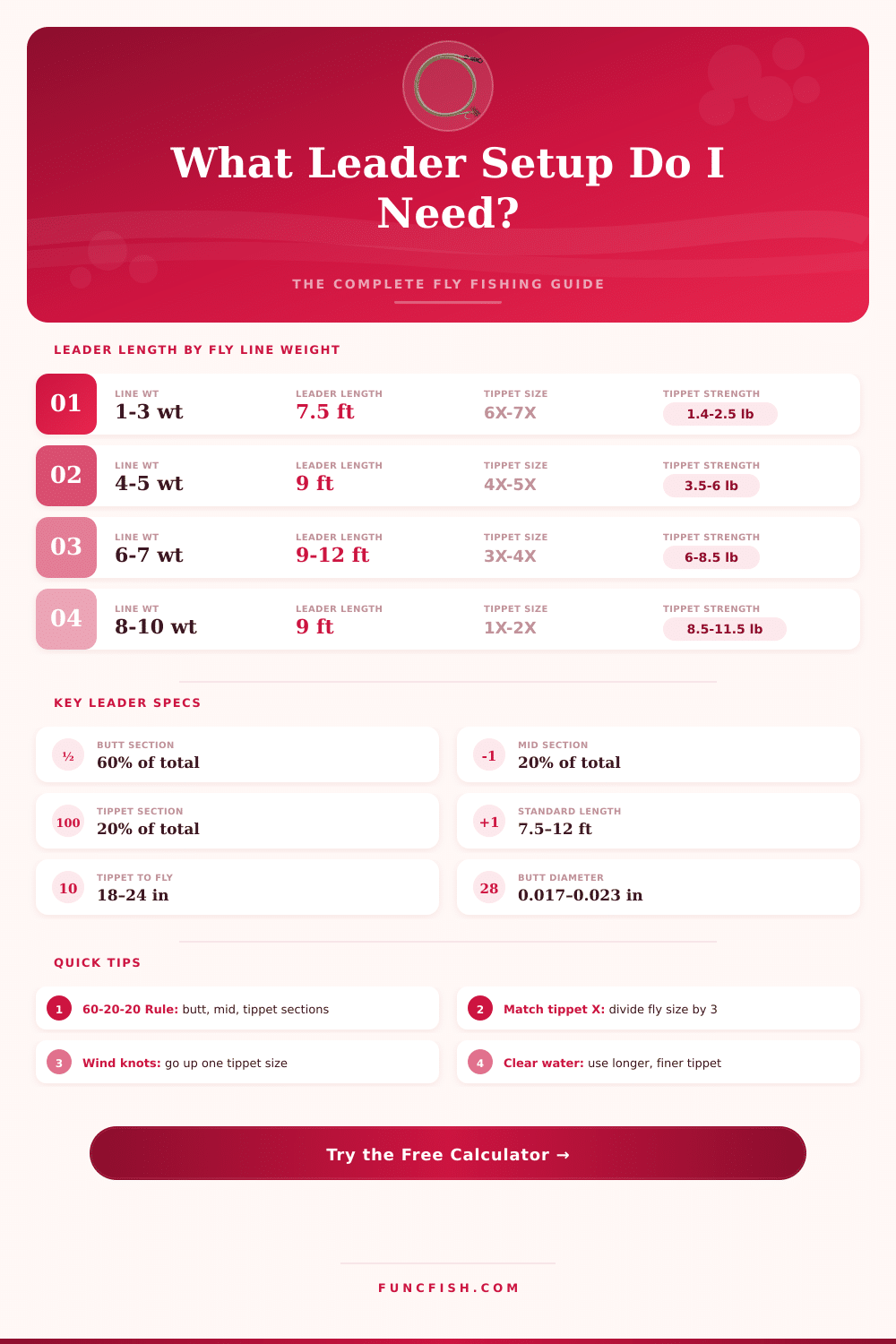
The tippet normally takes around a third of the whole Leader. For a 9-foot Leader, that means 3 feet of tippet. Standard tapered Leader comes in lengths like 7 feet 6 inches, 9 feet, 12 feet and even more.
For newcomers, start with a 9-foot Leader, attach some extra feet of tippet, and you are ready for the most trout, bass and panfish situations.
Long Leaders also affect the motion of baits. Added length allows live bait, like shiners or minnows, to swim more naturally and freely, though it makes it easier to miss bites. Short Leaders give better control over the bait path.
For drop-shot rigs, something between 6 and 36 inches works according to how far you want the bait from the weight. ShortLeaders help to also avoid tangles with sliding sinkers.