🎣 Fishing Jig Weight Calculator
Find the ideal jig weight for your depth, current speed, line type, and target species
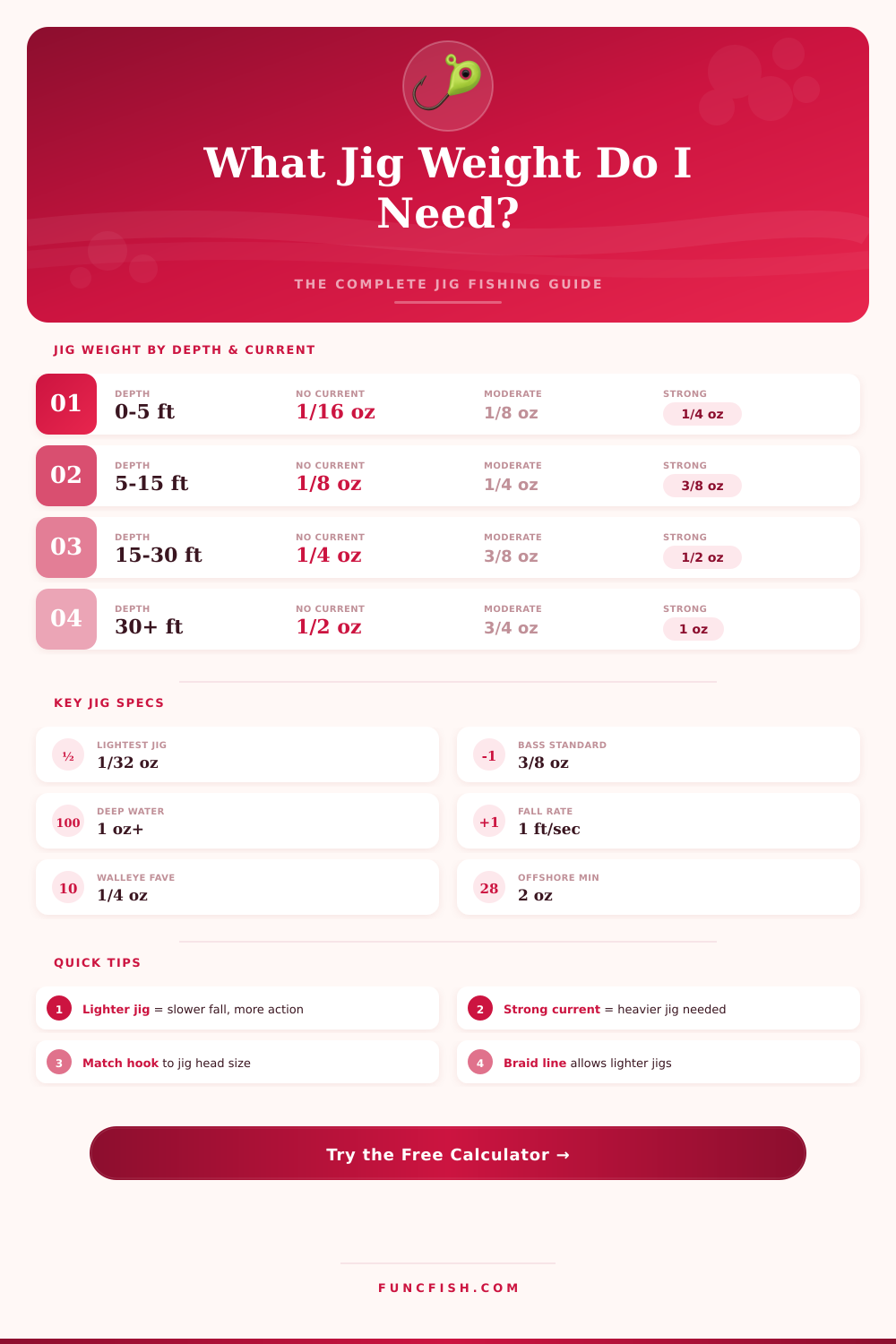
| Depth | No Current | Moderate (1–3 mph) | Strong (3+ mph) |
|---|---|---|---|
| 0–5 ft (0–1.5m) | 1/32–1/16 oz (0.9–1.8g) | 1/8 oz (3.5g) | 1/4 oz (7g) |
| 5–10 ft (1.5–3m) | 1/16–1/8 oz (1.8–3.5g) | 1/4 oz (7g) | 3/8 oz (10.6g) |
| 10–20 ft (3–6m) | 1/4 oz (7g) | 3/8 oz (10.6g) | 1/2 oz (14.2g) |
| 20–35 ft (6–11m) | 3/8–1/2 oz (10.6–14.2g) | 3/4 oz (21.3g) | 1 oz (28.3g) |
| 35–60 ft (11–18m) | 3/4–1 oz (21.3–28.3g) | 1–1.5 oz (28–42g) | 2 oz (56.7g) |
| 60+ ft (18m+) | 1.5–2 oz (42–57g) | 2–3 oz (57–85g) | 3–4 oz (85–113g) |
| Species | Typical Weight | Rec. Jig Weight | Best Jig Type |
|---|---|---|---|
| Largemouth Bass | 1–8 lb (0.5–3.6 kg) | 3/8–1/2 oz (10.6–14.2g) | Football / Flipping |
| Smallmouth Bass | 1–5 lb (0.5–2.3 kg) | 1/4–3/8 oz (7–10.6g) | Finesse / Round |
| Walleye | 2–10 lb (0.9–4.5 kg) | 1/8–3/8 oz (3.5–10.6g) | Stand-Up / Round |
| Trout (Rainbow) | 0.5–4 lb (0.2–1.8 kg) | 1/32–1/8 oz (0.9–3.5g) | Dart / Finesse |
| Crappie / Panfish | 0.25–2 lb (0.1–0.9 kg) | 1/32–1/16 oz (0.9–1.8g) | Round / Finesse |
| Pike / Muskie | 5–30 lb (2.3–13.6 kg) | 1/2–1 oz (14.2–28.3g) | Bucktail / Swim |
| Striped Bass | 5–40 lb (2.3–18 kg) | 1–3 oz (28.3–85g) | Bucktail / Dart |
| Tuna (Yellowfin) | 20–200 lb (9–91 kg) | 2–8 oz (56.7–227g) | Bucktail / Metal |
| Redfish / Flounder | 1–10 lb (0.5–4.5 kg) | 1/4–3/4 oz (7–21.3g) | Round / Stand-Up |
| Snook | 5–20 lb (2.3–9 kg) | 1/4–1/2 oz (7–14.2g) | Swim / Dart |
| Jig Type | Best Use | Weight Range | Fall Action |
|---|---|---|---|
| Round Ball | General / Vertical | 1/32–1 oz | Fast / Direct |
| Stand-Up | Rocky / Structured Bottom | 1/8–3/4 oz | Slow / Upright |
| Swim Jig | Weed Edges / Open Water | 1/4–3/4 oz | Horizontal |
| Football | Deep Rocks / Hard Bottom | 3/8–1.5 oz | Rolling |
| Dart / Arky | Current / Drifting | 1/16–1/2 oz | Darting |
| Finesse | Clear Water / Pressured Fish | 1/32–1/4 oz | Slow / Subtle |
| Bucktail | Saltwater / Striper | 1/2–4 oz | Pulsing |
| Flipping Jig | Heavy Cover / Thick Grass | 3/8–1 oz | Punching |
Election of the right Weight for the Fishing Jig can be hard because of the many factors that affect this decision. The temperature of the water plays an important role. If the water is below 65 degrees then use of more lightweight weights, as half an ounce or even less, commonly works more well.
Factors as depth, flow, wind, size of the line and even kind of the Fishing Jig all help to decide what Weight to choose.
How to Choose the Right Fishing Jig Weight
A common rule simply is use around 1.5 grams for every foot of depth. So, for water at 100 feet, a 150-gram Fishing Jig would give a good start. Another guide offers 1.5 until 3 grams for every metre of depth.
For instance, in 3 metres of water, a 6-gram jig-head works well.
In shallow water, lightweight jig-heads are the best choice. With an almost light jig-head in rough shallow reefs, one escapes easily getting stuck on the bottom. A practical tip is to count the seconds during the bait falls down.
One takes known depth and measures time, how many time it requires to reach the bottom. Later, one multiplies that for other depth to count how long to expect.
Many fishers reckon that 3/8 ounce is an excellent everyday Weight. It works for swimming jigs, cast jigs, flipping jigs, football jigs and even for chatterbait types. Sizes of 1/16 and 1/8 ounce also are liked for pitching, and having a range of 1/32 until 1/8 ounce quite a lot covers the most shallow spots.
Deep water changes everything entirely. For depth between 100 and 130 feet, around 3.5 ounces usually works. Jigs until 17 ounces are made for even deeper places.
In deep water with big fishes, heavy jigs in a range of 400 until 600 grams get the task done. Even so, heavier jigs require more fource for fishing.
In the bay, one rarely needs more than 3 ounces. If wind and flow push in opposite directions, then 2 until 3 ounces maybe must be used. With 10-pound braided line, half an ounce commonly works to reach around 30 feet, although strong wind and flow require heavy weights.
The Weight of a Fishing Jig does not serve only to reach depth. The speed of the fall is what attracts the bites. Sometimes the bass responds more well too very slow sinking.
Use the most lightweight Weight that it is possible under the conditions, usually is the best plan. One fisher found that a 1/16-ounce jig-head gave better results in water until 6 feet than heavy choices. Also, some folks fish entirely without Weight, only with hook and heavy soft plastic.
An interesting fact is that not all jig-heads weigh exactly what the packet says. Some brands mark a Fishing Jig as 1/16 ounce, but it actually weighs close to 1/8 ounce. Some brands aremore reliable than others about the listed weights.