🌕 Solunar Chart Fishing Calculator
Find your peak fishing times using moon phase, sun position & local solunar periods
| Species | Moon Sensitivity | Best Moon Phase | Optimal Temp (°F) | Optimal Temp (°C) | Peak Period Type |
|---|---|---|---|---|---|
| Largemouth Bass | High | Full & New | 65–75°F | 18–24°C | Major |
| Smallmouth Bass | High | Full & New | 60–70°F | 15–21°C | Major |
| Rainbow Trout | Moderate | New Moon | 50–60°F | 10–16°C | Minor |
| Brown Trout | High | Full Moon | 55–65°F | 13–18°C | Major |
| Channel Catfish | Very High | Full Moon | 70–85°F | 21–29°C | Major (Night) |
| Walleye | High | Quarter | 55–68°F | 13–20°C | Dawn / Dusk |
| Northern Pike | Moderate | Full Moon | 55–70°F | 13–21°C | Major |
| Bluegill / Crappie | Moderate | New Moon | 65–75°F | 18–24°C | Minor |
| Redfish / Red Drum | High | Full & New | 65–78°F | 18–26°C | Tidal Major |
| Striped Bass | High | Full Moon | 55–68°F | 13–20°C | Major (Night) |
| Period Type | Trigger Event | Duration | Activity Level | Occurs Per Day |
|---|---|---|---|---|
| Major Period 1 | Moon Overhead (Transit) | ~2 hours | Peak (90–100%) | 1x |
| Major Period 2 | Moon Underfoot (Anti-transit) | ~2 hours | Peak (85–95%) | 1x |
| Minor Period 1 | Moonrise | ~1 hour | High (65–80%) | 1x |
| Minor Period 2 | Moonset | ~1 hour | High (60–75%) | 1x |
| Solar Peak | Sunrise / Sunset | 1–1.5 hrs | Moderate–High | 2x |
| Solunar Overlap | Moon + Sun aligned | 2–3 hours | Extreme (+40%) | Rare |
| Pressure State | Reading (inHg) | Reading (mbar) | Fish Behavior | Activity Modifier |
|---|---|---|---|---|
| High & Rising | >30.2 inHg | >1022 mbar | Moving to shallows, feeding | +15% |
| Stable High | 30.0–30.2 | 1016–1022 | Normal feeding patterns | +5% |
| Stable Normal | 29.7–30.0 | 1005–1016 | Predictable activity | 0% |
| Rapidly Falling | Drop >0.06/hr | Drop >2/hr | Brief feeding frenzy then slow | -10% |
| Low & Stable | <29.7 inHg | <1005 mbar | Lethargic, near bottom | -20% |
| Storm Approaching | Rapid drop | Rapid drop | Pre-storm feeding spike | +20% then -30% |
Solunar fishing chart helps anglers find the best times for fishing according to the positions of the sun and moon regarding the Ground. All charts deliver predictions for every month of the year and let fishermen, hunters and even birdwatchers plan the best days for their activities. The main idea is that fish act during certain lunar phases because of the gravitational pull and position of the moon
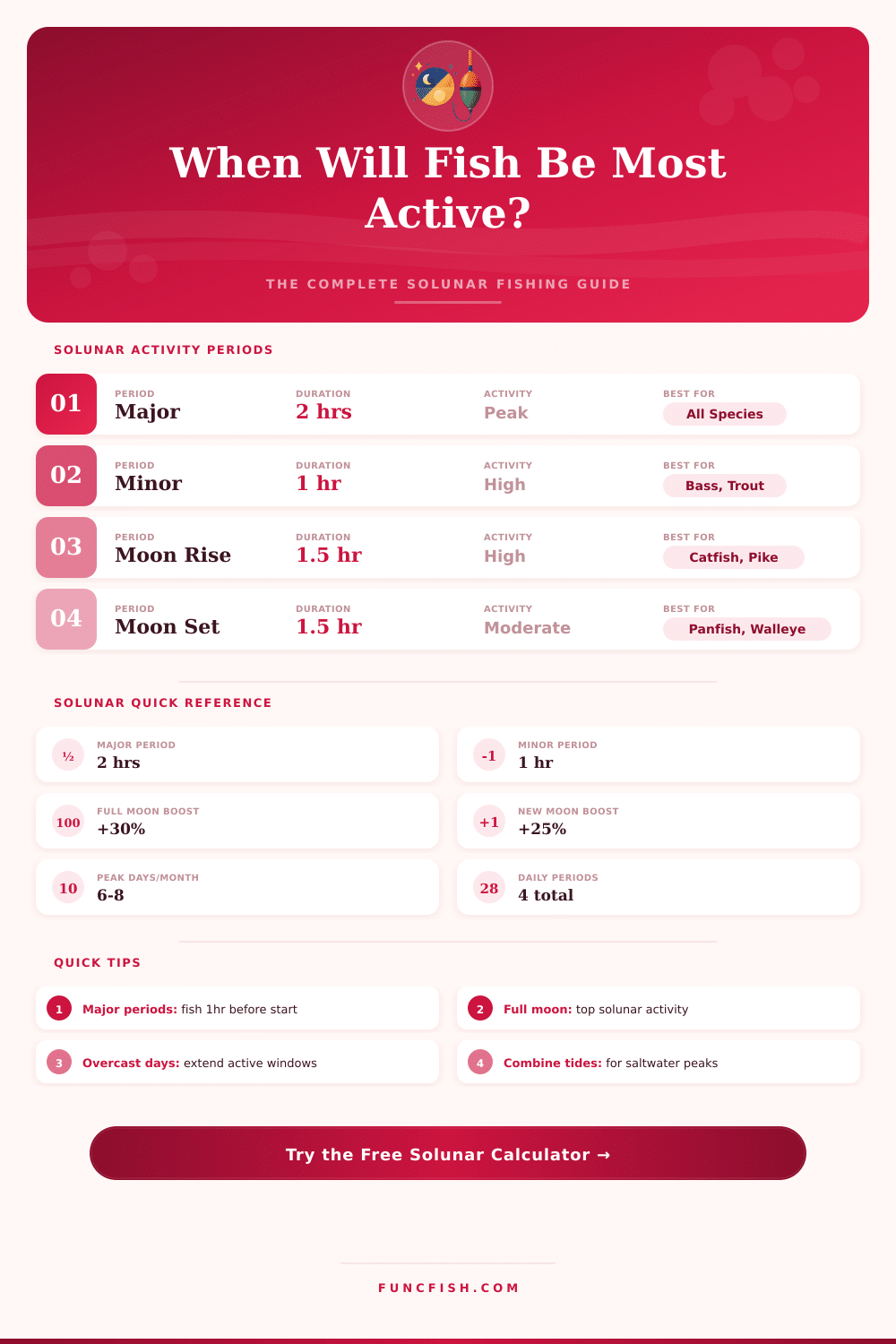
Solunar tables point to two minor and two major feeding periods every 24 hours. On the charts green and yellow zones mark the good times for fishing, those major and minor periods. Blue areas show high and low tides.
Best Times to Fish by the Sun and Moon
In the center of some charts show the present moon phase, for instance a waning gibbous moon with 81% lighting. Lunar periods become even more effective when they coincide with solar periods, and the best of those overlaps usually are marked by sun symbols.
In the net are many free tools. Some allow anglers to enter a place, and the program does all calculations automatically. One type gives full solunar report about major and minor fishing feeding times for today and the next ten days.
Others generate tables according to ZIP code or according to state and city in United States. Some services deliver the best times for hunting and fishing for any place in the world, and monthly calendars you can download in PDF format for printing.
According to the position of the moon with its phases and the sun position these tools inform about the best moments for fishing or hunting. Commonly they include tide tables, times of sunrise and sunset, moonrise and moonset, weather conditions and fish activity together with the solunar data. The tidal coefficient matters, because it shows when the most water moves.
Not everyone agrees about the real accuracy of those charts. The time of solunar periods is not always perfect, because a lot of other factors play a role, as flow, wind and temperature. If a front arrives, solunar tables cannot cover everything.
Water level and clarity also affect. Some anglers fish whenever they can, without minding the charts. Even so for saltwater and non-migratory game fish the tables work quite well.
In coast and little lakes they also seem reasonably accurate.
Before leaving, checking tides and flow, with barometer, fishing reports and solunar activity is a good strategy. The more information, the better the angler can adapt on the water. Keeping a log about catches and comparing successful trips with solunar predictions you find if the tables have real value.
For those who fish only some days yearly or book a charter, minding those charts can genuinely help choose the bestdays.